

Provider review · Cricket-first live scores and fantasy apps
CricketAPI review
CricketAPI is Roanuz’s dedicated cricket product for developers building score pages, match-following features, fantasy games or cricket-focused publishing. Its own product material spans core match feeds, tournament and player statistics, fantasy endpoints, analytics, widgets and broadcast-oriented tools. That range can make one vendor useful across several surfaces, but it also means a buyer should separate the API being licensed from ancillary widget or service products instead of assuming every advertised feature sits in one subscription.
 By Sarah Mitchell
Updated
Our verdict
Editorial integration fit: 8.7/10. This is a strong shortlist candidate for cricket-specific products because Roanuz describes both granular match data and several routes for delivering updates. The score reflects the useful documented product breadth and developer materials—not an independent judgement of feed accuracy, latency, service reliability, or customer satisfaction. The main buyer task is translating headline tournament counts into a competition-by-competition specification and confirming which package actually grants those records and fields.
Key facts
- Provider relationship
- CricketAPI is presented as a Roanuz product. [1]
- Advertised scope
- Roanuz advertises 400+ cricket tournaments; this is a provider claim, not an independent coverage audit. [1]
- Delivery methods
- The site describes REST access and live updates through WebSocket, webhook and Firebase. [2]
- Package structure
- Current public package descriptions distinguish match and request allowances, API bundles and enterprise arrangements. [1]
Pros and cons
Pros
- The cricket-specific focus allows the product story to include innings-level material, scorecards, tournament tables and player statistics rather than only generic event schedules. That coherence is useful when the interface centres on cricket, although the actual endpoint list and availability should be confirmed for a target competition.
- The provider documents several integration patterns, including request-based REST access and push-oriented options. Teams can assess whether polling suits their project or whether event-driven delivery could reduce their own refresh orchestration; advertised transport choices do not establish measured latency.
- Roanuz presents adjacent fantasy, analytics, widgets and broadcast tools alongside the core data product. Buyers can evaluate those as potential implementation shortcuts, while keeping separate the question of whether each tool is included, separately licensed or appropriate for their publishing rights.
Cons
- Package scope is not a minor detail: the public plans describe different match and request allowances and endpoint bundles. A product that grows across leagues or needs more historic context can outgrow an initial package, so procurement should map the expected calendar to actual quotas instead of extrapolating from a broad tournament count.
- The homepage’s coverage figures are promotional totals. They do not by themselves reveal which competitions have ball-by-ball detail, which have only basic schedules, or whether current seasons and historic seasons are treated alike. A proof-of-concept should test the intended tournament and a range of match states.
- The marketing mixes the API, fantasy calculations, widgets, AI tools and overlays. That breadth is attractive but can blur the buyer’s scope. Ask for the specific endpoints, delivery channel, caching rules, storage permission and commercial display rights rather than treating every visible product as part of a single data license.
Provider website screenshots
A cricket product with several layers
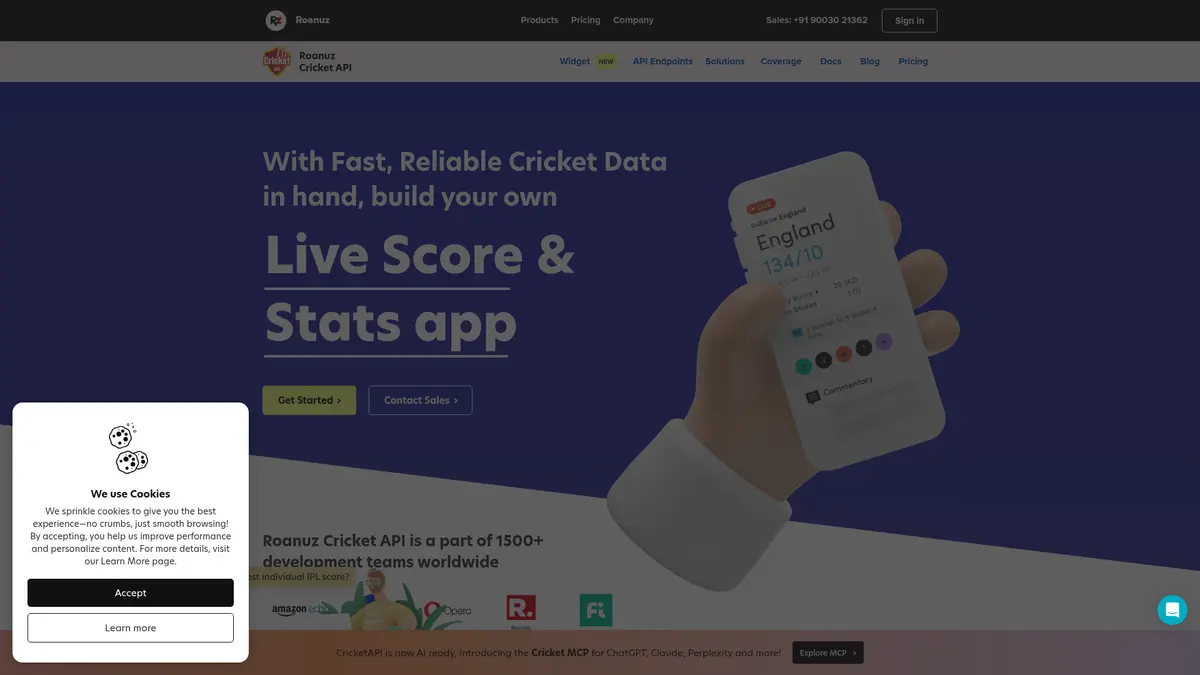
The main product description names live score feeds, ball-by-ball updates, points tables, fixtures, squads, tournament statistics and player statistics. Separate pages also introduce fantasy sports, cricket intelligence, conversational tools, widgets and broadcast overlays. The breadth is more than a score endpoint, but it should be read as a catalogue of related offers, not proof that one key unlocks every interface or every field. Request a current endpoint-to-plan matrix for the particular experience you intend to ship.
The practical distinction is between a data feed and an already composed presentation. A mobile application may want normalized match objects, while a newsroom may prefer a ready-made widget or a broadcaster may need an overlay. Roanuz advertises all three kinds of work, which could reduce custom UI effort, yet each has different branding, styling, accessibility and licensing implications. Decide whether the product needs raw data, a maintained display layer, or both before comparing it with a specialist cricket feed.
Sources: [1] Roanuz Cricket API — product overview, [2] Roanuz Cricket API — documentation index
Coverage claims need a competition-level check
Roanuz states that its cricket coverage spans more than 400 tournaments, and names major international and franchise examples in its public copy. That is useful discovery information: it suggests that the catalogue is not limited to one national league. It is still a provider-authored total, not an external measure of completeness. A shortlist should require the supplier to identify each target tournament, season, endpoint family, player-stat depth and available live state.
For cricket, “covered” can mean very different things: a fixture record, a final result, a full scorecard, ball-by-ball progression, or a richer set of player and team metrics. The public materials list those categories but do not establish uniform depth across every competition. Model the exact feeds needed for your use case and ask what happens for rain interruptions, abandoned games, super overs and delayed corrections; those operational cases shape a reliable product more than a headline count.
Sources: [1] Roanuz Cricket API — product overview, [2] Roanuz Cricket API — documentation index
Developer routes and package boundaries
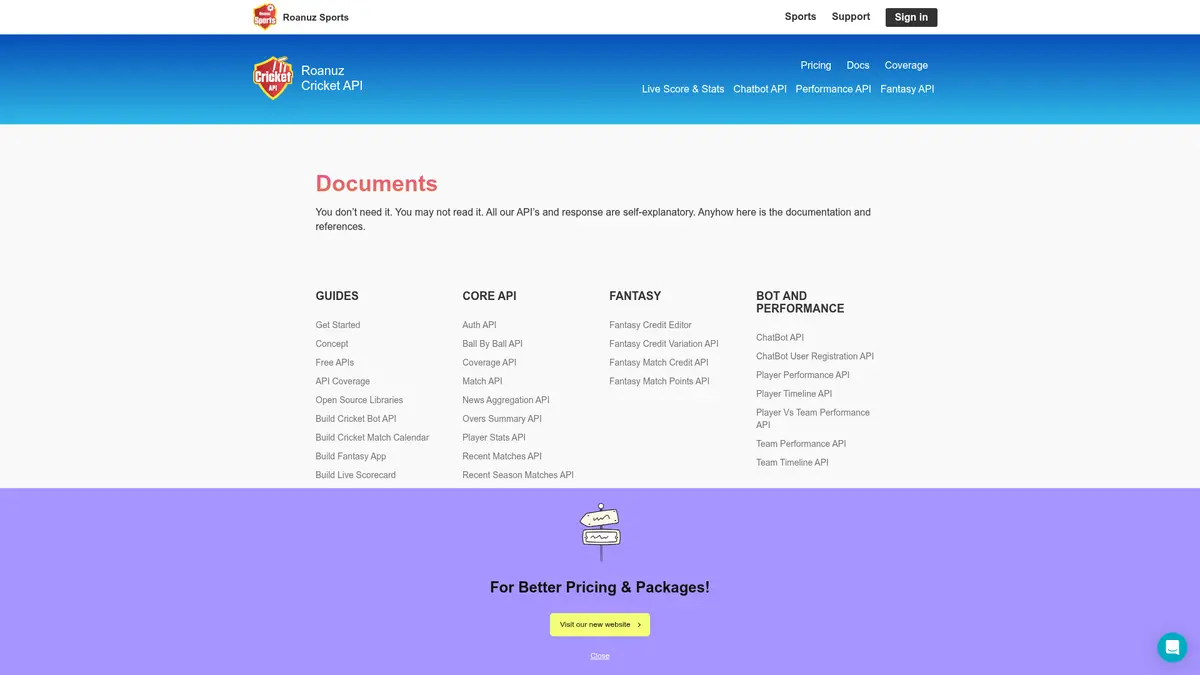
Roanuz describes a REST API and push delivery through WebSocket, webhook and Firebase, with documentation, open-source libraries and web templates. This is a useful menu for teams with differing infrastructure: REST is familiar for lookup and refresh flows, while push methods may suit active-match screens. The documentation should be used to inspect authentication, event ordering, cache behaviour, retry handling and identifiers. The existence of several delivery modes is a product description, not a promise that every endpoint exposes every mode.
The public packages are organized around limits such as match access, monthly request allowances and API bundles, with custom enterprise arrangements described separately. Those are important architectural constraints, not small billing details. Estimate how many competitions, events, users and background refreshes the application will create, and ask whether quotas are consumed on each access path. Keep current commercial terms, display rights, data retention and any restrictions on redistribution in writing before launch.
Sources: [2] Roanuz Cricket API — documentation index, [1] Roanuz Cricket API — product overview
Where CricketAPI fits—and where it does not
CricketAPI is most compelling when cricket is the core product and the team values a single supplier that documents match data, fantasy-oriented data and ready-to-use presentation options. It is less naturally suited to a buyer seeking a uniform API schema across a large portfolio of unrelated sports. Roanuz mentions football and Pro Kabaddi in its broader sports positioning, but those should be evaluated as separate products, not assumed to share cricket’s level of detail or the same commercial package.
A sensible evaluation is a small, representative integration rather than a generic demo. Include a live match, a completed fixture, a scheduled game, a competition table and one player-stat use case, then compare returned identifiers and update semantics against your product design. That is an evaluation recommendation, not a claim that we performed those tests. The editorial score rewards documented breadth and several integration choices; it discounts the extra due diligence created by package segmentation and claims that are not independently audited.
Sources: [1] Roanuz Cricket API — product overview, [2] Roanuz Cricket API — documentation index
Questions to resolve before committing
Ask Roanuz to map the precise tournament list to the required fields and seasons, including whether historical records are available on the plan you are considering. Confirm refresh expectations, correction behaviour, API call accounting, rate limits, caching rules and the effect of exceeding a package allowance. Ask whether webhooks or WebSockets are available for the exact match resources, and whether the same access token and identifiers work across each interface you plan to use.
The commercial review should cover more than an invoice: who may display the data, whether it can be cached or retained, whether derived metrics may be published, and whether widgets require attribution or impose separate styling restrictions. Also establish the support route during major tournaments and which commitments, if any, are contractual. Roanuz advertises integration support and enterprise arrangements, but only negotiated terms can establish the service level and rights for your application.
Sources: [2] Roanuz Cricket API — documentation index, [1] Roanuz Cricket API — product overview
Frequently asked questions
Is CricketAPI a Roanuz service?
Yes. Roanuz presents CricketAPI as its cricket product and links the cricket site with the wider Roanuz Sports family. Treat CricketAPI as the cricket-focused listing; do not confuse its name with an unrelated provider just because both offer cricket scores.
Sources: [1] Roanuz Cricket API — product overview, [2] Roanuz Cricket API — documentation index
Does the advertised tournament count mean every competition has ball-by-ball data?
No. The provider’s headline tournament figure is a catalogue claim, not a field-by-field coverage audit. Ask for the competitions and seasons you need, then verify the exact endpoints and detail level, including live ball events, scorecards, tables and player statistics.
Sources: [1] Roanuz Cricket API — product overview, [2] Roanuz Cricket API — documentation index
Can I receive updates without polling?
Roanuz describes WebSocket, webhook and Firebase delivery in addition to its REST API. Confirm which resources and plans support each transport, how retries and event ordering work, and what happens when your consumer is temporarily offline.
Are widgets and fantasy features automatically included with the API?
The website describes widgets, fantasy endpoints and other adjacent products, while the package pages distinguish API bundles and match allowances. Do not assume inclusion from catalogue placement; request a current written scope for each component and its publishing rights.
What does the editorial score measure?
The 8.7 score is an editorial assessment of fit for cricket-centric website and app integration, based on public product scope and documentation. It is not customer feedback or a measured rating of data accuracy, uptime, speed or support quality.
Sources: [1] Roanuz Cricket API — product overview, [2] Roanuz Cricket API — documentation index
How our editorial ratings work
CricketAPI scores 8.7 out of 10. This is our editorial fit score, not a customer score.
Our scores are subjective website-integration fit assessments based on providers’ publicly described products, not customer-review averages or independent speed, uptime or accuracy tests. We consider publishing usefulness, integration options, documented data scope, access information and clarity of product documentation. A higher score is not a guarantee of suitability. BettorServe is the featured first placement; the remaining list is a curated shortlist, not an exhaustive market ranking.
This is a commercially oriented comparison site. We may earn a commission through eligible partner links, at no extra cost to you. BettorServe is our featured first listing. Commercial relationships and featured placements should be considered alongside the product details, and you should confirm current terms directly with a provider before purchasing.
Sources
Content last reviewed