

Provider review · Cricket prototypes and straightforward JSON integrations
Cricket Data API review
Cricket Data API is a cricket-only service whose public site describes a practical set of JSON resources: series and match listings, current fixtures, scorecards, player information and fantasy-oriented endpoints. The documentation also explains how to authenticate, inspect account usage and page through responses. That makes the service approachable for a developer who wants a concrete cricket feed rather than a broad multi-sport platform. Its accessible documentation should not be mistaken for proof that every record is complete or that a free key grants commercial publishing rights.
 By Sarah Mitchell
Updated
Our verdict
Editorial integration fit: 7.8/10. Cricket Data earns a useful place on a shortlist for a narrow cricket feature or prototype because its API structure and pagination behaviour are visible in public documentation. The score is deliberately below full-service platforms: the reference warns about partial coverage, optional fields, row limits and heavy queries. We have not tested a key, compared scores with a match source, or measured updates; buyers should validate their own competition and licensing requirements.
Key facts
- Brand wording
- The provider calls the service Cricket Data and describes it as the newer brand for CricAPI. [1]
- Response format
- Documentation describes JSON responses and API-key authentication. [2]
- Pagination
- The guide states a default 25-row page and asks clients to supply an offset for further records. [2]
- Coverage qualification
- The guide notes that some series or matches may have partial coverage. [2]
Pros and cons
Pros
- A focused cricket API can keep a small product model simpler than a wide, multi-sport catalogue. The public reference groups resources around series, matches, players and scorecards, which maps cleanly to common cricket pages without first navigating multiple league-specific product families.
- The documentation makes pagination and response structure visible rather than hiding all details behind a sales conversation. It names an offset parameter, default page size, possible optional fields and account usage information, allowing an implementer to plan defensive parsing and incremental requests.
- The site links code examples across several languages and describes a self-service key flow. For an early-stage integration, that may reduce discovery friction, provided the developer first confirms present-day key eligibility and separates a trial allowance from permission to publish commercially.
Cons
- The reference says a response can be limited to 25 rows and requires correct offset handling. A naïve client may silently show only the first page of series, players or matches. Pagination therefore needs to be a deliberate part of data ingestion, with explicit completeness checks rather than an optional optimization.
- The documentation warns that some events or series have only partial coverage and that response keys marked optional may be absent. That variability raises schema and QA work: downstream pages must tolerate missing values and the buyer needs a target-event test set before promising a complete scorecard or historical archive.
- The “lifetime free” language appears in the public guide, but no free access label should be treated as an evergreen commercial offer. Check current quotas, change notices, commercial rights, caching and redistribution. A convenient signup does not establish that a public production service will be adequately provisioned for a high-traffic event.
Provider website screenshots

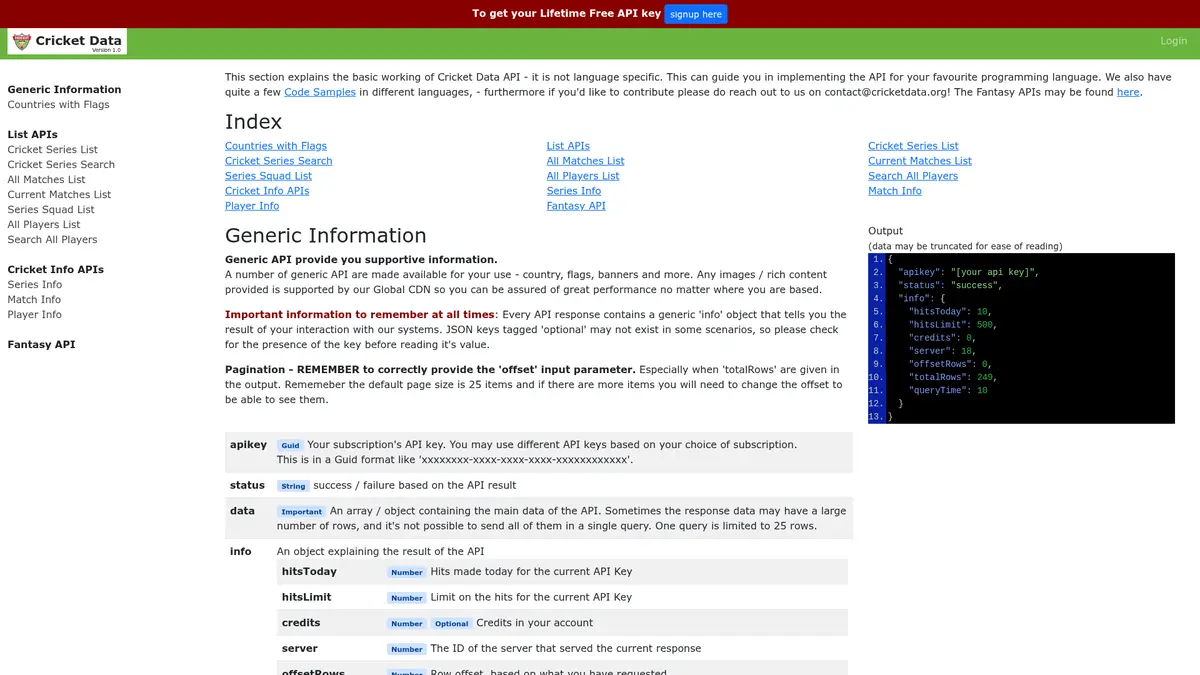
A cricket API, with a visible brand transition
The public website uses the Cricket Data name while retaining references to CricAPI in the documentation and historical articles. Its own copy characterizes Cricket Data as the newer avatar of CricAPI. That relationship is worth preserving in procurement notes: it explains why search results or older code samples may use the previous name, without implying a separate API vendor or asserting that every old route is still supported. Use the current official documentation as the integration authority.
The product is specific to cricket. It describes generic country and flag information alongside lists and detail endpoints for series, matches and players, plus fantasy-related material. This shape is appropriate when the product’s primary content is cricket and a small set of normalized pages. It is not evidence for a common schema across other sports, nor does the visible endpoint list establish that all competitions provide equal statistics, live refresh or historical depth.
Sources: [1] Ultimate Cricket Data API — product overview, [2] Documentation — How to use Cricket Data API
JSON is approachable; completeness is the harder question
The documentation explains an API key in requests and JSON objects in responses, and gives examples in multiple programming languages. It also highlights an `info` block with account usage and response metadata, a useful hint for an integration that needs to monitor its own allowance. Optional fields may be absent, however, so code should test for the presence of keys rather than assuming that one sample object defines every match or series response.
The service covers the familiar sequence from a series list to match information and scorecard-level data. The important caveat is the document’s own acknowledgement that some records can be partial. For a cricket experience, a missing innings breakdown or player field can be more consequential than a missing decorative value. Review a representative set of completed, scheduled and in-progress games and make the product’s fallback states explicit before choosing the service.
Sources: [2] Documentation — How to use Cricket Data API, [1] Ultimate Cricket Data API — product overview
Pagination and request planning are part of the API contract
The guide describes a default page size of 25 and warns that a client must provide the correct offset to reach additional rows. It also says a single query may be limited to 25 records. Treat those statements as operational requirements: implement page traversal where necessary, stop only when the API’s total-row metadata indicates completion, and avoid writing a sync job that mistakes the first response for the full catalogue.
A particularly useful warning is that the Series Info query is heavy and the guide advises limiting how frequently it is called. That advice should shape caching and refresh policy rather than simply be copied into code. Keep relatively static series metadata on a slower schedule and reserve frequent requests for live match resources if the provider confirms that approach. Ask whether the recommendation remains current for the plan and API version you will use.
Free-key language is not the same as a production license
The current website and reference describe a free sign-up/key route, but that is an access statement, not a full statement of production rights. A public app needs clear answers about commercial display, attribution, caching, storage, redistribution and whether a free allowance can be used for the intended audience. Because offers and request quotas can change, confirm the live account terms and price directly rather than relying on an old article or a directory listing.
The reference exposes account hits and limits in its response information, which is helpful for monitoring usage. It also means capacity needs to be designed, not assumed. Estimate calls from event count, scheduled refreshes and client traffic, then ask how requests are counted, whether a quota applies per key or resource, and what the API returns when a limit is reached. Add usage alerts and graceful degradation to any live-score feature.
Sources: [1] Ultimate Cricket Data API — product overview, [2] Documentation — How to use Cricket Data API
Best used for a bounded cricket feature
Cricket Data looks most useful for an application that needs ordinary cricket entities and can accept a measured integration exercise around pagination and partial data. Its public reference is more candid than many brief sales pages about handling incomplete fields and response size. That transparency is a positive product signal, but not independent proof that every current feed behaves as documented. A buyer should test the precise tournaments and match states that define the feature rather than treating the API as a universal cricket database.
For broader fantasy, media or commercial builds, compare the service not just on whether it has a scorecard endpoint but on the licence, event-level metrics, update rules and support available at the required scale. The 7.8 assessment recognizes its accessible JSON model and specific implementation guidance while discounting the uncertainty around record depth and usage terms. It does not rank the company’s accuracy or reliability, which cannot be inferred from its own promotional claims.
Sources: [1] Ultimate Cricket Data API — product overview, [2] Documentation — How to use Cricket Data API
Frequently asked questions
Is Cricket Data the same service as CricAPI?
The provider’s site describes Cricket Data as the newer brand for CricAPI and the documentation still uses the CricAPI name in places. Treat older references as related branding, but validate the current endpoint, authentication and version against the active official reference.
Sources: [1] Ultimate Cricket Data API — product overview, [2] Documentation — How to use Cricket Data API
What does the API return?
The public reference describes cricket series, matches, current match lists, match and series details, players, scorecards and fantasy-related APIs. Exact fields and depth vary by resource; check the endpoint guide and a target competition instead of inferring a complete scorecard from a product summary.
How should I handle its 25-row limit?
The official guide says the default page contains 25 rows and that an offset is needed to retrieve additional results. Implement pagination deliberately, compare returned totals where available, and avoid treating the first page as a complete set of competitions or matches.
Is a free key suitable for a commercial live-score site?
Not automatically. The public materials describe a free-key path, but you still need current confirmation of quotas, production use, commercial display permission, caching and redistribution. Trial or developer access should not be treated as an unrestricted licence.
Sources: [1] Ultimate Cricket Data API — product overview, [2] Documentation — How to use Cricket Data API
Why is this review’s score lower than a broad API platform?
The 7.8 editorial score reflects the useful cricket-focused JSON resources and unusually explicit pagination notes, balanced against documentation warnings about partial records, optional fields and request limits. It is not a customer rating or an independent measure of feed quality.
Sources: [2] Documentation — How to use Cricket Data API, [1] Ultimate Cricket Data API — product overview
How our editorial ratings work
Cricket Data API scores 7.8 out of 10. This is our editorial fit score, not a customer score.
Our scores are subjective website-integration fit assessments based on providers’ publicly described products, not customer-review averages or independent speed, uptime or accuracy tests. We consider publishing usefulness, integration options, documented data scope, access information and clarity of product documentation. A higher score is not a guarantee of suitability. BettorServe is the featured first placement; the remaining list is a curated shortlist, not an exhaustive market ranking.
This is a commercially oriented comparison site. We may earn a commission through eligible partner links, at no extra cost to you. BettorServe is our featured first listing. Commercial relationships and featured placements should be considered alongside the product details, and you should confirm current terms directly with a provider before purchasing.
Sources
Content last reviewed