

Provider review · Football-focused live scores, statistics and fantasy products
FootballAPI review
FootballAPI is Roanuz’s dedicated football-data product. Its official site presents a football-specific API with match, tournament, schedule, statistics and fantasy-oriented resources. The plans page frames the product for live-score applications and more detailed media or gaming builds, and the documentation provides routes into match endpoints and coverage. That offers a useful starting point for a football-first project, but it is essential to separate the product’s plan scope from the broader promises of a catalogue page.
 By Sarah Mitchell
Updated
Our verdict
Editorial integration fit: 8.6/10. Roanuz FootballAPI merits a strong shortlist position for a focused football application because it exposes sport-specific plans, documentation and several kinds of match and fantasy data. The assessment is about the clarity and apparent usefulness of the public integration proposition. It is not a rating of live accuracy, speed, uptime, customer feedback or agreement terms. A project should validate its competitions and package limits before choosing a plan.
Key facts
- Provider identity
- FootballAPI identifies the service as Roanuz Football API. [1]
- Product scope
- Official plan pages describe core football and fantasy API groups. [2]
- Coverage
- The provider advertises worldwide competition coverage; actual league and season access is plan-dependent. [3]
- Plan differentiation
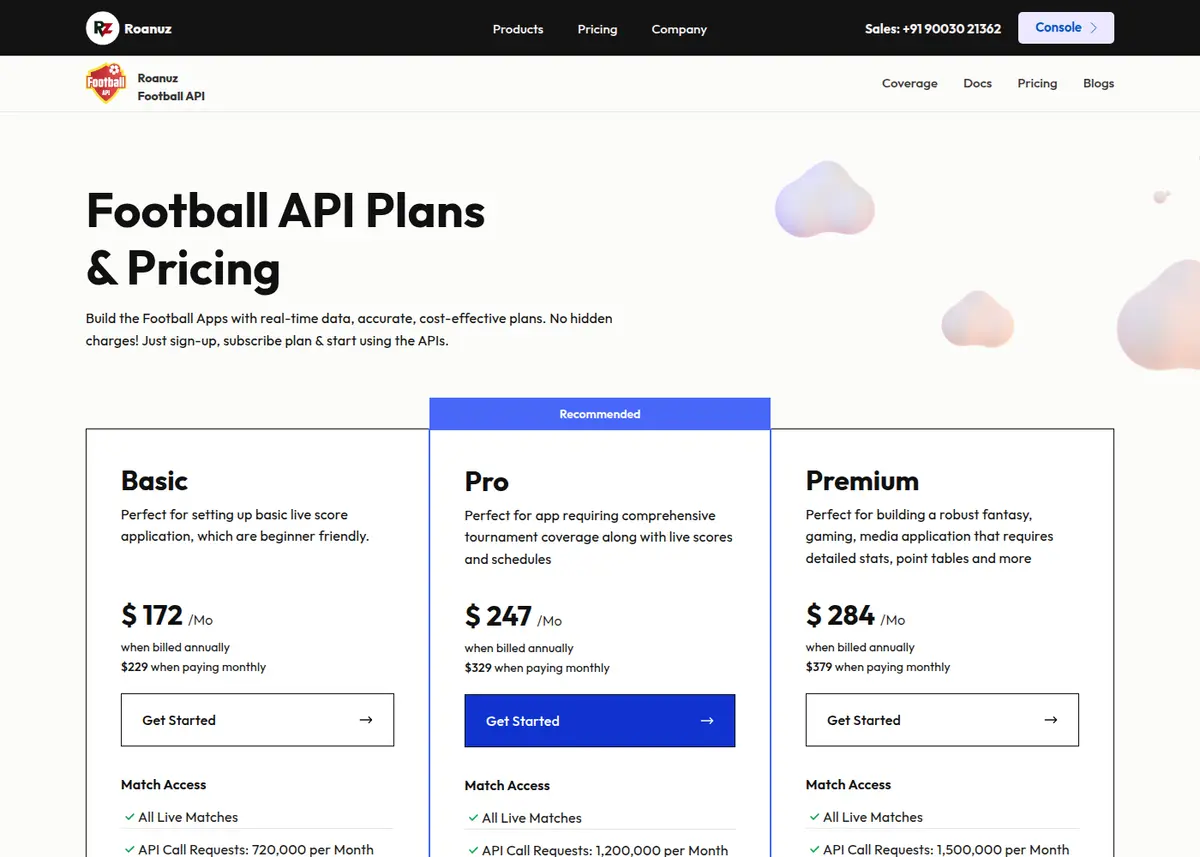
- Public tiers distinguish API request volumes and match access. [2]
Pros and cons
Pros
- A dedicated football service can be easier to evaluate than a broad sports catalogue when the product is a live score centre or football-specific app. The provider describes football resources directly and organizes its offer into core and fantasy API categories.
- Roanuz publishes separate plan information and documentation, which gives a buyer a route to ask targeted questions about competition access, request volume and data fields. The marketing page is not a substitute for testing, but the visible plan structure makes scope questions concrete.
- The product material includes fantasy-oriented endpoints alongside match data. For a fantasy application, that potentially reduces the number of separate data models a team must evaluate, although the rules, scoring definitions and licensed use must be confirmed for the intended game.
Cons
- A league count or broad global-coverage statement cannot settle which seasons, match fields and historical records are available to one account. The plan page shows that access varies by tier, so buyers should not extrapolate the full catalogue from the most prominent product description.
- Different plans have request and match boundaries. A growing fixture calendar, user traffic or a strategy that polls many endpoints can change consumption quickly. The procurement exercise should model calls and ask about throttling, overages, response behavior at quota limits and whether the plan can be changed mid-season.
- The similar name causes a real comparison hazard. FootballAPI is Roanuz’s service at footballapi.com, whereas API-Football belongs to API-Sports and has separate documentation and account terms. An implementation, price comparison or source citation that merges those products will mislead both developers and readers.
Provider website screenshots
FootballAPI means the Roanuz product
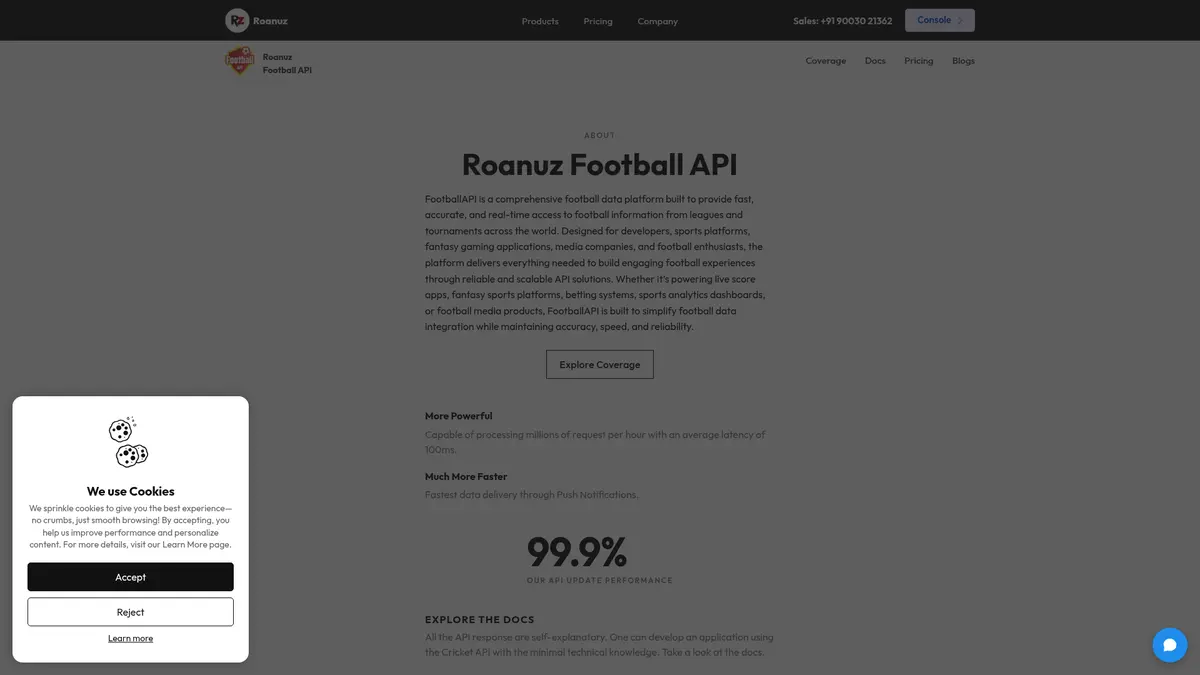
The official domain identifies its product as Roanuz Football API, and its navigation points to football plans, coverage, docs and fantasy features. This establishes the identity relevant to this review: a Roanuz football service, not API-Football from API-Sports. Those are distinct brands with separate product pages and account systems. Directory readers should compare them as separate providers rather than borrowing one company’s claims, plan details or endpoint examples for the other.
The product is football-focused even though Roanuz’s wider company also offers cricket and Kabaddi products. That relationship is useful if a customer may later need more than one sport, but the football feed should be reviewed on its own competition coverage and contract. A parent-company catalogue is not proof of shared schemas, commercial rights or cross-sport subscriptions. Confirm what is included in the FootballAPI plan itself.
Sources: [1] Roanuz Football API — about the product, [2] Football API plans and pricing
Core match data and fantasy use cases
The plans and documentation describe match APIs and tournament resources, with the commercial page positioning the service for live scores, schedules, detailed statistics and fantasy products. The page’s product tiers are meant to accommodate different application profiles. A simple live-score screen and a fantasy game have very different requirements, so ask whether lineups, historical games, player metrics, point calculations and standings are included for the exact league and selected plan.
A helpful way to evaluate the product is to separate entity lookups from live-match updates. Verify how a client resolves a tournament and season, how it requests a match, which status transitions appear, and how the response handles corrections or postponed fixtures. The documentation provides a concrete place to begin that review; it is not an independent demonstration of all fields or update behavior. No performance measurements are implied by the provider’s marketing claims.
Sources: [2] Football API plans and pricing, [4] Roanuz Football API — Match API reference
Coverage has to be matched to a plan
Roanuz advertises broad football competition coverage, while its commercial page separates access by plan. A headline total may help identify potential breadth, but it does not show whether a target league has live statistics, historical seasons, fantasy endpoints or only base-level match records. Build a competition matrix listing league, season, requested fields and refresh expectations, then ask Roanuz to confirm each row against a named subscription.
Plan pages make request allowances and match access important dimensions. Estimate scheduled polling and active-match traffic using your own expected service design, then ask how a request is counted and whether a quota is shared among endpoints. Ask about rate limiting, overage behavior, access changes if a tournament is added, and whether development and production environments draw from the same pool. Avoid using an old directory price as a current quote.
Sources: [3] Roanuz Football API — coverage guide, [2] Football API plans and pricing
The implementation case for football teams
The public documentation and plan pages can support a practical engineering review: identify a match endpoint, inspect identifiers and response models, and list how the API represents teams, tournaments and player statistics. A team with a football-only product can then build a thin adapter without carrying unrelated sport schemas. Keep credentials server-side, record source timestamps, and make visible the difference between a provider correction and a user-generated state in your own application.
Fantasy applications should take particular care with points and player metrics. A published endpoint label does not establish the scoring rules your market requires, how corrections are handled or whether the resulting values may be used in a competition. Confirm scoring semantics, calculation timing, player identity resolution and licence terms. For media products, check display and redistribution permissions. Those practical questions decide whether a seemingly suitable feature list becomes a manageable integration.
Sources: [4] Roanuz Football API — Match API reference, [2] Football API plans and pricing
How to treat performance and quality statements
FootballAPI’s official marketing describes speed, scale and reliability in promotional language. This review does not repeat those claims as verified performance: a supplier website can establish what is advertised, not that the service has a particular measured latency or uptime for a buyer’s route. Ask for the contractual service level, incident history where available, update definitions and any monitoring or escalation process relevant to a high-visibility match product.
The score of 8.6 rewards a focused football product, a public plan structure and accessible API documentation. It does not mean Roanuz is faster or more accurate than a competitor, and it is not based on user reviews. Treat a short technical evaluation as a means to validate your own integration—not as a retrospective test we have performed. A commercial buyer should resolve support coverage and rights in the agreement, not infer them from a website slogan.
Sources: [1] Roanuz Football API — about the product, [2] Football API plans and pricing
Frequently asked questions
Is FootballAPI the same thing as API-Football?
No. FootballAPI at footballapi.com identifies itself as Roanuz Football API. API-Football is a different product in the API-Sports family. They have separate company identities, documentation, endpoints and access arrangements, so keep their claims and accounts distinct.
Sources: [1] Roanuz Football API — about the product, [2] Football API plans and pricing
What data does Roanuz FootballAPI advertise?
The official pages describe football match and tournament resources, schedules, statistics and fantasy-oriented API categories. The exact endpoint and field set depends on the chosen product and plan; verify your competitions and required data in the documentation and account scope.
Sources: [2] Football API plans and pricing, [4] Roanuz Football API — Match API reference
Does one plan include every football competition?
The provider advertises broad coverage but also distinguishes plans by access and request limits. Do not assume a headline coverage list means every competition, season or advanced field is included in each subscription. Ask for confirmation against the actual plan.
Sources: [3] Roanuz Football API — coverage guide, [2] Football API plans and pricing
How should I size an API plan?
Estimate requests from your target competitions, active matches, refresh strategy and background jobs, then ask how calls, rate limits and overages are counted. Also confirm match-access boundaries and whether the plan can be adjusted if your product adds leagues.
Sources: [2] Football API plans and pricing
Is the editorial score a reliability rating?
No. The 8.6 score is an editorial fit assessment for public product scope and integration clarity. We did not measure feed accuracy, latency, uptime or customer satisfaction; obtain contractual terms and conduct your own scoped evaluation.
Sources: [1] Roanuz Football API — about the product, [2] Football API plans and pricing
How our editorial ratings work
FootballAPI scores 8.6 out of 10. This is our editorial fit score, not a customer score.
Our scores are subjective website-integration fit assessments based on providers’ publicly described products, not customer-review averages or independent speed, uptime or accuracy tests. We consider publishing usefulness, integration options, documented data scope, access information and clarity of product documentation. A higher score is not a guarantee of suitability. BettorServe is the featured first placement; the remaining list is a curated shortlist, not an exhaustive market ranking.
This is a commercially oriented comparison site. We may earn a commission through eligible partner links, at no extra cost to you. BettorServe is our featured first listing. Commercial relationships and featured placements should be considered alongside the product details, and you should confirm current terms directly with a provider before purchasing.
Sources
Content last reviewed