
Provider review · Prototypes and sports artwork
TheSportsDB review: free sports API, artwork & premium
TheSportsDB offers a free JSON sports API for data and artwork, alongside a premium membership with additional features and limits. It is a relevant starting point for prototypes, hobby projects and developers exploring structured sports records. This TheSportsDB review examines the official free API page and documentation, explains version and access differences, and highlights what a commercial website should verify before relying on the service.
Last updated
Our verdict
TheSportsDB is worth considering when accessible sports records and artwork are more important than a negotiated enterprise live-data package. Its public documentation, examples and free entry route support learning and prototyping. Our 8.5/10 editorial fit score is not a guarantee of complete or instantaneous coverage. Production permissions, image rights, record completeness and premium requirements should be checked against your actual project.
Key facts
Pros and cons
Pros
- Free entry access is useful for learning and evaluating a sports data project.
- Data and artwork resources can support richer team and player pages.
- Public documentation includes examples, API versions and developer resources.
Cons
- Free access does not include every premium method or higher allowance.
- A database entry is not proof of comprehensive real-time competition coverage.
- Artwork access still requires checking the relevant reuse and trademark rights.
Provider website screenshots
What is TheSportsDB and who is it for?
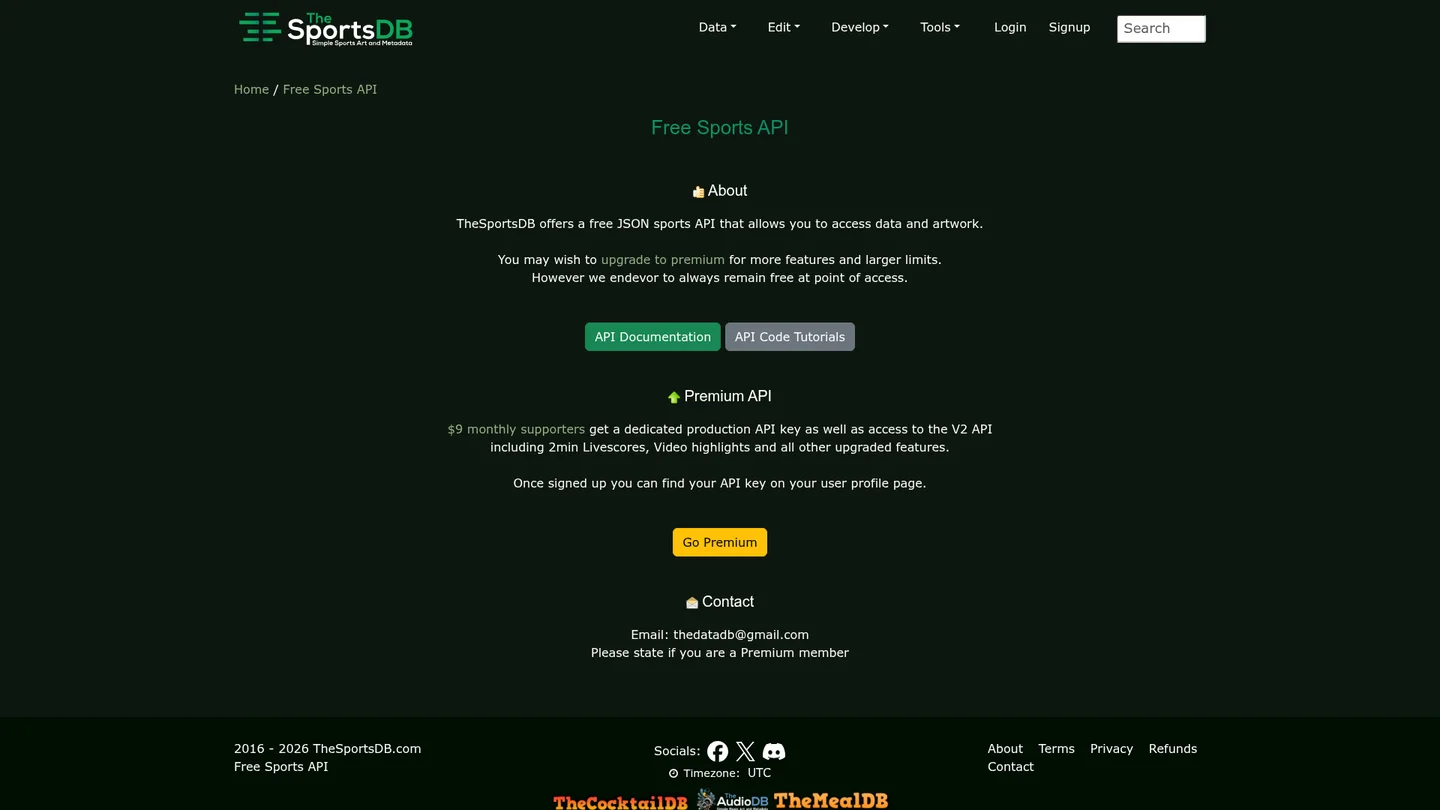
TheSportsDB presents itself as a sports database with a JSON API for records and artwork. Its free API page directs developers to documentation and tutorials, while advertising premium access for expanded features and limits. That makes it useful to investigate when you need structured information for a small sports application, directory or initial website prototype.
A prototype might explore teams, players, leagues or events before committing to a larger commercial data relationship. A public website still needs to evaluate the records and permissions it depends on. The availability of a free endpoint should not be interpreted as a promise of complete sports coverage, an enterprise service level or unrestricted rights to reuse every returned asset.
Sources: [1] TheSportsDB free sports API and advertised premium features, [2] TheSportsDB documentation, versions and available methods
Sports records, artwork and available resources
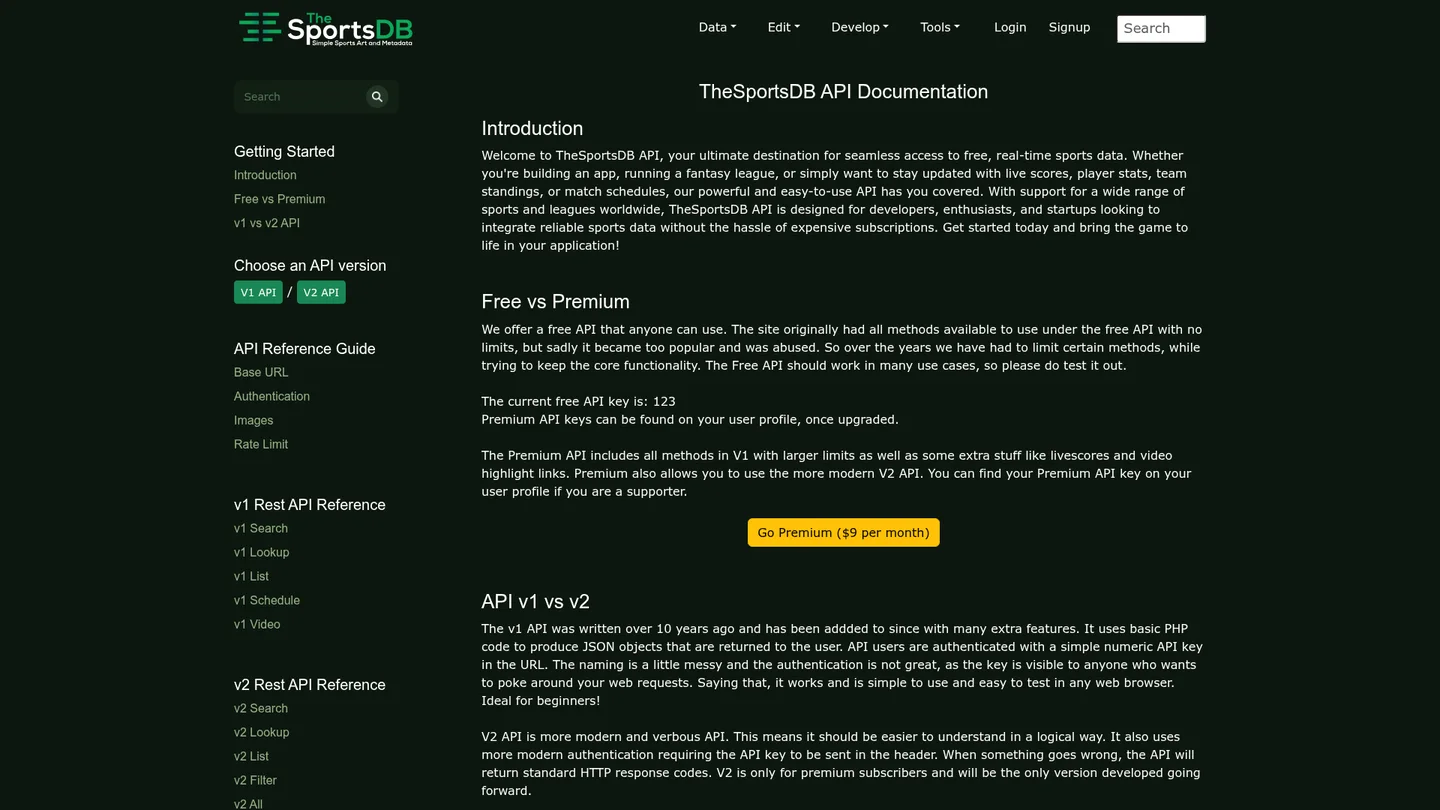
The documentation includes search and lookup resources for sporting entities, as well as lists and schedules. Examples cover teams, players, events, leagues and venues, with additional methods varying by API version and access level. Artwork is part of the advertised proposition, which can help explain why the service appeals to developers building more visual sports pages.
Inspect a representative sample from your target competition. Check spelling, identifiers, relationships, missing records and available image fields rather than assuming every team or event has identical detail. Build a design that handles absent artwork and incomplete optional information honestly. Images, logos and trademarks can involve separate rights; the fact that a URL appears in a database does not settle permission for every commercial use.
Sources: [1] TheSportsDB free sports API and advertised premium features, [2] TheSportsDB documentation, versions and available methods
V1, V2 and integration differences
TheSportsDB documents both V1 and V2. Its documentation describes V1 as an older interface with a key in the URL and V2 as a newer premium interface using header-based authentication. That distinction affects how your application constructs requests and protects production credentials. Check the current version-specific reference rather than assuming an old example applies unchanged to a new project.
The documentation also provides developer resources such as examples and API specifications. Start with a search or lookup request and follow related identifiers through the resources your website needs. Plan caching, rate-limit handling and explicit empty states. Do not store private credentials in public code or expose them unnecessarily through logs. A successful tutorial request is only the beginning of a reliable publishing integration.
Sources: [2] TheSportsDB documentation, versions and available methods
Livescores, schedules and historical expectations
The free API page describes two-minute livescores as a premium feature, alongside video highlights and other upgraded resources. This distinction is particularly important for a website that promises live results. Access to scheduled events or past records is not the same as access to a comprehensive, continuously updated live match feed.
Check the competitions, update behaviour and current premium method documentation against your audience expectations. A live-score page should show suitable timestamps and handle unavailable data clearly. If historical analysis is your goal, verify the seasons and statistical fields actually present. A sports database may be useful for context and reference information without being the right fit for every latency-sensitive or highly detailed professional application.
Sources: [1] TheSportsDB free sports API and advertised premium features, [2] TheSportsDB documentation, versions and available methods
Commercial use, quality checks and alternatives
Before launching, describe your intended website and ask about attribution, data storage, public display, redistribution and image use. Test how your application handles inconsistent or absent optional fields, changed event information and missing artwork. Sports API has not independently benchmarked TheSportsDB accuracy, availability or update speed, so do not treat the editorial score as a service-level commitment.
Compare football-focused services such as API-Football or Sportmonks when you need deeper football match information, and consider commercial league-data providers for negotiated support and delivery terms. BettorServe offers an alternative route for publishers wanting ready-made widgets. TheSportsDB is most attractive when the actual records, access terms and integration effort match a clearly defined project, rather than simply because free access is available.
Sources: [1] TheSportsDB free sports API and advertised premium features, [2] TheSportsDB documentation, versions and available methods
Frequently asked questions
Is TheSportsDB API free?
The official site offers a free JSON sports API, with premium access for additional methods, features and larger limits. Verify the current endpoint permissions and allowances for your project. Free entry access should not be assumed to include all premium capabilities or unlimited commercial production use.
Sources: [1] TheSportsDB free sports API and advertised premium features, [2] TheSportsDB documentation, versions and available methods
What does TheSportsDB premium cost?
The checked free API page advertises $9 monthly supporter access with a dedicated production API key and V2 access. Reconfirm current pricing, billing terms, limits and entitlements directly. This is an advertised membership example, not a permanent price guarantee from Sports API.
Sources: [1] TheSportsDB free sports API and advertised premium features
Does the free API include all livescores?
The free API page specifically presents two-minute livescores as a premium feature. Confirm current method access and competition coverage before promising a live-results website. The availability of event records or schedules on a free interface does not establish a comprehensive live score service.
Sources: [1] TheSportsDB free sports API and advertised premium features
What is the difference between TheSportsDB V1 and V2?
The documentation describes V1 as an older interface using a key in the URL, and V2 as a newer premium interface using header-based authentication. Methods and response conventions differ, so consult the selected version’s documentation and confirm current entitlements before designing your integration.
Sources: [2] TheSportsDB documentation, versions and available methods
Can I use artwork returned by TheSportsDB on my website?
Artwork is advertised as part of the service, but you should check its reuse conditions, attribution and any underlying image or trademark rights. API access alone does not settle every commercial permission. Confirm the specific assets and intended publishing use before republishing them.
Sources: [1] TheSportsDB free sports API and advertised premium features, [2] TheSportsDB documentation, versions and available methods
How our editorial ratings work
TheSportsDB scores 8.3 out of 10. This is our editorial fit score, not a customer score.
Our scores are subjective website-integration fit assessments based on providers’ publicly described products, not customer-review averages or independent speed, uptime or accuracy tests. We consider publishing usefulness, integration options, documented data scope, access information and clarity of product documentation. A higher score is not a guarantee of suitability. BettorServe is the featured first placement; the remaining list is a curated shortlist, not an exhaustive market ranking.
This is a commercially oriented comparison site. We may earn a commission through eligible partner links, at no extra cost to you. BettorServe is our featured first listing. Commercial relationships and featured placements should be considered alongside the product details, and you should confirm current terms directly with a provider before purchasing.