
Provider review · Developer-led football projects
API-Football review: football data, plans & widgets
API-Football is the football service in the API-Sports family, with documented endpoints for fixtures, standings, teams, players and match information. It also advertises free widgets for publishing football data. This API-Football review examines the official product and pricing information, explains the distinction between a data feed and a finished website, and outlines the checks that matter before selecting a plan.
Last updated
Our verdict
API-Football deserves consideration for developers building a football score centre, statistics page or club-focused application. The public documentation, published request allowances and widget option provide useful evaluation starting points. Our 9.2/10 editorial fit score is not an accuracy or speed benchmark. The important purchase decision is whether the selected seasons, fields and request budget match your actual audience and application.
Key facts
- Product family
- Football API from API-Sports [1]
- Core data
- Fixtures, standings, events, players, lineups and statistics [1]
- Free allowance
- 100 requests per day advertised [3]
- Paid plan example
- Pro: $19/month and 7,500 requests/day advertised [3]
- Developer access
- API-key authentication; GET requests documented [2]
Pros and cons
Pros
- A broad football endpoint catalogue supports more than a basic final-score page.
- Published free and paid request allowances make usage planning more concrete.
- Free widgets and language examples offer different routes into a publishing project.
Cons
- Free-plan season restrictions may exclude the historical data your website needs.
- Daily allowances still require caching and careful live polling design.
- Other API-Sports sports are separate services; verify their subscription requirements.
Provider website screenshots

What is API-Football used for?
API-Football can supply the structured football information behind fixtures pages, live match centres, team profiles and league tables. The official site lists livescores, events, lineups, players, statistics, odds and predictions. These categories describe potential data resources; they are not a guarantee that every field is populated for every league, season or fixture.
The wider API-Sports catalogue includes other sports, but this review concerns the football product. A multi-sport website should map the appropriate service for each sport and confirm its access arrangements. Do not assume that a football subscription is a single unlimited licence for every basketball, hockey, rugby or motorsport endpoint advertised elsewhere in the product family.
Football coverage and season availability
The homepage advertises more than 1,200 leagues and cups and says plans include all competitions and endpoints, while noting free-plan limitations on available seasons. That distinction is important: an endpoint being accessible does not mean it supplies the historical season or competition detail you require. Inspect coverage using the provider information for your exact target leagues.
For a club website, check the club identifier, current season, fixture statuses, squad information and competition standings together. For a statistics application, additionally inspect event detail and player-level fields. Data depth should be tested with representative fixtures rather than inferred from a broad competition count. Build explicit handling for absent records instead of quietly treating missing statistics as genuine sporting results.
Sources: [1] API-Football official features and widgets, [3] API-Football official pricing and request allowances
Documentation, authentication and API integration
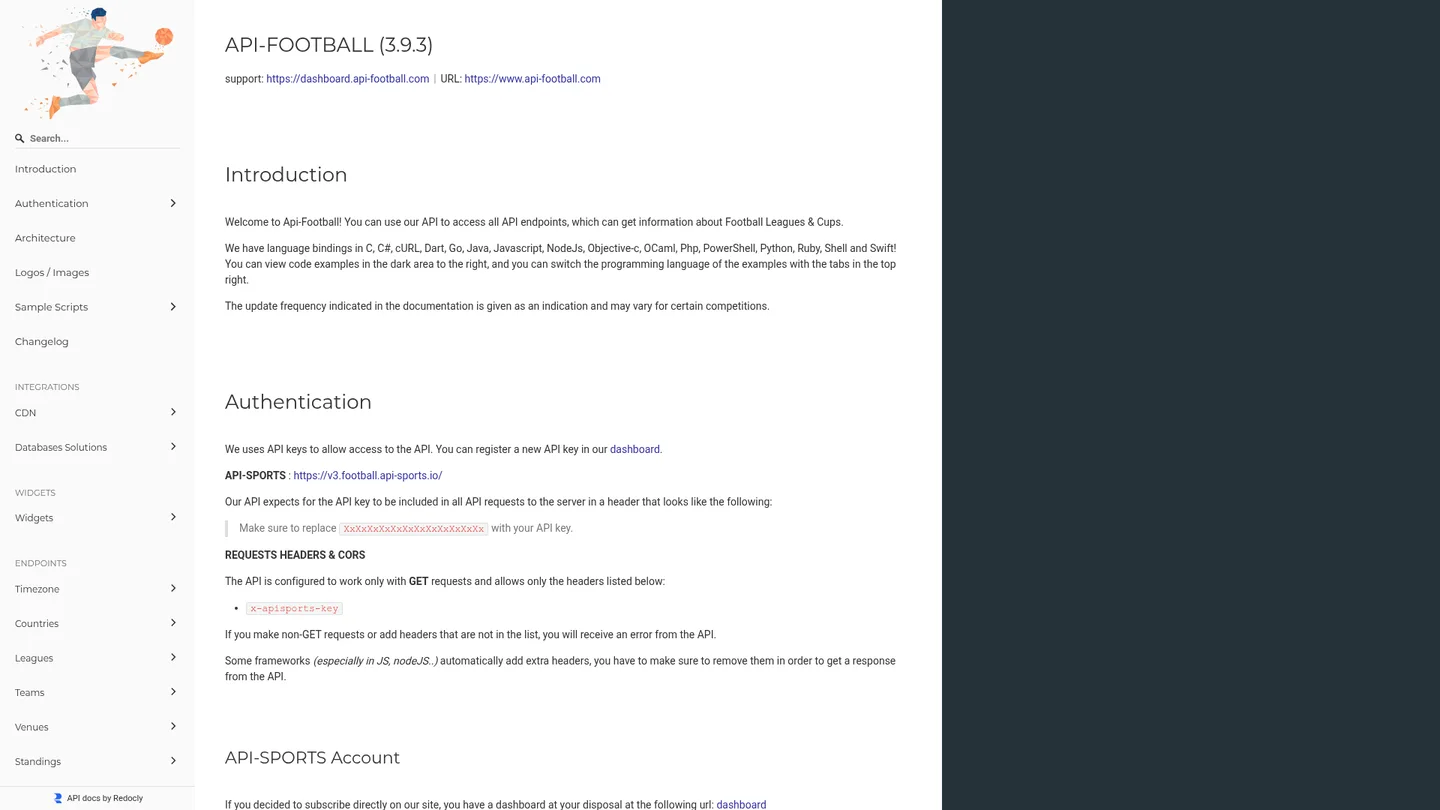
The public version-three documentation describes API-key authentication and GET requests. It includes language examples and a structured reference for the service. A developer should use the current authentication header and base URL from that reference, rather than copying an old tutorial without checking the current version and account route.
Design the integration around shared server-side requests where appropriate, so several visitors do not each consume another identical upstream call. Protect production credentials, handle unsuccessful responses and log quota-related errors without logging secret keys. Test a scheduled fixture, a live fixture and a completed game. The documented update frequencies are indicative and can vary for certain competitions; they are not independently measured results from this review.
API-Football pricing and request limits
The pricing page captured on 18 October 2026 advertises a free plan with 100 requests per day, Pro at $19 monthly with 7,500 requests daily, Ultra at $29 with 75,000, and Mega at $39 with 150,000. These are the advertised dollar figures on the checked page; confirm current currency, taxes and checkout terms directly.
Choose an allowance by estimating your real request pattern. A site polling multiple competitions throughout a matchday can consume far more requests than a static fixtures page, particularly during development. Include scheduled imports, retries and administrative tools in the estimate. Check per-minute controls and exhaustion behaviour in the current documentation as well as the headline daily quota.
Sources: [3] API-Football official pricing and request allowances, [2] API-Football version-three documentation
Football widgets and website presentation
The official site advertises free football widgets for livescores, fixtures and standings and describes widget customisation resources. This can be relevant when a publisher wants to add a familiar football display without first designing a complete user interface. A widget is still an integration: confirm how it uses your account, credentials and available request allowance.
Test widgets in your actual content management system and page layout. Check keyboard access, mobile widths, theme contrast and how the display behaves when the API is unavailable. The provider publishes caching and security guidance, which should be reviewed before launch. If you need unusual filtering or a custom editorial workflow, direct API development may be more appropriate than adapting a standard display component.
Commercial use and comparison considerations
Clarify the rights that apply to publicly displayed data, stored historical records and any associated logos or images. An API subscription is not automatically permission to sublicense data or redistribute artwork. Your intended website, territories and business model should be part of the discussion, especially if you plan to combine football statistics with affiliate links or paid user features.
Compare API-Football with Sportmonks for another football-focused integration and BettorServe for a more embed-led publishing proposition. The strongest reason to select API-Football is a match between its documented resources, season availability and request economics and your requirements. Its score here reflects that editorial assessment, not a promise that it is the fastest or cheapest service in every situation.
Sources: [1] API-Football official features and widgets, [2] API-Football version-three documentation, [3] API-Football official pricing and request allowances
Frequently asked questions
Is API-Football free to use?
A free plan is advertised with 100 requests per day. The provider says free plans have restrictions on available seasons, even though endpoints and competitions are included. Check the current plan information and your intended use before treating free access as suitable for a commercial launch.
Sources: [3] API-Football official pricing and request allowances
Does API-Football include live scores and lineups?
The official site lists livescores, events, lineups and statistics among its features. Availability and update detail should be checked for your specific leagues and fixtures. A general feature list does not establish identical coverage across every competition, season and data field.
Can I use API-Football without writing a complete app?
The provider advertises free football widgets for information such as fixtures, livescores and standings. You still need to configure and evaluate the integration. Confirm account requirements, quota consumption, security guidance and presentation options rather than assuming an embed removes every technical responsibility.
How much is the API-Football Pro plan?
The checked pricing page advertises Pro at $19 per month with 7,500 requests per day. Current prices, taxes, billing conditions and other limits should be confirmed directly. Ultra and Mega plans advertise larger daily allowances, but the right choice depends on your workload.
Sources: [3] API-Football official pricing and request allowances
Are other sports included in a football subscription?
API-Sports offers a wider catalogue of sports services, but football and other sports have distinct APIs. Verify the current account, free-access and paid subscription arrangements for each sport. A single football price should not be interpreted as unrestricted multi-sport access.
How our editorial ratings work
API-Football scores 9.2 out of 10. This is our editorial fit score, not a customer score.
Our scores are subjective website-integration fit assessments based on providers’ publicly described products, not customer-review averages or independent speed, uptime or accuracy tests. We consider publishing usefulness, integration options, documented data scope, access information and clarity of product documentation. A higher score is not a guarantee of suitability. BettorServe is the featured first placement; the remaining list is a curated shortlist, not an exhaustive market ranking.
This is a commercially oriented comparison site. We may earn a commission through eligible partner links, at no extra cost to you. BettorServe is our featured first listing. Commercial relationships and featured placements should be considered alongside the product details, and you should confirm current terms directly with a provider before purchasing.