
Provider review · Bookmaker odds comparisons
The Odds API review: bookmaker odds, pricing & data
The Odds API focuses on bookmaker prices for upcoming and in-play sporting events, with JSON delivery, documentation and spreadsheet options. It is a specialist choice rather than a replacement for every sports statistics feed. This review explains its sports-and-markets model, how request credits affect a website, and what publishers should verify before building an odds comparison experience.
Last updated
Our verdict
The Odds API is worth considering when comparing bookmaker prices is the main purpose of your product. Its documented request parameters and examples make the proposition relatively focused. Our 8.8/10 editorial fit score reflects that specialist publishing use case, not a profitability forecast or independent latency test. Deep player statistics, complete historical coverage and every bookmaker market should not be assumed.
Key facts
Pros and cons
Pros
- A focused bookmaker-odds product suits comparison pages and market monitoring.
- Public documentation explains regions, markets, odds formats and usage headers.
- Spreadsheet tools and an advertised widget offer alternatives to a fully custom interface.
Cons
- It is not a comprehensive replacement for a detailed player statistics feed.
- Multiple regions, markets and historical requests can change credit requirements.
- Available bookmakers and markets vary by sport, event and region.
Provider website screenshots
What is The Odds API used for?
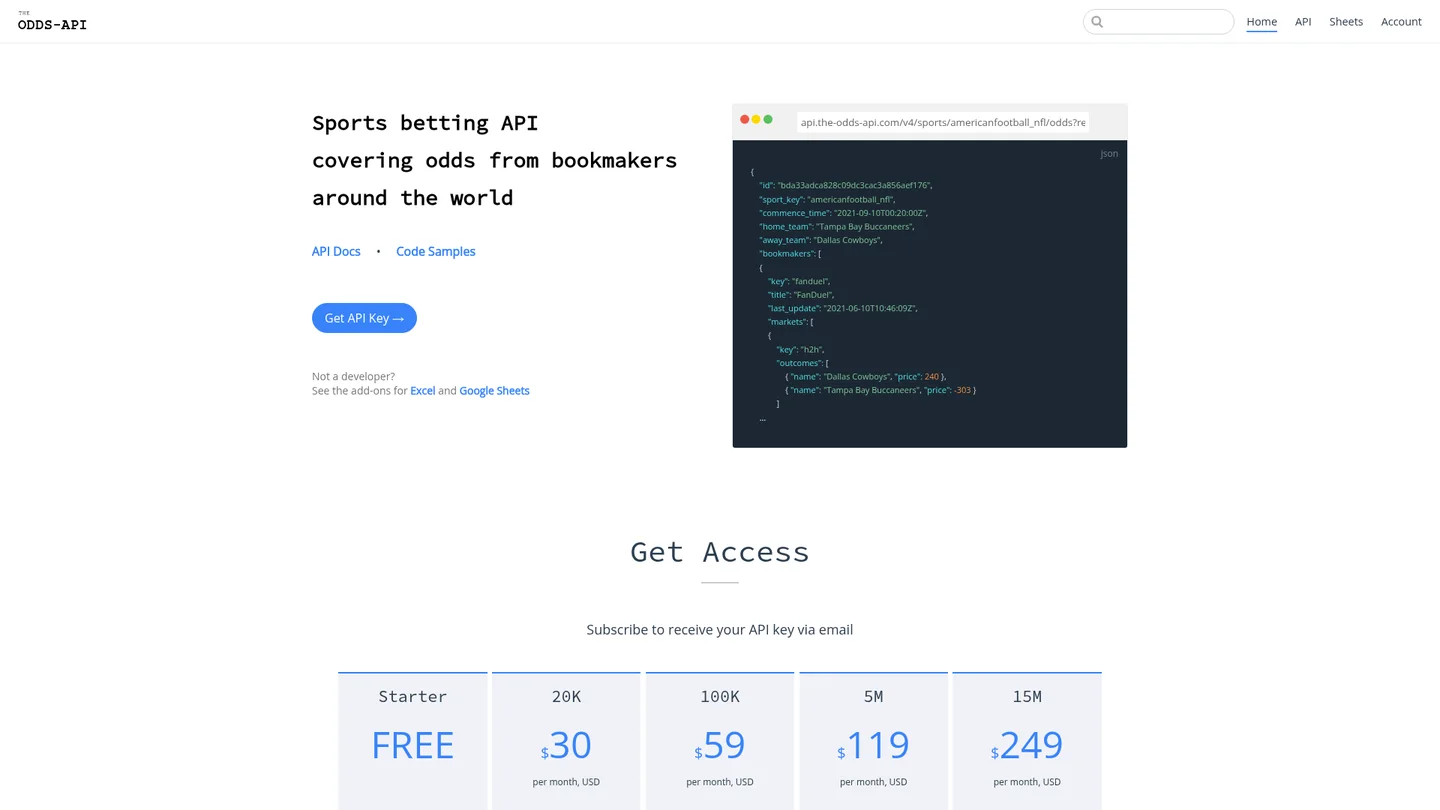
The Odds API supplies bookmaker odds that developers can turn into comparison tables, market dashboards or editorial supporting information. Its homepage describes upcoming and in-play events, while the documentation explains how to request sports and associated prices. A typical application needs to identify the sport, event, bookmaker and market rather than treat an odds value as a standalone statistic.
This specialism is important when choosing a provider. An odds-focused publication may not need a deep player database, while a fantasy or scouting application usually needs much more than bookmaker prices. The service also documents scores and results, but that does not make it equivalent to every league statistics product. Match the data categories to your actual website brief.
Sources: [1] The Odds API official features, plans and related tools, [2] The Odds API version-four documentation and quota rules
Sports, bookmaker regions and markets
The official site lists sports including American football, soccer, basketball, hockey, golf and tennis, with a separate bookmaker catalogue. The version-four documentation describes region controls and markets such as head-to-head, spreads, totals and outrights. Some additional markets, including player props, are advertised for selected sports and bookmakers rather than universally.
Build your coverage checklist around the bookmakers and events your readers actually use. Confirm the markets available before promising a comparison table for a particular competition. A region selects a group of bookmakers; it is not a guarantee that every bookmaker has prices for every game. Your website should show unavailable markets clearly instead of inventing a zero price or quietly substituting a different market.
Sources: [1] The Odds API official features, plans and related tools, [2] The Odds API version-four documentation and quota rules
JSON integration and odds presentation
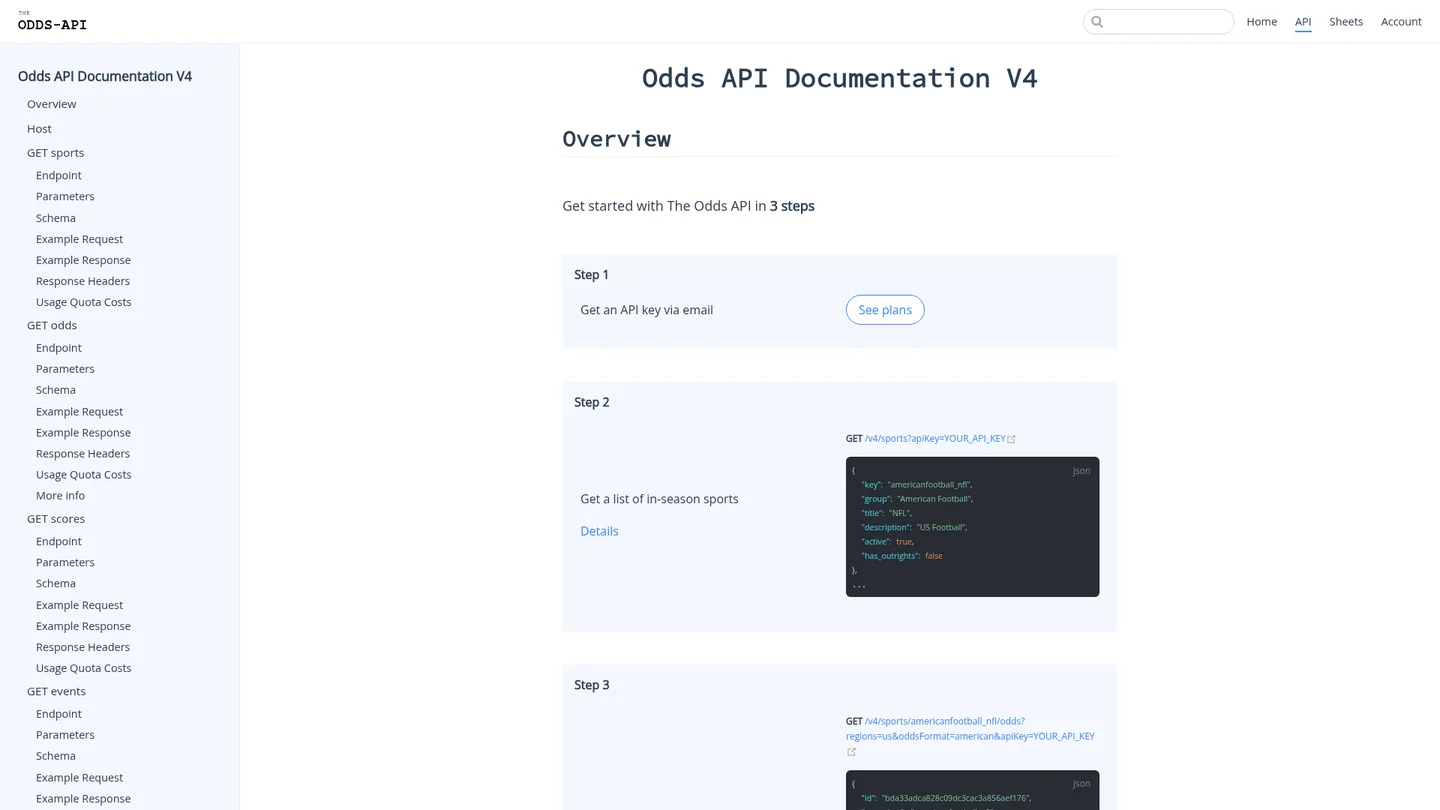
The documentation starts with an API key, a list of in-season sports and an odds request using a sport identifier. It supports decimal and American odds formats and documents timestamp options. Those controls help developers produce displays appropriate to their audience, but the implementation still needs consistent event mapping and clear labels for bookmaker and market.
Use server-side credential handling and a shared cache where appropriate rather than exposing private credentials or requesting identical prices for every visitor. Preserve timestamps so readers can understand how recent the displayed data is. Handle empty results, suspended markets and changed event schedules explicitly. The examples explain the request model; they do not independently establish a delivery speed or a guaranteed bookmaker price.
Sources: [2] The Odds API version-four documentation and quota rules
Plans, request credits and cost planning
The homepage advertises a free starter option and paid plans. Request credits are not always equivalent to a simple count of HTTP calls: the documentation explains how market and region selections can affect quota cost. It also documents usage headers, including remaining and used credits, which are useful for monitoring an application.
Estimate your workload across sports, market types, refresh schedules and background tasks before selecting a plan. Historical resources may have their own access and credit rules, so include them separately. Confirm current plan prices and allowances directly rather than assuming a free account will support a busy public comparison website. Limit retries and duplicate polling so development mistakes do not unnecessarily consume your budget.
Sources: [1] The Odds API official features, plans and related tools, [2] The Odds API version-four documentation and quota rules
Historical odds, spreadsheets and website widgets
The official site advertises historical odds snapshots going back to 2020, with access subject to the relevant product and plan. That is useful context for research, but it does not imply that every sport, bookmaker and market has an identical archive starting on the same date. Check the historical endpoint documentation against your exact analysis period.
Excel and Google Sheets add-ons provide options for working with data without building a complete application. A website odds widget is also advertised, including the use of a publisher’s own affiliate links. Evaluate the product-specific requirements, display controls and licence before choosing a tool. A spreadsheet workflow, website widget and raw API integration can have different operational and publishing implications.
Sources: [1] The Odds API official features, plans and related tools
Licensing, freshness and alternatives
Bookmaker odds change, and displayed values should never be presented as guaranteed available offers. Show an appropriate update time and direct readers to the bookmaker to confirm the current market and price. Ask about permitted redistribution, storage, attribution and territories, especially where a comparison site uses affiliate links. Data access does not itself authorise betting activity or settle regulatory requirements.
Compare Goalserve or broader betting-data providers when your brief needs other feed types. Compare Sportmonks or API-Football if detailed match statistics are more important than bookmaker comparisons. The Odds API is most relevant when its supported sports, markets and credit model fit a defined odds use case. Sports API has not independently tested its production accuracy, uptime or response latency.
Sources: [1] The Odds API official features, plans and related tools, [2] The Odds API version-four documentation and quota rules
Frequently asked questions
Is The Odds API a complete sports statistics API?
Its central offering is bookmaker odds, with related event scores and results documented. It should not be assumed to include comprehensive player records, lineups or advanced match statistics. Specify those requirements separately and compare a detailed sports data feed if they are essential to your website.
Sources: [1] The Odds API official features, plans and related tools, [2] The Odds API version-four documentation and quota rules
Which odds formats does The Odds API support?
The version-four documentation describes decimal and American odds formats. Select the appropriate request parameter and label the displayed format clearly for your readers. Format selection changes representation, not the availability of every bookmaker or market, and displayed prices can change before a visitor reaches a bookmaker.
Sources: [2] The Odds API version-four documentation and quota rules
Does each request use one credit?
Not necessarily. Usage costs depend on the endpoint and requested resources, with market and region choices affecting the documented quota model. Inspect the current rules and usage headers. Estimate actual workloads rather than equating every possible HTTP request with the same credit charge.
Sources: [2] The Odds API version-four documentation and quota rules
Can I access historical bookmaker odds?
Historical snapshots are advertised, with the homepage referring to data back to 2020. Exact coverage, snapshot availability, plan access and credit costs need checking for your sport and market. Do not assume a complete uniform archive for every bookmaker and competition from that date.
Sources: [1] The Odds API official features, plans and related tools, [2] The Odds API version-four documentation and quota rules
Can non-developers use The Odds API?
The provider advertises Excel and Google Sheets add-ons, as well as a website odds widget. These can reduce the amount of custom interface work needed. Confirm the selected tool’s access requirements, usage costs, configuration and publishing rights before relying on it for a commercial workflow.
Sources: [1] The Odds API official features, plans and related tools
How our editorial ratings work
The Odds API scores 8.8 out of 10. This is our editorial fit score, not a customer score.
Our scores are subjective website-integration fit assessments based on providers’ publicly described products, not customer-review averages or independent speed, uptime or accuracy tests. We consider publishing usefulness, integration options, documented data scope, access information and clarity of product documentation. A higher score is not a guarantee of suitability. BettorServe is the featured first placement; the remaining list is a curated shortlist, not an exhaustive market ranking.
This is a commercially oriented comparison site. We may earn a commission through eligible partner links, at no extra cost to you. BettorServe is our featured first listing. Commercial relationships and featured placements should be considered alongside the product details, and you should confirm current terms directly with a provider before purchasing.