
Provider review · Large multi-sport platforms
Sportradar review: sports APIs, coverage & access
Sportradar offers a substantial sports API catalogue through its developer platform, with league-specific interfaces, general sport APIs and related content products. It is a potential option for organisations building broad sports experiences or requiring detailed league data. This Sportradar API review explains the public product structure, the importance of coverage tiers, and the commercial and technical questions to resolve before integrating a feed.
Last updated
Our verdict
Sportradar is worth evaluating when product breadth, documented league workflows and negotiated commercial access matter more than finding a single simple starter endpoint. Its catalogue is extensive, but integration and licensing are product-specific. Our 9.0/10 editorial fit score is a website-integration assessment, not evidence from independent speed or accuracy testing. Start with the exact sport, competition and intended publishing rights you need.
Key facts
- Catalogue
- League-specific and general sport APIs [1]
- Examples
- Soccer, NFL, NBA, MLB, NHL and racing products [1]
- Coverage tool
- Interactive Coverage Matrix linked in official guidance [1]
- Access
- Marketplace trials and product-specific commercial terms [1]
- Architecture
- B2B APIs not intended for direct client-app calls [1]
Pros and cons
Pros
- A broad sports catalogue supports organisations comparing several leagues or sports.
- Public documentation distinguishes depth-focused league APIs from wider general sport feeds.
- Coverage tools and integration guides help scope a detailed evaluation.
Cons
- A large catalogue does not mean every competition has the same fields.
- Product-specific structures and commercial agreements require careful integration planning.
- The B2B APIs are not intended as direct browser-side calls.
Provider website screenshots
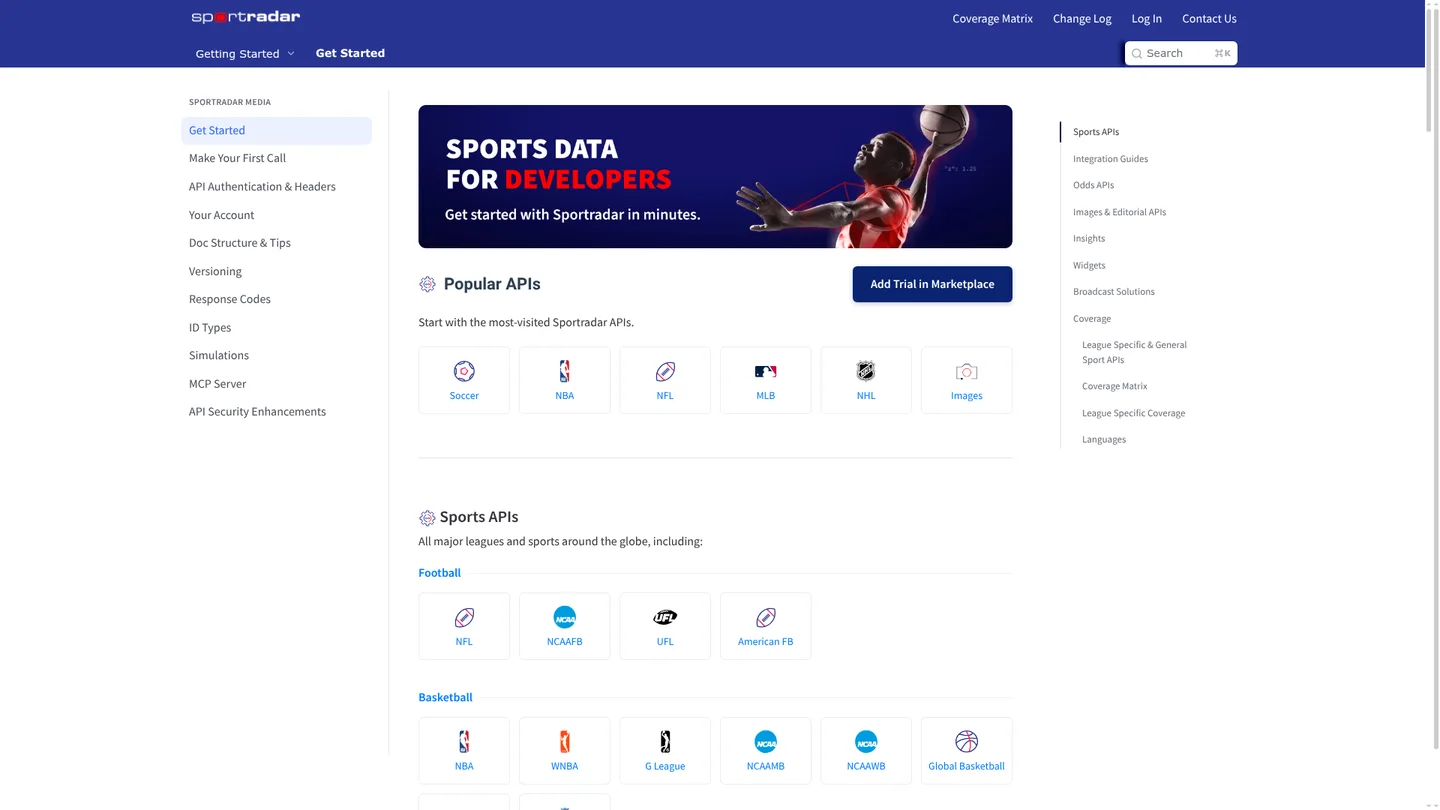
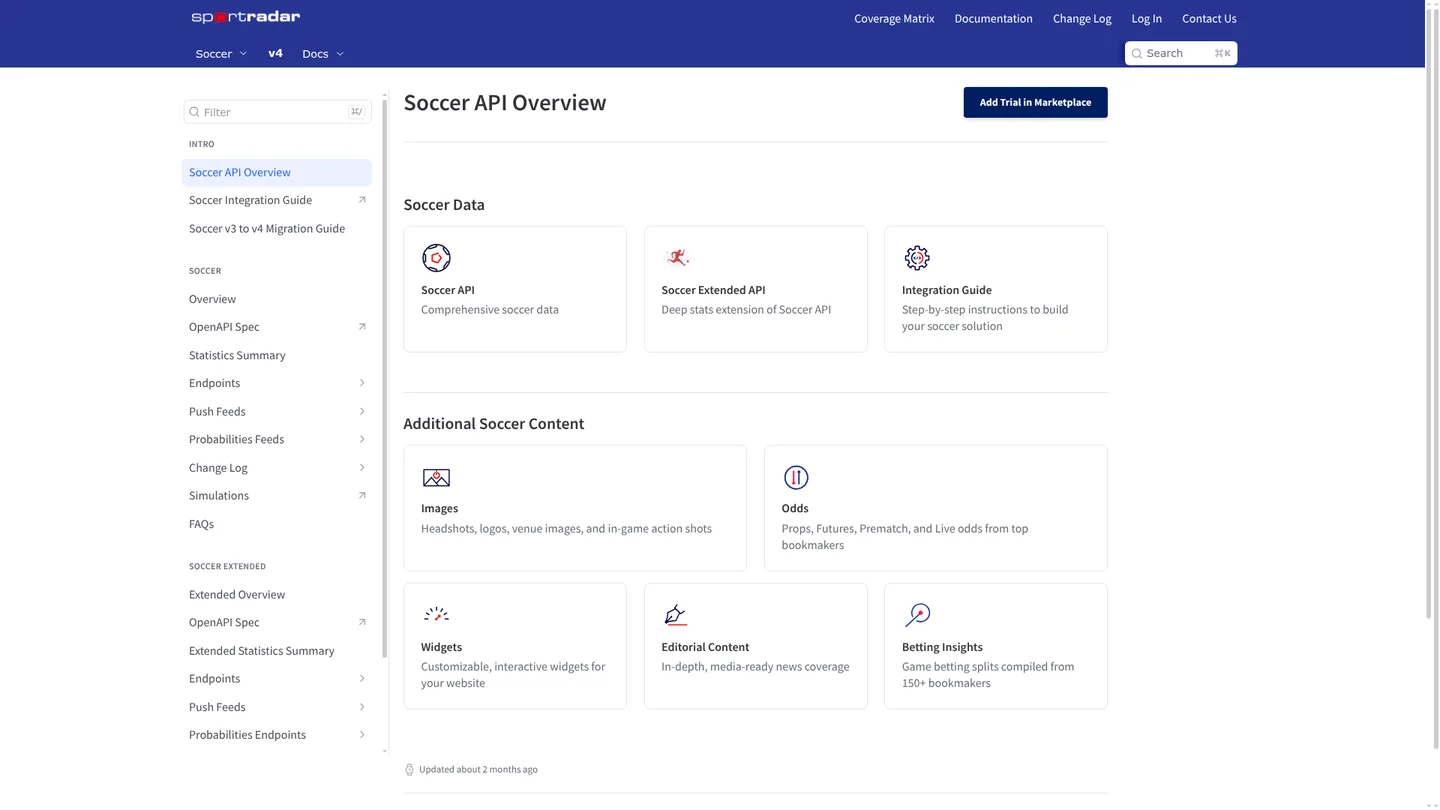
What does the Sportradar API catalogue include?
The developer platform lists products for soccer, American football, basketball, baseball, hockey and racing, among other sports. Major league interfaces sit alongside broader general sport products. The site also describes odds, images and editorial content, insights and widgets. A buyer therefore needs to identify a specific product combination rather than think of Sportradar as one undifferentiated feed.
This breadth may suit a multi-sport publication or a platform planning several detailed league experiences. A small website displaying one table may not need the same scope. Write down the events, fields, historical periods and publishing outputs you need, then map each requirement to the appropriate documented API. Avoid buying a brand name without understanding the actual resources covered by the agreement.
Sources: [1] Sportradar official getting-started, access and coverage guidance
League-specific APIs versus general sport APIs
Official guidance distinguishes league-specific APIs, which are tailored to a particular league and its statistics, from general sport APIs that cover multiple competitions with a consistent structure. The former emphasise depth for that league; the latter emphasise breadth across competitions. This is a meaningful product distinction when designing your application and comparing the data available from different subscriptions.
The same guidance notes that general sport coverage can vary by league, competition and event. Use the linked Coverage Matrix to inspect the categories important to your website, not only the sport name. A match being listed does not necessarily establish that detailed player information, play-by-play or every advanced statistic is available at the same level.
Sources: [1] Sportradar official getting-started, access and coverage guidance
Developer documentation and server-side integration
Sportradar explicitly describes its APIs as B2B services not intended to be called directly from a client application. Plan a server-side integration rather than embedding a production API key in browser code. The developer platform provides authentication guidance, first-call instructions, versioning information and integration guides, which are relevant starting points for your technical team.
Evaluate the documentation for the exact product and version you are purchasing. Confirm identifiers, supported languages, event status models and update workflows. If you combine several sports, do not assume that every league-specific endpoint shares an identical response structure. Test scheduled, live and completed events and design explicit handling for unavailable data, rate limits and corrections before exposing the results to readers.
Sources: [1] Sportradar official getting-started, access and coverage guidance
Trials, access and pricing questions
The public developer pages link to adding a trial through the Sportradar Marketplace. That is an evaluation route, not a blanket promise of permanent free production access. Establish which sport or league product the trial covers, what request controls apply, how long evaluation lasts and whether public display is allowed during that period.
Request commercial terms for your defined use case. This review does not quote a universal monthly price because the inspected documentation presents multiple products and access arrangements. Ask about your domains, territories, users, storage needs and planned outputs, as well as any additional content or support. A quotation should distinguish the core feed from extras rather than leave your team guessing about the final package.
Sources: [1] Sportradar official getting-started, access and coverage guidance
Soccer products and additional website content
The soccer overview illustrates the wider catalogue structure. It presents a Soccer API, a Soccer Extended API and an integration guide, with additional links for images, odds, widgets, editorial content and betting insights. These are distinct resources. A soccer score centre might use the core data, while an analytical application could require different depth or associated products.
A publisher should decide which of those extras genuinely improves its own website. Images can introduce additional reuse conditions, widgets can change the implementation approach, and odds require separate market and territory checks. Do not read a link in the soccer catalogue as confirmation that it is included in the same subscription or available for every competition and event.
Sources: [2] Sportradar Soccer API overview and related products
Operational checks, rights and alternatives
Ask how data corrections, postponed fixtures and changed event schedules should be handled. Establish any contracted delivery expectations and live-event support process. Sportradar offers detailed documentation, but this review has not independently measured its production latency, accuracy or availability. Screenshots show public pages, not proof of the response quality a particular customer will receive.
Compare SportsDataIO for other league-focused requirements, Stats Perform for data-led media and analysis, and simpler football services for narrower projects. Before deciding, clarify public display, archiving, attribution, redistribution and image rights in the actual agreement. If your platform publishes in multiple territories or supplies downstream clients, make those uses explicit rather than assuming an API subscription grants unrestricted global reuse.
Sources: [1] Sportradar official getting-started, access and coverage guidance, [2] Sportradar Soccer API overview and related products
Frequently asked questions
Does Sportradar have one API for every sport?
Its developer platform presents a catalogue of products rather than one identical interface for all use cases. League-specific APIs and general sport APIs serve different requirements. Review the documentation and commercial access for the particular sports and competitions your website needs.
Sources: [1] Sportradar official getting-started, access and coverage guidance
What is the difference between league-specific and general sport APIs?
Official guidance describes league-specific APIs as tailored to a particular league with deeper league detail, while general sport APIs cover broader sets of competitions with a consistent format. Coverage varies, so inspect the relevant matrix and documentation rather than assuming every listed event has equal depth.
Sources: [1] Sportradar official getting-started, access and coverage guidance
Can I call Sportradar directly from my website browser code?
The official access note says its B2B APIs are not intended to be called directly from a client application. Plan server-side requests and secure credential handling. Your application can then publish the permitted results through its own controlled interface and caching layer.
Sources: [1] Sportradar official getting-started, access and coverage guidance
Does Sportradar offer a free trial?
The developer platform links to adding trials through its Marketplace. Check eligibility, selected product, duration, request limits and evaluation rights directly. A trial link does not establish that an unrestricted free production plan or public-display permission is available for every sports feed.
Sources: [1] Sportradar official getting-started, access and coverage guidance
Are images, widgets and odds included with sports data?
Those resources appear as distinct product categories and links in the official documentation. Confirm their inclusion, competition coverage and rights in your agreement. A core sports API entitlement should not be interpreted as automatic permission to use every associated image, widget or betting data product.
Sources: [1] Sportradar official getting-started, access and coverage guidance, [2] Sportradar Soccer API overview and related products
How our editorial ratings work
Sportradar scores 9.0 out of 10. This is our editorial fit score, not a customer score.
Our scores are subjective website-integration fit assessments based on providers’ publicly described products, not customer-review averages or independent speed, uptime or accuracy tests. We consider publishing usefulness, integration options, documented data scope, access information and clarity of product documentation. A higher score is not a guarantee of suitability. BettorServe is the featured first placement; the remaining list is a curated shortlist, not an exhaustive market ranking.
This is a commercially oriented comparison site. We may earn a commission through eligible partner links, at no extra cost to you. BettorServe is our featured first listing. Commercial relationships and featured placements should be considered alongside the product details, and you should confirm current terms directly with a provider before purchasing.