

Provider review · Horse-racing positional and sectional data products
Total Performance Data review: sports data, access and fit
Total Performance Data (TPD) is a specialist horse-racing data company. Its current product pages describe GPS/GNSS-based tracking, live race progress, post-race sectional and points data, plus a historical package. That focus makes TPD a poor substitute for a broad football or basketball API but potentially a much more relevant supplier when a racing product needs horse position, timing or related race analysis.
 By Sarah Mitchell
Updated
Our verdict
Our 8.0/10 editorial-fit score reflects specialist value for horse-racing use cases and a specific menu of live, post-race and historical data. It is not a performance test or a claim that coverage is uniform globally. Buyers should confirm target tracks, countries, protocol, rights, historical range and whether their intended downstream use is supported before treating a live feed description as commercial availability.
Key facts
Pros and cons
Pros
- Product pages separate live tracking from post-race sectionals and point data.
- A dedicated race-tracking page explains the physical collection system and types of outputs.
- The product is purpose-built for racing workflows rather than a generic sports score feed.
Cons
- The service is narrow by sport and is not suitable as a multi-sport API replacement.
- Live data is described as a JSON stream over UDP, which may require specialized infrastructure.
- Track, territory, access and data rights require direct commercial confirmation.
Provider website screenshots

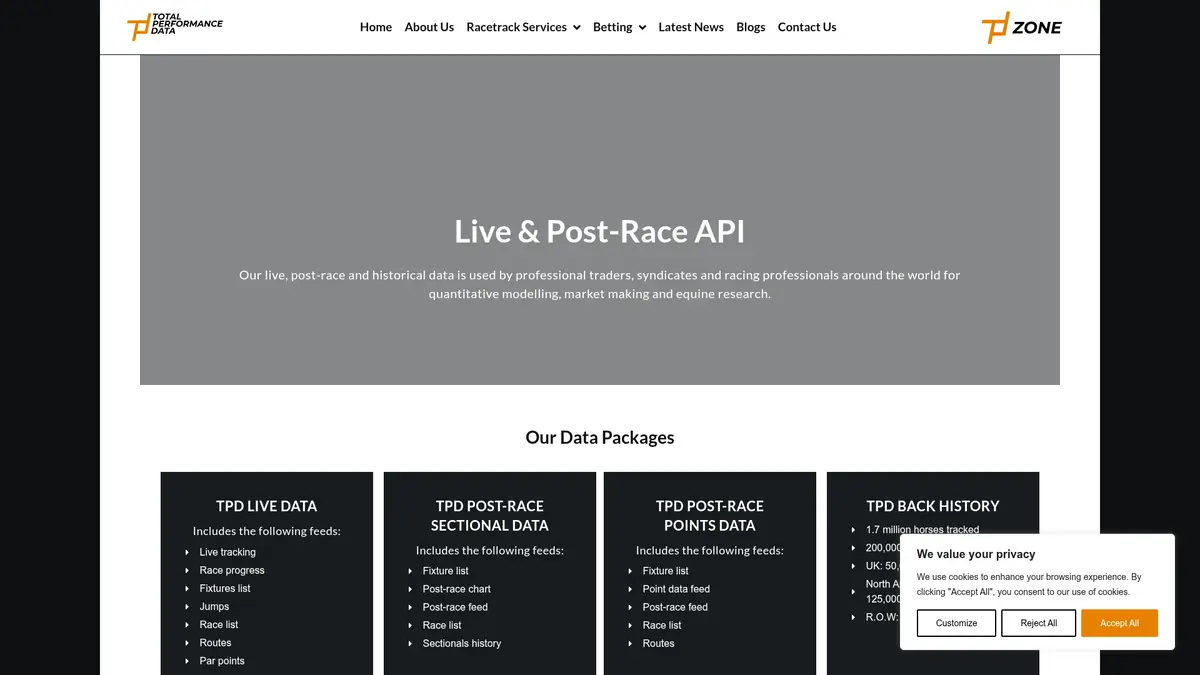
Specialist race data, not general scores
TPD’s product menu centers on horse racing, including race tracking and timing, graphics, in-play odds and a live/post-race API. This specialization matters because the useful units are not only match score and team statistics: a racing feed may carry horse position, route, sectionals, race progress and other derived measures. A general multi-sport provider may not expose equivalent detail.
The API page lists several separate data packages, while the company homepage positions the offer around global horse-racing data. Treat these as provider claims that require a current coverage schedule. Confirm which tracks and meetings are supported, how the company defines live availability, whether historic meetings are licensed and how the feed identifies horses across events.
Sources: [1] Live & PR API - Total Performance Data, [2] Race Tracking & Timing - Total Performance Data
Live tracking and transport
TPD describes GPS/GNSS tracking equipment collecting race information and its live API as a JSON stream delivered over UDP. This is a specific technical choice with architectural consequences. UDP is not the same as ordinary request-response HTTP: the receiving system must plan for message handling, connectivity, sequencing, monitoring and recovery rather than assuming it can simply poll a REST endpoint.
Before implementation, request protocol specifications, a sandbox stream, network requirements and expectations for dropped or repeated messages. Understand whether updates are deltas or snapshots and how a client can reconstruct the race state after a disconnect. The public product page gives a useful outline of the data categories, but it does not replace the engineering runbook or a negotiated service-level definition.
Post-race and historical products
The API page distinguishes live data, post-race sectional data, post-race points data and back-history. That separation is valuable for analytical applications: a real-time display may need current location and progress, while a form or performance model may rely on sectionals and stored records. A buyer should map these packages to separate product requirements rather than assume all historical records accompany the live feed.
Ask how historical packages define inclusion, completeness, time zones, corrections and horse identity. Sectional data can support comparisons across races, but the definitions and collection quality determine whether those comparisons are meaningful. TPD’s page describes the types of package and selected record counts; no independent audit or historical dataset inspection informed this review.
Data collection, racecourse scope and rights
TPD’s race-tracking page describes a system developed with Gmax Technologies and explains that tracking supports race graphics, sectional timing and other outputs. A physical collection operation means venue access and racecourse coverage are central questions, unlike a purely web-scraped schedule API. Verify each track and jurisdiction and establish what happens when an event is unavailable or equipment is offline.
Rights depend on how data is used. A trading or internal analysis licence may not automatically permit publication, redistribution, wagering or onward supply. Identify whether the project is a consumer website, betting product, broadcaster graphics workflow or research system and seek written permission for each. The provider’s product categories are not a grant of rights, and a company-wide relationship with a track does not necessarily extend to every customer.
Sources: [2] Race Tracking & Timing - Total Performance Data, [1] Live & PR API - Total Performance Data
Appropriate buyers and editorial score
TPD is compelling only when the use case aligns with racing-specific detail. A publisher building general live scores should not shortlist it as an alternative to a multi-sport feed, while a racing analytics team could find its positional and post-race data categories worth a serious conversation. The niche itself is a strength for the right application and a material limitation for all others.
The 8.0 score recognizes the concrete specialization and distinct data packages while withholding a stronger recommendation until track coverage, commercial availability and protocol obligations are established. Build an acceptance test around target meetings, representative horses, missing-message recovery and required historical fields. Confirm rights separately for each channel. This review examined official product descriptions only; it did not connect to a race feed or validate latency.
A racing product should also define how human-facing displays interpret raw telemetry. Position, stride and sectional values may need domain-specific context, and graphics or trading models can have stricter freshness and correctness requirements than a retrospective results page. Ask for data dictionaries, units, clock definitions and examples for interrupted or unusual races. If a service combines equipment at the track with API delivery, identify both the data-collection escalation contact and the technical integration contact. This is a focused operational diligence list, not a claim about how often problems occur.
Racing calendar and venue operations can change at short notice, so ask how new meetings, cancellations and late alterations are represented. A feed consumer needs to distinguish a temporary signal interruption from a change to the scheduled race itself. Clarify whether historical corrections are sent as new events, replacements or a separate post-race package. Include these cases in acceptance criteria before any visual graphics or predictive logic depends on a stable identifier and event lifecycle.
Sources: [1] Live & PR API - Total Performance Data, [2] Race Tracking & Timing - Total Performance Data
Frequently asked questions
What does TPD’s live API provide?
The official product page lists live tracking, race progress, fixtures, jumps, race lists, routes and par points. Confirm which fields and racecourses are included in the package you are offered.
Is Total Performance Data a general sports API?
No. Its documented products focus on horse racing, including tracking, timing, sectionals and points data. It should not be treated as a multi-sport scores provider.
Sources: [1] Live & PR API - Total Performance Data, [2] Race Tracking & Timing - Total Performance Data
How is live data delivered?
TPD describes live JSON data delivered over UDP. Request the current protocol, sample stream, network requirements and reconnect/recovery guidance before building an integration.
Does TPD offer historical data?
The product pages list post-race and back-history packages as separate options. Confirm the period, tracks, fields, correction policy and commercial rights for the historical data you need.
Is TPD data available for every racecourse?
The company advertises coverage from 150-plus racecourses, but that headline does not establish availability for every country or event. Obtain a current track list for your target jurisdiction.
Sources: [1] Live & PR API - Total Performance Data, [2] Race Tracking & Timing - Total Performance Data
How our editorial ratings work
Total Performance Data scores 8.0 out of 10. This is our editorial fit score, not a customer score.
Our scores are subjective website-integration fit assessments based on providers’ publicly described products, not customer-review averages or independent speed, uptime or accuracy tests. We consider publishing usefulness, integration options, documented data scope, access information and clarity of product documentation. A higher score is not a guarantee of suitability. BettorServe is the featured first placement; the remaining list is a curated shortlist, not an exhaustive market ranking.
This is a commercially oriented comparison site. We may earn a commission through eligible partner links, at no extra cost to you. BettorServe is our featured first listing. Commercial relationships and featured placements should be considered alongside the product details, and you should confirm current terms directly with a provider before purchasing.
Sources
Content last reviewed