

Provider review · Developers comparing many league APIs and webhooks
BALLDONTLIE review: API features, coverage & fit
BALLDONTLIE has expanded from a sports API brand into a broad product set that includes league-specific data references, odds and props, webhooks, a model-building Lab and a separate StoryStats content offering. Its documentation hub currently groups dozens of APIs by sport and league, a useful level of specificity for shortlisting. The breadth creates an integration question as much as an advantage: the public catalogue does not mean a single data schema, shared subscription or identical entitlement across every league. This review distinguishes the data API from adjacent products and evaluates only the advertised scope.
 By Sarah Mitchell
Updated
Our verdict
A developer who wants many league choices, OpenAPI specifications and event webhooks may find BALLDONTLIE unusually easy to map into a prototype plan. Its public docs expose numerous individual league destinations rather than one generic “all sports” endpoint. The principal caveat is product and billing complexity: the provider advertises tiers per sport, and adjacent odds, webhook, Lab and StoryStats features have their own scope. Our 8.5/10 fit score reflects catalogue breadth and documentation, not independent data accuracy, availability or customer sentiment. Pin down the exact league, tier, endpoint and product before assuming the account covers a multi-sport application.
Key facts
- Catalogue
- 41 league APIs grouped by sport on the documentation hub at review date [2]
- Documentation
- OpenAPI specifications are advertised for API products [1]
- Access model
- Official page shows per-sport tiers as well as an all-sports option; verify present checkout terms [1]
- Adjacent products
- Webhooks, BDL Lab and StoryStats are described separately from core sports data [1]
Pros and cons
Pros
- A centralized docs index makes individual league references discoverable across numerous sports and competitions.
- OpenAPI specs and webhooks are advertised, giving teams machine-readable integration material and a push-style alternative to polling.
- Stats, odds, props, injuries, content and analytical products give a buyer options beyond basic fixture and score lookups.
Cons
- Each league has a distinct API reference and access can be per sport; teams should budget for multiple schemas and subscriptions.
- A headline count of supported leagues does not establish equal history, update intervals or depth for every competition.
- Model metrics and marketing claims on the company site are not a neutral benchmark of API performance or betting outcomes.
Provider website screenshots
Many league APIs rather than a universal sports object
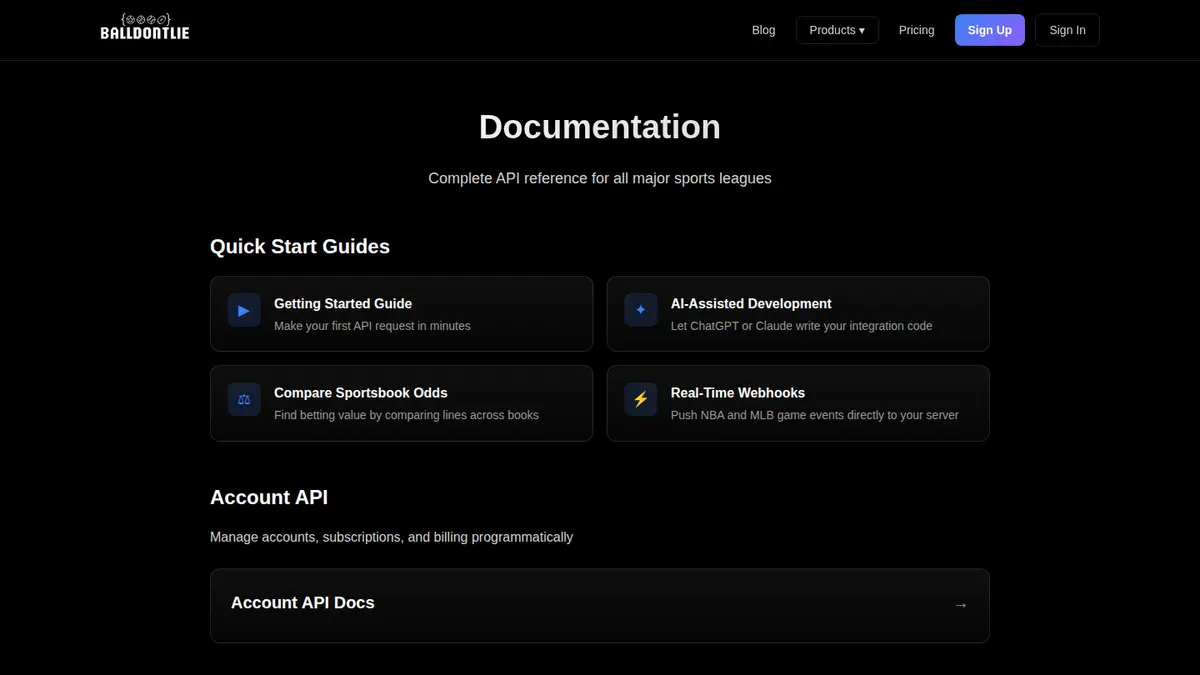
The documentation hub lists a substantial range of individual league products: multiple basketball competitions, major soccer leagues, NFL and college football, MLB and college baseball, NHL, ATP and WTA tennis, golf, Formula 1, MMA and esports titles. For a buyer, this specificity is valuable because it reveals which competitions the vendor is choosing to expose and gives each a direct documentation path. It also signals that the service should not be assumed to provide one universal endpoint or one identical coverage profile.
A product that combines NBA and Premier League content, for example, should validate both APIs separately, compare their identifiers and timestamps, and define its own common model. A directory entry naming 41 APIs does not show how interchangeable they are or what historical depth and update cadence each delivers. Work from the exact league list, then request a sample for the intended season, resources and event types. This is more reliable than extrapolating from a general home-page claim about many sports or “hundreds of years” of history.
Sources: [1] BALLDONTLIE official sports data platform and product access, [2] BALLDONTLIE league-specific API documentation index
OpenAPI specifications and event-driven options
BALLDONTLIE advertises OpenAPI specs for each product and links them from its documentation hub. That is a practical advantage for teams that generate client types, inspect schemas or hand a formal specification to developer tooling. The company also promotes a native MCP interface and account tools, but neither an AI-oriented workflow nor an API spec absolves the integrator from validating the actual data fields and access constraints. Confirm authentication requirements, versioning, rate limits, pagination and per-endpoint entitlement before using generated code in production.
The provider describes real-time webhooks with signed payloads and automatic retries. A push notification can reduce unnecessary polling, but the associated product is not automatically available in every plan, sport or event. Confirm the supported event types, signing and replay behavior, delivery guarantees, retry policy and monthly allowance. Build idempotent handlers and reconcile final records through the API where necessary. The advertised webhook model can be an architectural benefit; this review does not verify actual end-to-end latency or the completeness of notifications.
Sources: [1] BALLDONTLIE official sports data platform and product access, [2] BALLDONTLIE league-specific API documentation index
Separate data, odds and content products
The homepage positions its data service around scores, player statistics, odds, props and injuries. It also presents StoryStats as a separate content product and BDL Lab as an analytical environment. Those adjacent offers can be useful if a product needs game narratives or an environment for model experiments, but the buyer should keep their licensing, response formats and access separate from the core league API. A package labeled “all access” on the current pricing page may bundle several products, yet buyers should verify what is included and the period of the offer.
The currently visible page describes per-sport plans and an all-sports tier, with different rate limits and data access levels. These prices and quota details are volatile and are not needed to assess the product fit; verify current commercial terms before purchase. More importantly, an all-sports marketing tier does not establish a shared response shape or equivalent deep data across sports. Estimate API requests by actual use, test the free account against the target leagues and decide whether webhooks or adjacent content features are independently worth the extra complexity.
Sources: [1] BALLDONTLIE official sports data platform and product access, [2] BALLDONTLIE league-specific API documentation index
Broad coverage is useful only when mapped to requirements
BALLDONTLIE fits a developer who wants to explore a menu of league-level APIs and values formal documentation before implementing a site or application. The strength is discoverability: a small team can inspect a sport or competition reference without first negotiating a bespoke product conversation. Its webhook and OpenAPI positioning can also suit teams with operational experience that want event-driven updates or generated clients.
The broader platform is less immediately straightforward for a project that needs uniform data across dozens of leagues or contractual assurances that go beyond a self-service plan. Ask what “real-time” means for the exact feed, whether the data is delayed, which seasons are available, and how corrections propagate. Also distinguish a provider’s modeling results or promotional product descriptions from independently validated accuracy. Our score rewards the visible API catalogue and developer resources, while the lower confidence around equal cross-league depth and package semantics keeps the rating below top-tier certainty.
Sources: [1] BALLDONTLIE official sports data platform and product access, [2] BALLDONTLIE league-specific API documentation index
Frequently asked questions
How many sports APIs does BALLDONTLIE document?
The documentation hub lists 41 APIs at the captured review date, grouped by sports and individual leagues. This is a changing catalogue count; it should not be read as proof that each API has identical coverage or data depth.
Sources: [2] BALLDONTLIE league-specific API documentation index
Is there one API for every sport?
The site lists league-specific API references, so integrations and coverage should be checked per product. A team using several leagues should compare identifiers, schemas, quotas and entitlements rather than assume one shared sports object.
Sources: [2] BALLDONTLIE league-specific API documentation index
Does BALLDONTLIE offer webhooks?
The company advertises webhooks for event notifications and describes signed payloads and retries. Verify which sports and events are supported, the plan allowance and delivery behavior. Webhooks still require secure, idempotent handling by your application.
Sources: [1] BALLDONTLIE official sports data platform and product access
Are odds, StoryStats and Lab part of the core API?
The provider presents odds and props, StoryStats content and BDL Lab as adjacent product areas. Check each product’s documentation, subscription and rights independently rather than assuming that a basic league API includes them.
Sources: [1] BALLDONTLIE official sports data platform and product access
Does a free BALLDONTLIE account cover every sport?
The current public plan page describes sport-specific tiers and a separate all-sports option. The exact free access, rate limits and included fields should be checked in the live account and current pricing terms.
Sources: [1] BALLDONTLIE official sports data platform and product access
How our editorial ratings work
BALLDONTLIE scores 8.5 out of 10. This is our editorial fit score, not a customer score.
Our scores are subjective website-integration fit assessments based on providers’ publicly described products, not customer-review averages or independent speed, uptime or accuracy tests. We consider publishing usefulness, integration options, documented data scope, access information and clarity of product documentation. A higher score is not a guarantee of suitability. BettorServe is the featured first placement; the remaining list is a curated shortlist, not an exhaustive market ranking.
This is a commercially oriented comparison site. We may earn a commission through eligible partner links, at no extra cost to you. BettorServe is our featured first listing. Commercial relationships and featured placements should be considered alongside the product details, and you should confirm current terms directly with a provider before purchasing.
Sources
Content last reviewed