

Provider review · Odds products that need scores and live game context
TheRundown API Review: odds, scores and integration
TheRundown presents a developer-facing sports odds and data API with REST access across plans and real-time REST/WebSocket access on higher tiers. Its documentation describes odds, scores, statistics and play-by-play with stable player and team IDs, alongside a recommended V2 market model and a legacy V1 line model. This positions the product as a broader data feed than odds alone. The useful distinction is how access, freshness, markets and historical depth vary by plan and sport; a free key is not the same as unrestricted production rights.
 By Sarah Mitchell
Updated
Our verdict
TheRundown earns an 8.5/10 editorial fit for teams that want a documented odds-centered API with related game data and a visible path from REST polling toward streaming. Its API and developer documentation explain versions, sports and tier boundaries, which helps a buyer scope a prototype. The score is not a test of accuracy, freshness or reliability. Verify the required sports, stat fields, WebSocket entitlements, commercial display rights, quotas and version migration before production.
Key facts
Pros and cons
Pros
- Current API documentation distinguishes the recommended market-oriented V2 from legacy V1.
- Odds data sits alongside scores, stats, plays and stable team/player identifiers.
- Public plan details and integration documentation make important REST and WebSocket gates visible.
Cons
- Real-time REST and WebSocket are not available on every tier; lower plans have stated delays.
- Sports, sources, stats and market depth vary by plan and coverage, so broad catalogue language needs verification.
- Publicly listed plan terms and limits can change and do not automatically grant every commercial display right.
Provider website screenshots

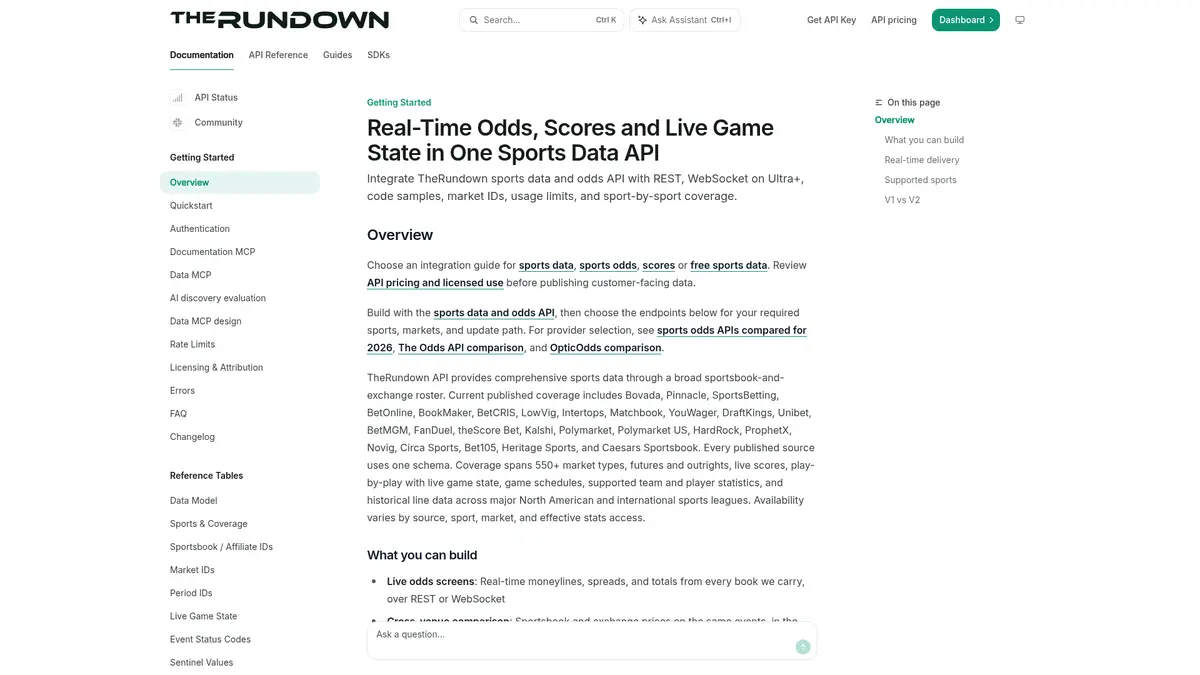
Odds with related game-state data
TheRundown’s API page describes odds, scores, stats and play-by-play with stable player and team IDs across games and seasons. That gives a developer a potential foundation for more than a line table: a market view can be tied to the event and related state, subject to the resources available for a given sport and plan. The documentation also points to a sports-and-coverage reference, an important detail because a broad API description is not a substitute for a competition matrix.
The API markets a normalized schema that combines sportsbook and prediction-market sources. That may reduce the effort needed to represent multiple source types, but normalization does not guarantee every source supplies the same market, player stat or event depth. Confirm source IDs, field semantics, supported markets and effective dates for the actual products in your account. If the interface is customer-facing, distinguish bookmaker prices from exchange-style or prediction-market observations where the provider schema allows it.
Sources: [1] TheRundown sports odds and data API, [2] TheRundown API documentation overview
V2 markets versus legacy V1
The developer overview recommends V2’s market-based model and identifies V1 as a legacy, flat line-based model. That distinction matters to new integrations: a market-centric structure can group participants, outcomes, lines and market identifiers in a way that is easier to extend, while a legacy flat representation may be familiar to older clients. Start a new build against the current recommended version unless a specific migration constraint requires V1, and ask how long compatibility is maintained.
Stable team and player identifiers are useful only when their lifecycle and mapping rules are understood. Test IDs across at least one upcoming, live and completed event and keep API version context in stored records. If you are migrating from V1, map old fields and results explicitly rather than copying display logic unchanged. The documentation is a starting point; it does not demonstrate that every V1 resource has a one-to-one V2 replacement.
Plan gates, freshness and quota
The public API page advertises a free key with a daily and monthly data-point limit, but pairs it with delayed pre-match odds and excludes real-time WebSocket access. It also differentiates paid tiers by delays and availability of streaming. These current published rules are operationally important: a successful free request demonstrates schema access, not live production suitability. Since plan details change, verify limits and the exact data-point accounting before modeling costs or displaying a price as current.
The API documentation says REST is available across plans, while real-time REST and WebSocket access are reserved for higher tiers. This invites an incremental architecture—start with REST for a prototype, then only move to streaming if the required freshness, connection count and subscription capacity justify it. Check per-plan rate limits, concurrent connection rules, market subscriptions and historical access directly. Do not infer that upgrading solely changes one delay; the product page lists multiple entitlement differences.
Sources: [1] TheRundown sports odds and data API, [2] TheRundown API documentation overview
Practical fit and rights checklist
TheRundown is a credible shortlist candidate for an odds-led site that also needs scores and live-game context, especially when a team can compare REST polling with a higher-tier streaming approach. It is not automatically the best choice for a deep statistics product: supported sports, leagues, sources, stat access and player props vary. Choose a specific event, market and history requirement and compare the provider’s actual sample against those criteria.
The 8.5/10 editorial fit reflects useful public documentation, visible plan boundaries and a unified data proposition. It is not a benchmark of update speed, accuracy, uptime or customer sentiment. Before launch, confirm commercial display rights, attribution, affiliate use, history retention, quotas and permitted redistribution. Keep a stale-data indicator and design for missing or delayed sources; no provider page removes the application’s responsibility to communicate uncertainty.
A sensible prototype can remain intentionally small: choose a single competition, one pre-match market, one live event if licensed, and a completed result, then confirm the same IDs and fields survive across states. Record which plan serves each response and whether WebSocket subscriptions are available. That exercise helps separate a technically successful request from a feed that genuinely supports the planned product, and keeps plan changes from silently changing displayed freshness.
Sources: [1] TheRundown sports odds and data API, [2] TheRundown API documentation overview
Frequently asked questions
Does TheRundown API include real-time odds?
The official plan page describes delayed odds on lower tiers and real-time REST plus WebSocket access on higher tiers. Confirm current tier requirements, market limits and connection entitlements before planning an in-play experience.
Sources: [1] TheRundown sports odds and data API, [2] TheRundown API documentation overview
What is the difference between V1 and V2?
The documentation recommends the V2 market-based model and describes V1 as a legacy flat-line model. New integrations should inspect V2 first and request a migration map if they depend on V1.
Is there a free TheRundown API key?
The API page advertises a free key with usage and freshness limits. It does not imply unrestricted live access or commercial display permission; check current allowances and license terms.
Does TheRundown cover scores and statistics as well as odds?
The product page describes scores, stats and play-by-play alongside odds. The actual leagues, fields and access depend on source and plan, so check the current sport-by-sport coverage documentation.
Sources: [1] TheRundown sports odds and data API, [2] TheRundown API documentation overview
Are the published timing and market-count claims independently measured?
No. They are the provider’s product descriptions and plan details. This review did not test latency, coverage or accuracy; obtain a sample and contractual terms for your project.
How our editorial ratings work
TheRundown scores 8.5 out of 10. This is our editorial fit score, not a customer score.
Our scores are subjective website-integration fit assessments based on providers’ publicly described products, not customer-review averages or independent speed, uptime or accuracy tests. We consider publishing usefulness, integration options, documented data scope, access information and clarity of product documentation. A higher score is not a guarantee of suitability. BettorServe is the featured first placement; the remaining list is a curated shortlist, not an exhaustive market ranking.
This is a commercially oriented comparison site. We may earn a commission through eligible partner links, at no extra cost to you. BettorServe is our featured first listing. Commercial relationships and featured placements should be considered alongside the product details, and you should confirm current terms directly with a provider before purchasing.
Sources
Content last reviewed