

Provider review · Developers seeking a self-service multi-sport JSON API
StatPal review
StatPal offers a multi-sport API for developers seeking live-score-oriented information, schedules and other sport data through a common provider account. Its public website lists coverage pages for soccer, American sports, cricket, golf, horse racing and several other categories, while its documentation uses OpenAPI and interactive examples. The unifying API proposition is attractive, but one implementation detail immediately matters: soccer is documented at v2 and other sports at v1. Treat StatPal as a family of sport-specific feeds with a shared vendor, not an identical schema everywhere.
 By Sarah Mitchell
Updated
Our verdict
Editorial integration fit: 7.9/10. StatPal has a reasonably legible self-service route: coverage pages, a quick start, interactive documentation and an OpenAPI description. That can help a small team evaluate the API without beginning with an enterprise procurement process. The score is held below a high specialist rating because sport depth, versions, plans and quotas require additional verification, and the provider’s own marketing language is not an independent performance audit.
Key facts
- API format
- The provider describes a REST JSON API and publishes OpenAPI and interactive documentation. [1]
- Version split
- Official docs state soccer uses v2 while other sports use v1. [1]
- Coverage breadth
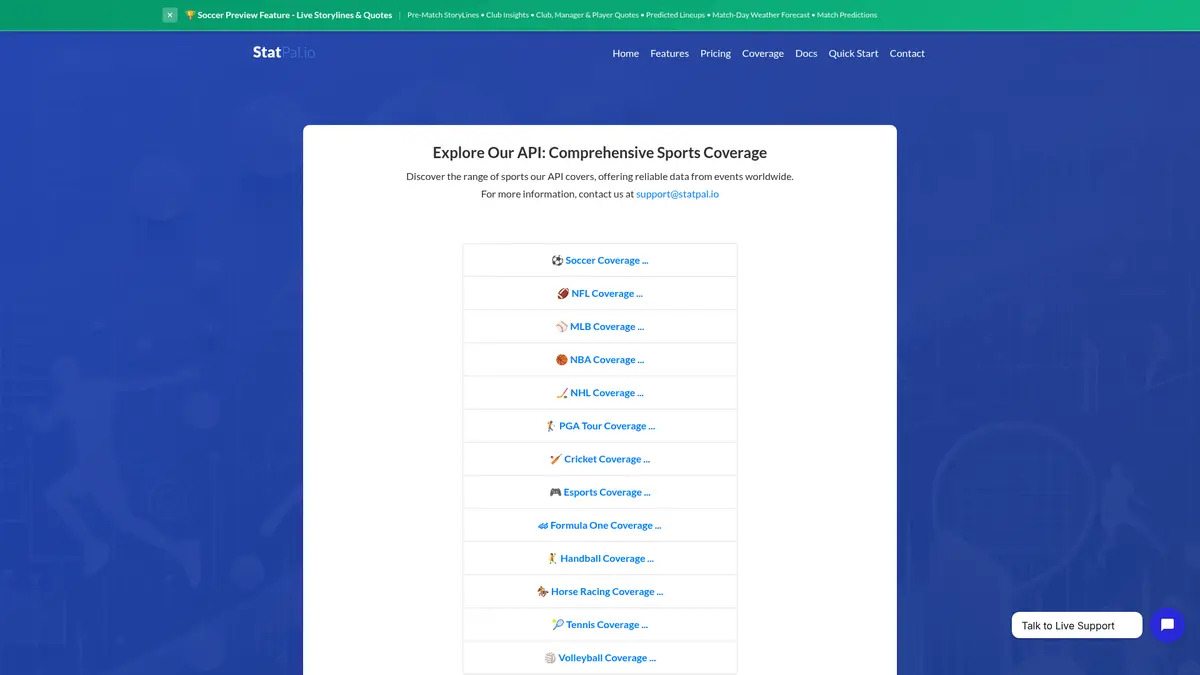
- The coverage page lists soccer, NFL, MLB, NBA, NHL, PGA Tour, cricket, horse racing and additional sports. [2]
- Quick-start model
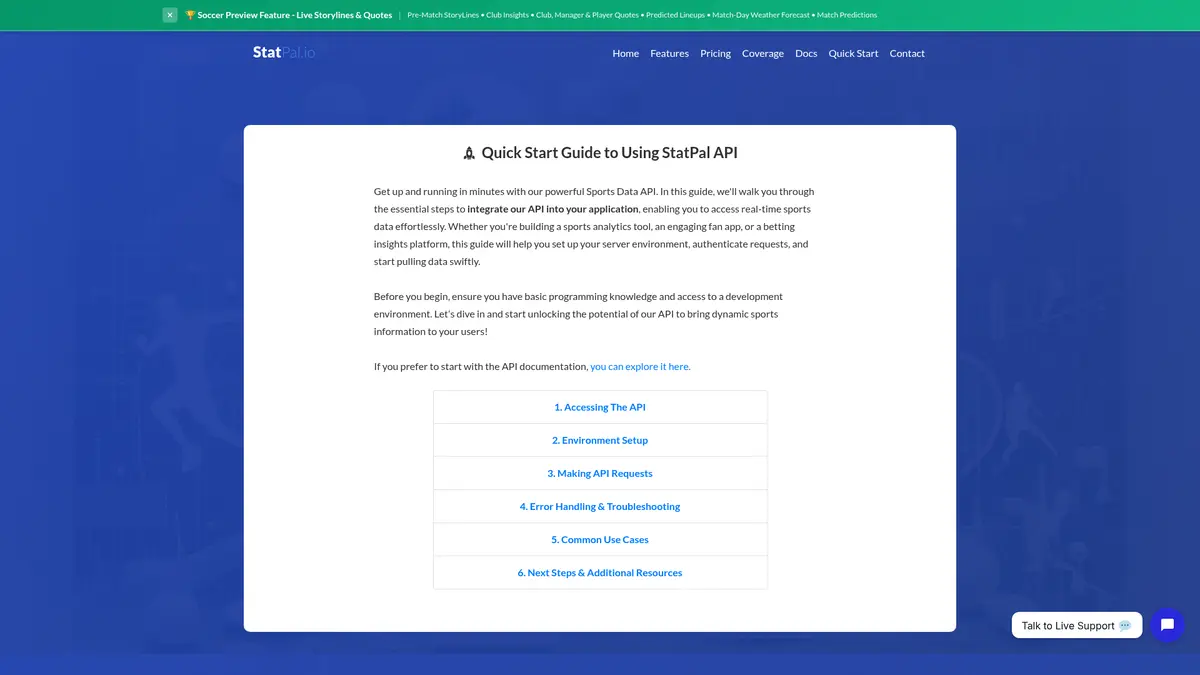
- The guide describes API-key authentication and request examples for server-side clients. [1]
Pros and cons
Pros
- The provider exposes public coverage pages for multiple sports, making early discovery straightforward for teams whose roadmap crosses football, US leagues, cricket or golf. A common vendor account may simplify initial evaluation, as long as the project does not assume that all sport products share identical depth.
- OpenAPI and interactive documentation are useful for inspecting endpoint parameters and generating a candidate client. The quick start provides server-side examples and API-key authentication guidance, giving engineers more to assess than a marketing list of scores and markets.
- The documented API versions are explicit. Knowing that soccer is v2 while other sports use v1 prevents an implementer from silently assuming one versioned schema. That is a practical strength if the team is willing to isolate sport adapters and maintain version-aware tests.
Cons
- A version split across sports can create more maintenance work than the phrase “unified API” suggests. Client code may need separate models, fixtures, pagination and error-handling assumptions for soccer and non-soccer products, and future version migrations should be monitored independently.
- The coverage page is a high-level catalogue and individual categories need direct validation. A league count does not show whether each competition has live updates, full statistics, odds, historical seasons or consistent IDs. Teams should test their target competition rather than plan against the broad list alone.
- The public pages promote self-service access and plans, but the precise current quotas, commercial terms and update expectations remain product-specific. Free or low-friction account creation should not be mistaken for permission to redistribute data or a service-level commitment for a commercial scoreboard.
Provider website screenshots
One supplier, several sport-specific feeds
StatPal positions itself as a multi-sport API and publishes coverage pages for a wide set of categories. For an application that may add another sport over time, a single provider can reduce account sprawl and make evaluation more convenient. Still, the content is best understood as a provider portfolio, not proof that every sport uses the same objects, field depth or update cadence. Compare the target sport’s own coverage and endpoints before choosing a shared internal schema.
The sports listed include soccer, American football, baseball, basketball, hockey, cricket, golf, horse racing and other categories. That variety makes the API a candidate for discovery, but the website’s own pages should be read as advertised product availability. They do not independently confirm competition completeness, historic records or reliable match-by-match delivery. Ask for competition-specific sample responses and confirm the plan entitlement for each required sport.
Sources: [2] StatPal API sports coverage, [1] StatPal API quick-start guide
An important version split
StatPal’s documentation explicitly distinguishes version 2 for soccer from version 1 for other sports. That is valuable information before a team writes a client library: endpoint paths, models, parameter names and error responses may not be identical across versions. Build separate adapters or generated clients where appropriate, and keep contract tests tied to each version rather than assuming the soccer API is representative of the rest of the platform.
The interactive docs and OpenAPI description provide a practical starting point for exploring endpoint shapes. The quick-start guide also describes obtaining an access key and making requests from server environments. Use those artifacts to investigate authentication, IDs, pagination and common errors. A generated client can reduce boilerplate but cannot validate that a competition, field or live state is actually enabled on a chosen subscription.
Sources: [1] StatPal API quick-start guide, [1] StatPal API quick-start guide
Coverage labels do not establish equal depth
The coverage directory points to detailed sport pages, including a soccer section and separate US league, cricket and golf categories. This drill-down is a strength because it encourages buyers to examine individual products. Even so, an aggregate count or list of competition names is not a complete coverage statement. Ask which seasons, statistics, event states and refresh expectations apply to every competition you intend to display, and record gaps where the API offers only basic fixtures or results.
StatPal’s main marketing describes live scores and other data, but our review does not treat “real time” as an independently measured service property. A live feature should ask what “live” means operationally: how changes are published, how often clients should request data, whether there are push mechanisms, and how corrections are delivered. If an API supports odds or news in addition to scores, determine whether those are separate resources, plans or providers.
Sources: [2] StatPal API sports coverage, [1] StatPal API quick-start guide
Self-service access still needs a rights check
The website promotes self-service access and plan information, and the quick-start guide outlines API-key use. That is useful for a developer who wants to inspect a request flow. It does not establish that every free or entry account can support a public commercial application. Ask about quotas, rate limits, plan-specific sports, usage overages and key rotation, then document the environment where credentials are stored.
The legal and editorial questions remain important even for a self-service feed: may the data be cached, retained or redistributed; is attribution required; can a publisher display derived statistics; and are there restrictions for betting-related products? The reviewed public pages do not settle every customer’s license. Confirm the exact subscription and rights before launching a paid or high-traffic service. Do not rely on another customer’s use case as permission for your own.
Sources: [1] StatPal API quick-start guide, [1] StatPal API quick-start guide
A credible broad option, not a coverage shortcut
StatPal’s strongest fit is a developer-led project that values online API documentation and wants to assess more than one sport, while accepting version-specific implementation and a careful coverage review. It is less compelling for a buyer who expects the same rich data model for every sport without separate work. Teams with demanding requirements should compare one league at a time against a specialist and ensure the provider’s actual response supports the intended user interface.
The 7.9 editorial score reflects the visible self-service documentation and product range, offset by the work needed to reconcile sport-specific versions, depth, plans and rights. It is a fit judgment, not a review average or tested performance result. The score should be interpreted in the context of your sport and desired fields: StatPal’s usefulness could be higher for one well-supported category and lower for a category whose coverage is only broadly described.
Sources: [2] StatPal API sports coverage, [1] StatPal API quick-start guide, [1] StatPal API quick-start guide
Frequently asked questions
What is StatPal’s API format?
StatPal describes its service as a REST JSON API and publishes OpenAPI and interactive documentation. The quick-start guide shows key-based requests. Use the docs for each sport to confirm the actual endpoint parameters, response model and plan access.
Sources: [1] StatPal API quick-start guide, [1] StatPal API quick-start guide
Does StatPal use one API version across all sports?
No. Its documentation says soccer uses v2 while other sports use v1. Keep versioned clients or adapters separate and check the current documentation for any changes before deploying across multiple sports.
Sources: [1] StatPal API quick-start guide
Which sports are listed?
The official coverage page includes soccer, American football, baseball, basketball, hockey, golf, cricket, horse racing and other categories. This catalogue is not proof of identical competition or data depth; validate the league and fields you need.
Sources: [2] StatPal API sports coverage
Does the free account include commercial rights?
The existence of self-service or free access does not settle commercial display, storage or redistribution permission. Confirm the current plan, quota, sports, production restrictions and intended use directly in the provider’s terms or subscription agreement.
Sources: [1] StatPal API quick-start guide, [1] StatPal API quick-start guide
Is StatPal’s score based on accuracy or uptime testing?
No. The 7.9 score is an editorial fit assessment based on publicly described API range and documentation. We did not measure accuracy, latency, availability or customer satisfaction, and the provider’s own promotional claims are not independent test results.
Sources: [2] StatPal API sports coverage, [1] StatPal API quick-start guide
How our editorial ratings work
StatPal scores 7.9 out of 10. This is our editorial fit score, not a customer score.
Our scores are subjective website-integration fit assessments based on providers’ publicly described products, not customer-review averages or independent speed, uptime or accuracy tests. We consider publishing usefulness, integration options, documented data scope, access information and clarity of product documentation. A higher score is not a guarantee of suitability. BettorServe is the featured first placement; the remaining list is a curated shortlist, not an exhaustive market ranking.
This is a commercially oriented comparison site. We may earn a commission through eligible partner links, at no extra cost to you. BettorServe is our featured first listing. Commercial relationships and featured placements should be considered alongside the product details, and you should confirm current terms directly with a provider before purchasing.
Sources
Content last reviewed