

Provider review · Sports publishers using feeds, widgets or CMS integrations
Statorium review
Statorium sits between a raw sports API and a ready-to-publish site product. Its official pages describe JSON data feeds, sports widgets, sports news and integrations for WordPress, Joomla and JoomSport. That combination can be valuable for a publisher that wants to put schedules, scores or league tables on an existing CMS without designing every presentation layer from scratch. It also requires a careful comparison of the data subscription, widget function and plugin rights, because those are distinct product layers.
 By Sarah Mitchell
Updated
Our verdict
Editorial integration fit: 8.1/10. Statorium earns a solid score for the range of delivery options and CMS-oriented presentation, especially for publishing teams that value a widget or plugin as much as a raw feed. The score is moderated by league-specific package variation and an official note that data generally starts in 2019. It is not a customer rating or a measurement of feed quality. Buyers should confirm the exact competition, historical range and rights before choosing a plan.
Key facts
- Product types
- Statorium describes JSON sports feeds, widgets, sports news and CMS integrations. [1]
- CMS support
- The provider describes native WordPress/Joomla integration and JoomSport support. [1]
- History
- The official product page says data generally starts from 2019; earlier collection may be requested. [1]
- Access
- Pricing pages describe league subscriptions, trials and custom options; terms vary by package. [2]
Pros and cons
Pros
- The combination of JSON, widgets and CMS plugins gives publishers more than one integration path. A team may choose raw data for a bespoke front end, a widget for a simpler page, or a plugin for a WordPress/Joomla workflow, rather than assume every project must build a complete sports UI.
- The public site organizes products by sports and leagues and documents integration routes. This can help a buyer connect a precise content need to a named competition and a delivery form. It also makes it easier to ask whether pricing is tied to the league, package, software or an enterprise arrangement.
- The provider openly notes that its data history generally begins in 2019 and that earlier material may be custom. That kind of boundary is useful for planning an archive feature, because it signals that historical depth should be verified rather than assumed from the presence of a sports API.
Cons
- The sport and league subscription model can make scope less obvious than a flat all-sport API. A publisher expanding from one league to many should request a full quote and confirm whether statistics, widgets, translations and news are included or separately licensed.
- The 2019 historical starting point may be inadequate for a long-range analytics, retrospective or player-career project. The provider says earlier data can be collected upon request, but that is not a guarantee of availability, completeness, timing or cost. Verify the years and fields needed.
- A widget or CMS plugin can accelerate publishing but may constrain branding, accessibility, layout, caching or integration ownership. A buyer needs to examine what the plugin actually renders and whether the underlying feed can also be used in a custom product under the same terms.
Provider website screenshots

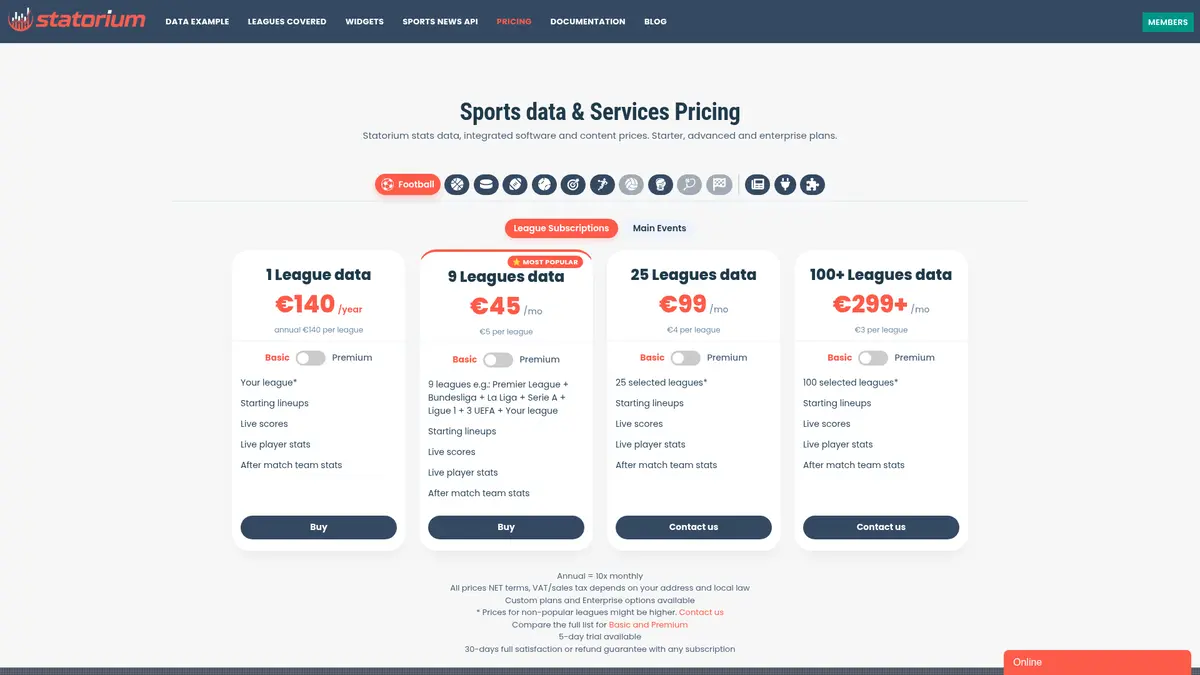
From a raw feed to a CMS-ready display
Statorium promotes JSON sports data feeds, widgets and sports news, alongside CMS integrations. The range matters to a publisher because it spans both information and presentation: API output can be used in a custom score page, while an embed or plugin may reduce the work needed to display a league schedule. Compare these as separate implementation options. A widget may be convenient but not necessarily provide the full raw-data rights or field flexibility required for an analytics product.
The site describes WordPress and Joomla integrations, including JoomSport workflows. A CMS administrator may value importing data into a site database and building views through existing plugin features. Developers should still check update behavior, version compatibility, ownership of imported content and the effect of plugin changes. A native integration is a meaningful product route, but its presence does not prove that every CMS configuration or custom theme is supported.
Sources: [1] Statorium — sports API and integration overview, [2] Statorium sports data and services pricing
Choose the league before the package
Statorium lists a range of sports and sells products around individual leagues and packages. That makes the choice of competition central to both fit and cost. A buyer should identify the exact league, gender, season, player information, statistics and desired publishing output. Confirm whether a non-popular competition incurs different terms, whether selected leagues are bundled, and how a product handles future seasons or competition name changes.
A broad sport list is not evidence of equal coverage in football, basketball, hockey, American football or other categories. Public product pages describe examples and subscription options, but the required detail should be verified on the specific league page or in the provider’s documentation. Ask for current sample responses and a field table, especially if the feature needs player translations, news content or advanced historical statistics.
Sources: [1] Statorium — sports API and integration overview, [2] Statorium sports data and services pricing
Historical and translated data require planning
The official product information says that data generally begins in 2019 and that collection of earlier records may be possible on request. That is a useful but consequential limitation. A site focused on upcoming fixtures may be unaffected; an archive, player-career tool or season-comparison feature may need much older results. Obtain a written list of available years for each league and confirm whether custom collection is feasible before designing a historical data model.
Statorium also distinguishes team-name and player-name translations in its product material, with some language features tied to higher or enterprise arrangements. If the site serves an international audience, the presence of a language option in a widget or API may not mean every entity has translated names. Verify the languages, fields and plan that cover the requested audience; include fallbacks where translated data is absent.
Sources: [1] Statorium — sports API and integration overview, [2] Statorium sports data and services pricing
Trial language is not a universal usage license
The pricing page describes league subscriptions, starter and advanced options, enterprise arrangements and a trial. Those are useful procurement signals, but product entitlements can change and may depend on the sport, league or integration form. Confirm current subscription terms and what is included in a trial before using it as evidence of production readiness. Historical collection, premium fields, widgets and CMS imports may carry distinct commercial boundaries.
Before buying, ask about display rights, storage and caching, attribution, redistribution, traffic limits, support and how a league subscription renews when a season changes. If both a widget and a raw API are required, clarify whether they share a license. The public pricing page is not a negotiated quote for every use case, and no historic directory listing should be treated as today’s price.
Sources: [2] Statorium sports data and services pricing, [1] Statorium — sports API and integration overview
Best for publishing teams that value presentation tools
Statorium is most promising for a publisher that wants sports data alongside widgets or CMS integrations and can match a specific league to a defined plan. It is less straightforward for a buyer whose priority is a very deep archive or a uniform, all-sports developer platform. A modern frontend team may prefer raw JSON; a CMS editor may value an embedded or plugin-driven view. The best path depends on who owns the display and how much customization is needed.
The 8.1 score reflects delivery flexibility and a visible fit with content-management workflows, while accounting for league-level package variation and the history boundary. It does not imply that the feed is more accurate, faster or more reliable than competing services. Make a requirements table for sport, league, season, history, languages and presentation mode, then compare Statorium’s written response against that table.
Sources: [1] Statorium — sports API and integration overview, [2] Statorium sports data and services pricing
Frequently asked questions
Does Statorium provide an API or only widgets?
The official site describes both JSON sports data feeds and sports widgets, along with news and CMS integrations. Confirm whether the specific plan you are considering includes the raw data, presentation component or both.
Sources: [1] Statorium — sports API and integration overview, [2] Statorium sports data and services pricing
Can I integrate Statorium with WordPress or Joomla?
Statorium describes integrations for WordPress and Joomla, including JoomSport workflows. Check the current plugin version, required CMS configuration, data import behavior and whether the integration supports your theme and intended display rights.
Sources: [1] Statorium — sports API and integration overview
How far back does its sports data go?
The provider says its data generally starts from 2019 and that earlier collection may be requested. That does not guarantee any particular league or field has a complete earlier archive, so request a season-by-season range before building history features.
Sources: [1] Statorium — sports API and integration overview
Are all leagues included in one subscription?
The pricing page describes league subscriptions and packages, with coverage and terms varying by product. Ask for a current quote and entitlement list covering each league, data fields, widget or plugin access and any custom historical work.
What does the 8.1 score mean?
It is an editorial website-integration fit score for the documented feeds, widgets and CMS options, moderated by league-level scope and historical boundaries. It is not customer feedback or an independently measured quality rating.
Sources: [1] Statorium — sports API and integration overview, [2] Statorium sports data and services pricing
How our editorial ratings work
Statorium scores 8.1 out of 10. This is our editorial fit score, not a customer score.
Our scores are subjective website-integration fit assessments based on providers’ publicly described products, not customer-review averages or independent speed, uptime or accuracy tests. We consider publishing usefulness, integration options, documented data scope, access information and clarity of product documentation. A higher score is not a guarantee of suitability. BettorServe is the featured first placement; the remaining list is a curated shortlist, not an exhaustive market ranking.
This is a commercially oriented comparison site. We may earn a commission through eligible partner links, at no extra cost to you. BettorServe is our featured first listing. Commercial relationships and featured placements should be considered alongside the product details, and you should confirm current terms directly with a provider before purchasing.
Sources
Content last reviewed