

Provider review · US-focused publishers needing basic scores, schedules and odds
SportsPage Feeds review: US-focused publishers needing basic scores, schedules and odds
SportsPage Feeds focuses on major US professional and college leagues, offering schedules, scores and odds through a compact API. Its docs list endpoints for teams, games, conferences and odds. This may suit a focused scoreboard or market panel, but the reviewed official materials do not establish broad international coverage or deep player analytics.
 By Sarah Mitchell
Updated
Our verdict
SportsPage Feeds receives a 7.5/10 editorial integration-fit score for a focused US sports product with simple documented GET endpoints. It is not a performance or customer score. Odds are not available for every game, some data is tier-gated, and history needs confirmation. The provider routes access through RapidAPI, so platform account terms and credentials are part of the integration.
Key facts
- Product focus
- A compact sports feed for major US professional and college leagues, with score, schedule and odds resources. [1]
- Documented integration
- GET endpoints authenticated through RapidAPI; JSON or XML responses [2]
- Coverage
- NFL, NBA, MLB, NHL, NCAAF and NCAAB, per current product pages [1]
- Current access caveat
- RapidAPI account and tiered usage; verify current quotas and rights [2]
Pros and cons
Pros
- The named US league scope is straightforward to compare with a focused scoreboard or schedule requirement.
- Documentation specifies authentication, response formats, endpoint parameters and pagination behavior.
- The odds product can complement game data when the required match has a supported market and plan.
Cons
- Official public materials establish a limited set of leagues and do not demonstrate extensive international or player-level depth.
- Odds may be absent for a game and require a higher access tier, so they cannot be assumed in every response.
- Historical coverage and retention are not established clearly by the checked official FAQ and documentation.
Provider website screenshots
A concise US sports scope
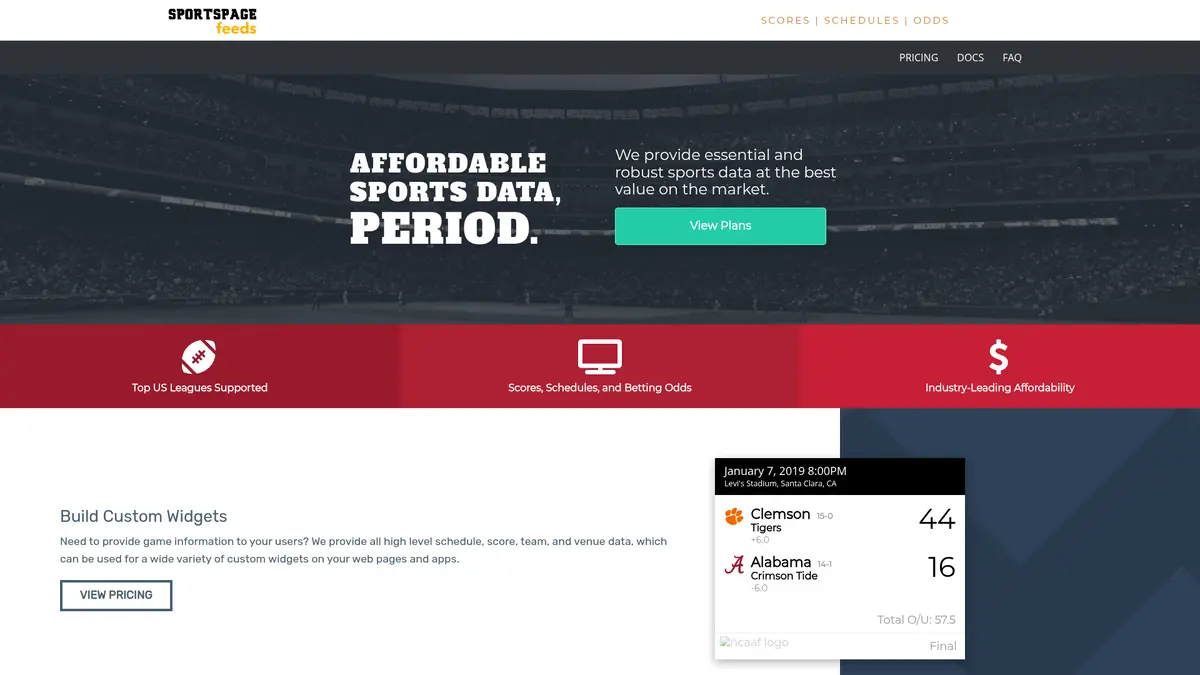
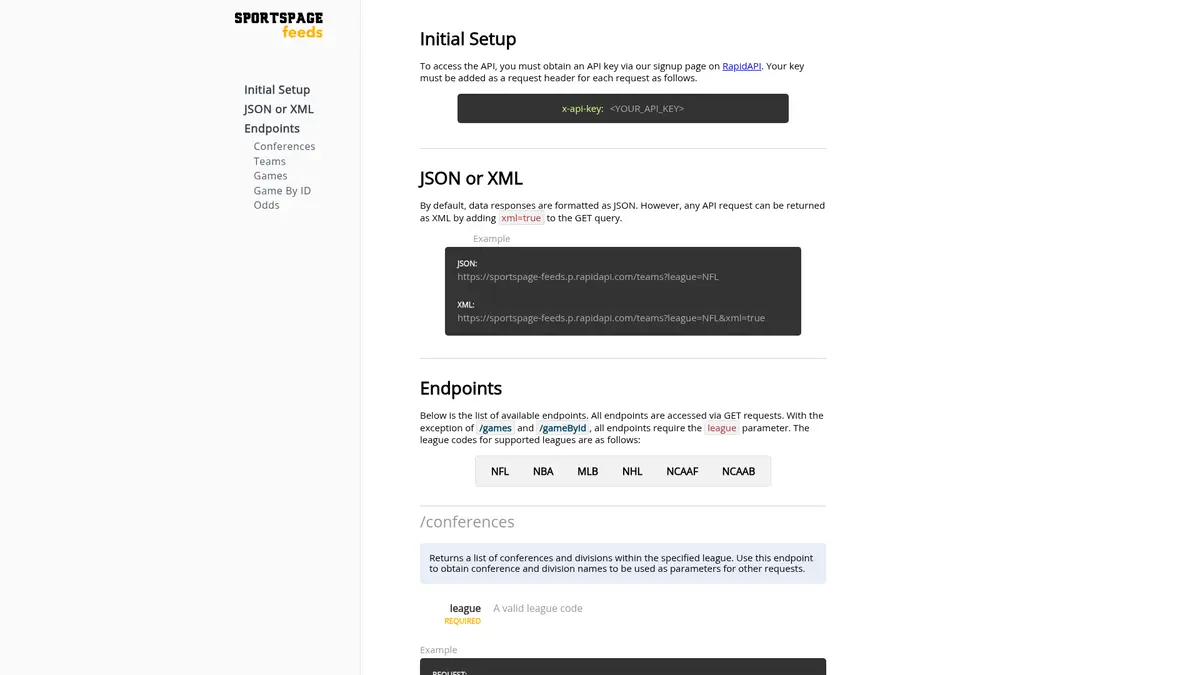
The provider’s site describes core feeds for top US leagues, and its documentation lists NFL, NBA, MLB, NHL, NCAAF and NCAAB categories with teams, schedules, games and odds. That is a useful fit for a product centered on a handful of major American leagues. It is not evidence of a global sports catalogue or full player-statistics platform, so scope should match the named endpoints. [@overview] [@docs]
A developer building a lightweight scoreboard can likely evaluate these records more directly than an enterprise feed with many unrelated sports. The same simplicity may be limiting for a match centre requiring detailed play-by-play, injuries, player performance or extended history; the public pages examined do not establish those capabilities. Ask for a sample of the exact response fields needed rather than inferring depth from the phrase “sports data.” [@docs] [@faq]
Sources: [1] Sportspage Feeds plans and coverage, [2] Sportspage Feeds documentation, [3] Sportspage Feeds FAQ
Odds availability is optional and tiered
SportsPage Feeds lists odds alongside scores and schedules and describes current and opening prices plus movement history in its plans. Its FAQ cautions that odds may not be available for every game, while the documentation restricts the odds endpoint to higher plans. A user interface should therefore treat the odds panel as optional, not convert missing prices into zero or claim that no market exists. [@plans] [@faq]
If odds are central to a product, request a current league-by-league market sample, bookmaker scope, update cadence and historical retention. The product page’s description is not a guarantee that every event has every market or that a specific display is licensed. Consider odds a separate workstream with its own permissions and feature fallback rather than an automatic part of any scoreboard subscription. [@docs] [@plans]
Sources: [1] Sportspage Feeds plans and coverage, [3] Sportspage Feeds FAQ, [2] Sportspage Feeds documentation
RapidAPI access and request handling
The official documentation says users obtain a key through RapidAPI and pass it in an x-api-key header. JSON is the default response, with XML supported by a request option. Most routes require a league parameter; the games and game-by-ID routes are exceptions. This creates a clear entry point for developers already using the marketplace, but the platform account, API host and plan limits are part of the complete integration. [@docs]
The docs specify pagination for larger game results using a skip parameter. Ignoring pagination can produce an incomplete schedule or archive without an obvious failure. Distinguish authorization errors on higher-tier odds routes from genuinely empty data, keep credentials on the backend and check the current RapidAPI plan. These are design implications of the provider’s documented API, not claims that the service has been tested or found unreliable. [@docs]
Sources: [2] Sportspage Feeds documentation
Small-publisher fit and editorial score
The service may fit a small publisher whose required sports align with its six listed categories and whose pages need schedules, scores and basic odds. Its homepage also advertises widgets, which might simplify a standard display, but styling and rights need review. If the product requires detailed college stats, international competitions or long historical archives, ask for explicit documentation before relying on those features. [@overview] [@docs]
The 7.5/10 editorial score reflects a specific US footprint and relatively approachable integration information, offset by uncertain historical depth and restrictions on odds. It is not based on marketplace ratings or measured speed and accuracy. A smaller feed may be preferable if the target site only needs basic results; a broader vendor may be more suitable when the requirements extend beyond these named resources. [@docs] [@plans]
Sources: [1] Sportspage Feeds plans and coverage, [2] Sportspage Feeds documentation, [1] Sportspage Feeds plans and coverage
Validation and commercial questions
Ask for a scheduled and completed match sample in each required league, including the team IDs, venue, final status and relevant odds response. Confirm the available seasons, game history and how postponements or corrections are represented. If your application relies on widgets, check whether their refresh, branding and access conditions match the raw API. This review has not queried an account, so sample testing is a buyer’s next step rather than a claim about response quality. [@docs]
The official pricing page and RapidAPI flow indicate tiered access. Confirm quotas, billing, public display, caching, historical storage and rights for any odds display. For historical data specifically, the public FAQ raises the question but the sources checked do not settle a complete retention window. Do not promise an archive until the provider confirms it. If the scope is adequate, SportsPage Feeds belongs on a shortlist for US-focused data products. [@plans] [@faq]
Sources: [2] Sportspage Feeds documentation, [1] Sportspage Feeds plans and coverage, [3] Sportspage Feeds FAQ
Marketplace access is part of the product decision
Because SportsPage Feeds directs users to RapidAPI for credentials, the project’s access path includes both the provider’s documentation and marketplace account setup. Confirm the active host, authentication header, plan usage, cancellation and support responsibilities in the current account. Marketplace listings can be useful for technical discovery, but user badges or ratings should not be read as independent proof of a provider’s statistical accuracy. [@docs] [@plans]
A US-only scoreboard may not need the odds route or a higher tier. Begin with the essential games and schedules, test the pagination behavior, and add markets only after confirming availability and permission. If college sports, historical seasons or a broader statistics package become central, seek explicit written evidence rather than letting a future roadmap depend on assumptions from a compact endpoint list. [@faq] [@docs]
Sources: [2] Sportspage Feeds documentation, [1] Sportspage Feeds plans and coverage, [3] Sportspage Feeds FAQ
Frequently asked questions
Which leagues does SportsPage Feeds list?
Its official docs name NFL, NBA, MLB, NHL, NCAA football and NCAA basketball. The pages checked do not establish broader international coverage. Verify the particular competitions and seasons needed for your product.
Sources: [2] Sportspage Feeds documentation, [1] Sportspage Feeds plans and coverage
Does it offer betting odds?
Odds are listed, but the provider’s FAQ says they may not be available for every game, and the API docs restrict the odds endpoint to higher access tiers. Ask for current markets and event availability.
Sources: [3] Sportspage Feeds FAQ, [2] Sportspage Feeds documentation
How do I authenticate?
The provider’s documentation says to obtain a key through RapidAPI and send it in the x-api-key header. Keep it on a server and confirm the current API host and account limits.
Sources: [2] Sportspage Feeds documentation
Can responses be XML?
The docs state that JSON is the default format and XML can be requested with an xml option. Game results also use pagination, so test that the integration retrieves all required records.
Sources: [2] Sportspage Feeds documentation
Is there historical coverage?
The official FAQ raises historical-data availability, but the sources checked do not establish a complete archive or retention period. Ask which seasons and game endpoints are included before promising historical results.
Sources: [3] Sportspage Feeds FAQ, [2] Sportspage Feeds documentation
How our editorial ratings work
SportsPage Feeds scores 7.5 out of 10. This is our editorial fit score, not a customer score.
Our scores are subjective website-integration fit assessments based on providers’ publicly described products, not customer-review averages or independent speed, uptime or accuracy tests. We consider publishing usefulness, integration options, documented data scope, access information and clarity of product documentation. A higher score is not a guarantee of suitability. BettorServe is the featured first placement; the remaining list is a curated shortlist, not an exhaustive market ranking.
This is a commercially oriented comparison site. We may earn a commission through eligible partner links, at no extra cost to you. BettorServe is our featured first listing. Commercial relationships and featured placements should be considered alongside the product details, and you should confirm current terms directly with a provider before purchasing.
Sources
Content last reviewed