

Provider review · Sports publishers combining data feeds and hosted score centres
Score24 review: sports data, access and fit
Score24 combines a live-score and statistics proposition with publisher-facing displays such as widgets and ScoreCenter. Its official solutions catalogue lists XML/JSON APIs, fixtures and results, statistics, rankings and hosted options. Product pages use different coverage totals, including a broad sports-feed headline and a larger number on the statistics page, so buyers should treat each number as scoped marketing rather than a reconciled guarantee.
 By Sarah Mitchell
Updated
Our verdict
Our 8.0/10 editorial-fit score reflects the unusual mix of raw feeds and ready-to-display products, which could suit a publisher building a score destination. It is not a customer rating or live-data benchmark. Ask Score24 to reconcile the target product’s coverage, detail and commercial access in writing; the public website establishes product categories more clearly than it establishes package-level entitlements.
Key facts
Pros and cons
Pros
- API, statistics and hosted score products are all visible in the official catalogue.
- XML/JSON delivery is described for feed-oriented use cases.
- Public product pages show how a live-score feed and a statistical API serve distinct needs.
Cons
- Coverage counts vary between official product pages and need product-specific interpretation.
- Public materials do not establish a self-service API key, list price or service-level terms.
- Screenshots of a widget or public score page do not verify feed delivery performance.
Provider website screenshots

More than one way to build a score product
Score24’s catalogue includes raw sports data and statistics APIs alongside widgets, hosted score products and customized solutions. A publisher can therefore compare the effort of consuming feeds and owning the interface with the alternative of embedding a more complete score experience. That range is appealing, but the contract should identify which product actually serves each surface.
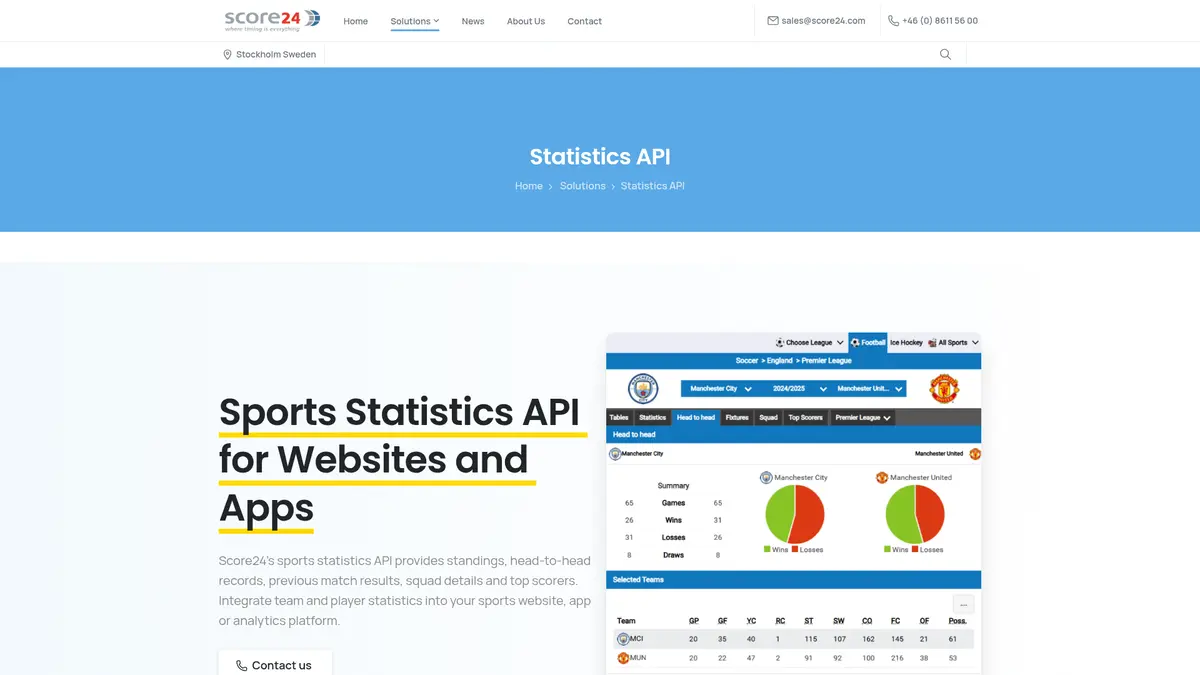
The live feed page describes fixtures, results, livescores and standings through XML/JSON delivery. The statistics API page emphasizes standings, head-to-head records, squad details, top scorers and other historical and current statistics. These are related but not identical jobs; decide whether your feature is mainly an event ticker, an analytical team page, or both.
Sources: [4] Realtime Sports Data Feed – Score24 (official product excerpt), [3] Statistics API – Score24 (official product excerpt)
Coverage totals and the scope problem
Score24’s realtime feed page uses a headline of 60-plus sports and 5,000-plus leagues, while the statistics page promotes 76-plus sports and over 10,000 leagues. These figures may describe different product sets or page revisions; the site does not fully reconcile them. Do not select the larger count and assume it applies to live event feeds, deep statistics and widgets alike.
Ask for a current dated coverage export that distinguishes products and data levels. List the competitions, seasons, live fields, historical ranges and update behavior your application requires. Where a count includes leagues that lack a specific stat, a project can still encounter a coverage gap despite the headline being technically accurate. Check representative low-profile events, not only marquee fixtures.
Sources: [3] Statistics API – Score24 (official product excerpt), [4] Realtime Sports Data Feed – Score24 (official product excerpt)
Feeds, APIs and hosted outputs
The official solutions page lists XML/JSON services and several product types. XML or JSON can fit established ingestion pipelines, but the implementation still depends on authentication, schemas, identifiers, delivery cadence and how corrections propagate. The public materials reviewed do not settle all of those technical details, so obtain the current API documentation before estimating work or promising a release date.
The ScoreCenter and widget offerings are potentially useful for publishers who want a prepared match view. They may also limit control over presentation or require a separate license. Compare the display against your layout, accessibility and privacy requirements. If using a feed, define caching and event-state handling in your own system; if using hosted content, clarify ownership of uptime, branding and analytics.
Sources: [4] Realtime Sports Data Feed – Score24 (official product excerpt), [2] Sports Data Solutions, Livescore, Sports data API, Statistics API
Commercial access and evaluation
Score24’s public site routes buyers toward contact rather than a clearly priced self-service plan. That is not necessarily a drawback for a publisher needing support, but it makes transparent comparisons harder. Request an itemized proposal covering sports, competitions, feed method, test access, rights, support, historic records and any hosted products. No current price is stated in this review because none was verified from the sources.
The official screenshots show product pages and an example feed-oriented experience, not a customer dashboard or a tested API. During evaluation, obtain credentials and compare actual payloads against the required fields. Include competition IDs, event corrections, postponed fixtures, season transitions and how widgets handle unavailable data. A demonstration can show the interface; only a contractual specification and your own acceptance work establish suitability.
Sources: [4] Realtime Sports Data Feed – Score24 (official product excerpt), [3] Statistics API – Score24 (official product excerpt)
Which buyer benefits most?
Score24 is best considered by a publisher that values both data and finished score presentation, and can work through a commercial conversation. A single-purpose app seeking a predictable monthly self-service subscription may prefer providers that publish an explicit trial and price ladder. A high coverage count alone is not a reason to select Score24 if your required leagues or historical fields are missing.
The 8.0 editorial score recognizes useful product breadth while accounting for unclear package boundaries and varying coverage counts. Prepare a fixed checklist before meeting sales, then score the actual response on coverage, data detail, implementation access and rights. Ask the supplier to confirm the figures relevant to your contract and date them; do not assume a homepage headline survives unchanged across product families.
A practical trial matrix should cover several sports if the project is genuinely multi-sport, as well as different event states within each one. Test how fixtures appear before play, how live scores transition to final results and whether a postponed event is removed or annotated. With a hosted product, inspect the same behaviors and measure what your team can customize without provider intervention. The aim is not to judge speed through a one-off browser visit; it is to expose product-scope and integration questions before procurement. Capture the provider’s answers alongside current documentation.
Build redundancy into the product plan if a score centre is central to user retention. Decide how your interface will behave if a vendor feed is late, a competition has no detail or an endpoint returns a temporary error. A fallback to a cached final result may be appropriate for one view but misleading during live play. Ask Score24 what support and incident channels exist, and make the fallback policy explicit in your own design. No uptime promise is inferred from the public product pages.
Sources: [2] Sports Data Solutions, Livescore, Sports data API, Statistics API, [3] Statistics API – Score24 (official product excerpt)
Frequently asked questions
What data does Score24’s real-time feed cover?
The page describes fixtures, results, livescores and standings through XML/JSON delivery. Confirm target competitions, detailed events, updates and historical seasons in the applicable feed specification.
Sources: [4] Realtime Sports Data Feed – Score24 (official product excerpt)
Does Score24 offer a statistics API?
Yes. Its statistics page describes standings, head-to-head records, team and squad details, top scorers and historical/current information. Ask which of those fields are included for each league.
Sources: [3] Statistics API – Score24 (official product excerpt)
Why do Score24 pages show different coverage totals?
The real-time feed and statistics pages use different sport and competition totals. The pages do not fully reconcile the counts, so request a dated product-specific list rather than treating them as interchangeable.
Sources: [3] Statistics API – Score24 (official product excerpt), [4] Realtime Sports Data Feed – Score24 (official product excerpt)
Can I use a Score24 widget instead of raw API data?
The company lists widgets and ScoreCenter alongside data feeds. Check the supported sports, custom styling, rights and whether the hosted display fits your platform before deciding.
Sources: [2] Sports Data Solutions, Livescore, Sports data API, Statistics API
Are API pricing and access self-service?
The official materials reviewed route buyers to contact the company and do not establish a public list price or unrestricted self-service key. Confirm test and production access in writing.
Sources: [2] Sports Data Solutions, Livescore, Sports data API, Statistics API
How our editorial ratings work
Score24 scores 8.0 out of 10. This is our editorial fit score, not a customer score.
Our scores are subjective website-integration fit assessments based on providers’ publicly described products, not customer-review averages or independent speed, uptime or accuracy tests. We consider publishing usefulness, integration options, documented data scope, access information and clarity of product documentation. A higher score is not a guarantee of suitability. BettorServe is the featured first placement; the remaining list is a curated shortlist, not an exhaustive market ranking.
This is a commercially oriented comparison site. We may earn a commission through eligible partner links, at no extra cost to you. BettorServe is our featured first listing. Commercial relationships and featured placements should be considered alongside the product details, and you should confirm current terms directly with a provider before purchasing.
Sources
Content last reviewed