

Provider review · Fantasy and sports products combining US league feeds and analytics
Rolling Insights review: Fantasy and sports products combining US league feeds and analytics
Rolling Insights offers DataFeeds for selected professional, college and international sports, with pre-game, post-game and live tiers. The structure is relevant to fantasy, analytics and scoreboard projects that can specify when they need information, not just which sport. Products and fields vary by league, so the catalogue should be read as a set of separate feed options rather than one unlimited cross-sport entitlement.
 By Sarah Mitchell
Updated
Our verdict
Rolling Insights earns an 8.1/10 editorial fit score for its visible selected-sport catalogue, tier logic and REST/GraphQL documentation. The score is editorial, not customer feedback or measured performance. Trial history limits and sport-specific products make sample validation important; confirm current pricing, seasons and rights before designing around a broader coverage statement.
Key facts
- Product focus
- DataFeeds combines live, pre-game and post-game information for North American leagues and selected other sports. [1]
- Documented integration
- JSON REST API and GraphQL option with token or OAuth authentication [2]
- Coverage
- Selected North American leagues plus Euro soccer, PGA and darts [1]
- Current access caveat
- Sport- and tier-specific access; free trial advertised; confirm commercial terms [2]
Pros and cons
Pros
- The pre-game, post-game and live framing maps well to distinct schedules, recap and live-score use cases.
- Public technical documentation describes REST and GraphQL paths, giving developers alternatives to assess before implementation.
- Coverage includes selected professional, college and non-US sport categories, useful when a project spans more than one audience.
Cons
- Coverage is selected rather than universal, with product depth and pricing differing by sport and tier.
- Trial history is constrained, so an evaluation may not reveal whether older seasons are suitable for the production archive.
- REST query tokens and GraphQL OAuth use different patterns and should be integrated and secured separately.
Provider website screenshots

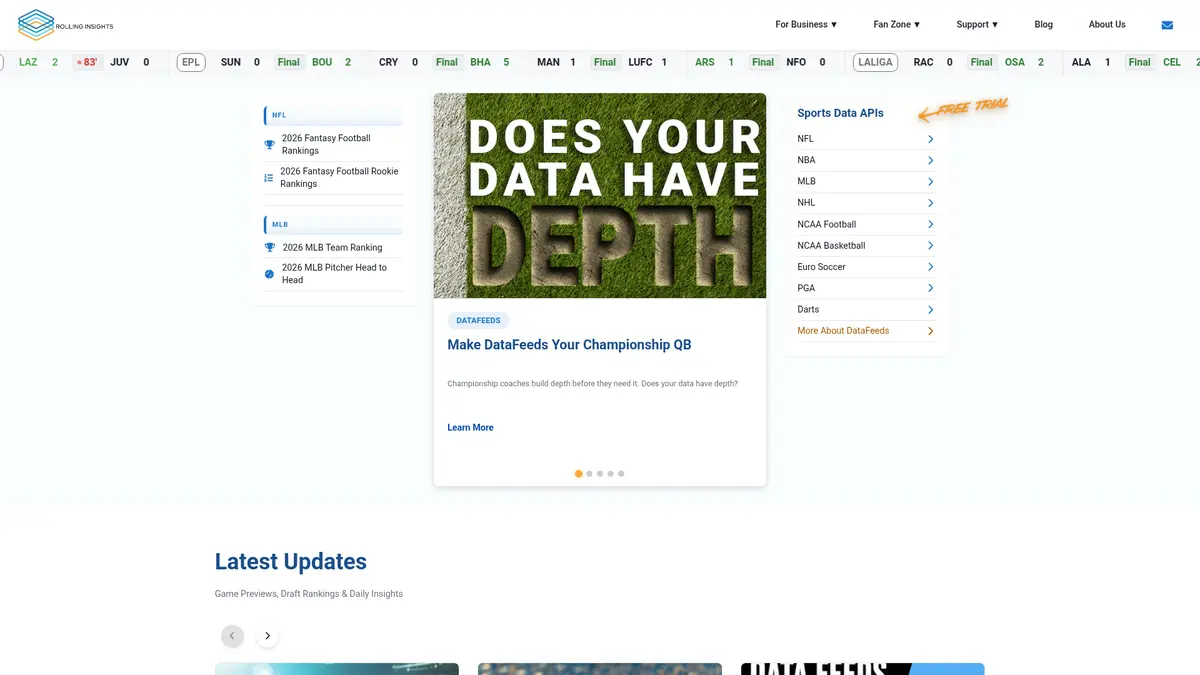
A selected catalogue with meaningful tier distinctions
DataFeeds lists NFL, NBA, MLB, NHL, NCAA football and basketball, Euro soccer, PGA and darts. It frames each sport with pre-game, post-game and live options, separating schedule and team context from final results and live information. That helps a product owner decide what stage of a sporting event the page needs. It does not mean the company supplies one identical data bundle for every sport. [@overview] [@plans]
The service can suit a fantasy or analytics product that combines scores with player or roster context. However, a football developer should not infer the data depth of one sport from another. Match the actual league, endpoint and tier, and request samples for the fields the interface needs. Broad sport names are useful discovery cues, not proof that all competitions and seasons offer the same statistics. [@overview]
Sources: [1] Rolling Insights DataFeeds API catalogue, [3] Rolling Insights DataFeeds plans
Pre-game, post-game and live have different jobs
The plans distinguish pre-game schedules and team/player context, post-game scores and historical game records, and live scores or in-progress information. This is more than naming: a schedule-only page may not need live access, while a fantasy recap may depend on box scores after a game. Select the tier by the workflow and avoid paying for a live product when the site only refreshes after completion. Check each sport’s plan separately. [@plans]
The docs state that trial tokens cannot reach older data beyond the latest two seasons. That matters when a team is evaluating an archive or building a historical model: a trial sample may show a smaller window than production, or the final contract may have its own conditions. Ask how historical access works for the intended plan and which seasons are retained for each league. Also review endpoint-level caveats in the official reference. [@docs]
Sources: [3] Rolling Insights DataFeeds plans, [2] DataFeeds API | Rolling Insights
REST, GraphQL and credential choices
The official documentation describes JSON over a REST API, with a token parameter, and a GraphQL endpoint using OAuth client credentials. REST can be straightforward for fixed product needs, while GraphQL may help a team request related information in a tailored shape. Neither interface automatically reduces cost or development effort. Use current sport-specific documentation to identify supported resources, then select the transport that best matches the application architecture. [@docs]
The REST query token should remain on a backend and be redacted from logs. GraphQL uses a different credential flow and should not be implemented by copying REST examples. The reference also notes field and endpoint limitations, so the consuming application must represent unavailable values. This review did not call either API or assess response timing; developer documentation is evidence of the advertised interface, not independent service-level validation. [@docs]
Sources: [2] DataFeeds API | Rolling Insights
Commercial access and the editorial score
Rolling Insights publishes sport-by-sport plans and advertises trial access, but exact current prices and commercial scope can change. This review does not treat historical directory prices as current. Request a quote specifying league, pre/post/live tier, seasons, request volume, support and rights. A trial can help inspect schemas but may not cover old history, which means it should not be used as proof that the production package will include the same records. [@plans] [@overview]
The 8.1/10 fit score reflects the clearly segmented feed types and useful technical documentation, offset by selected sports and package-level variation. It is not an uptime, latency or accuracy score. The service is worth shortlisting when a target league matches its catalogue and a project benefits from separating pre-game, final and live features. If every league needs custom coverage, that breadth should be tested before the engineering team assumes the vendor can provide one consistent feed. [@overview] [@docs]
Sources: [3] Rolling Insights DataFeeds plans, [1] Rolling Insights DataFeeds API catalogue, [2] DataFeeds API | Rolling Insights
Evaluate a particular league rather than the headline list
For each target sport, request a scheduled game, a completed record and a live sample where the plan permits it. Compare identifiers across schedules, teams, players and game records, and determine how rescheduled or corrected events are expressed. If player statistics or injuries are central, ask whether the selected tier includes them. Use a representative league rather than the most polished example from a provider overview. [@docs]
Clarify caching, historical storage, public display, client redistribution and derived analytics rights. Explain whether your product is a consumer scoreboard, fantasy tool or enterprise data service, because the commercial terms can differ. Then compare the relevant DataFeeds product with a league specialist. A narrower, lower-complexity selection may be more suitable than taking every category; match product scope and rights to the editorial feature you are actually building. [@plans] [@overview]
Sources: [2] DataFeeds API | Rolling Insights, [3] Rolling Insights DataFeeds plans, [1] Rolling Insights DataFeeds API catalogue
How to interpret DataFeeds as a specific product
DataFeeds is the sports feed offering within Rolling Insights, not a claim that every company product, fantasy tool or content page is part of the same API entitlement. Keep the buying conversation focused on DataFeeds endpoints and the leagues listed for the chosen package. The homepage’s broader sports and analytics context may help identify a use case, but it does not replace a product-specific statement of included resources. [@overview]
For a portfolio with multiple league products, compare response schemas and update conventions before assuming that one adapter can serve them all. If an application uses GraphQL for one sport and REST for another, document the distinct credential lifecycle and error handling. A provider’s broad list is most useful after it has been translated into a precise field, season and access matrix. [@docs] [@plans]
Sources: [1] Rolling Insights DataFeeds API catalogue, [2] DataFeeds API | Rolling Insights, [3] Rolling Insights DataFeeds plans
Frequently asked questions
What sports does DataFeeds list?
Rolling Insights lists NFL, NBA, MLB, NHL, NCAA football and basketball, Euro soccer, PGA and darts. Products are sport-specific, so confirm which competitions and fields are available in the relevant tier.
What is the difference between its tiers?
The company groups offerings into pre-game, post-game and live products, with schedules, results, historical and in-progress information varying by sport. Check the exact plan for your league and required data fields.
Sources: [3] Rolling Insights DataFeeds plans
Does Rolling Insights support GraphQL?
Yes. Its official docs describe GraphQL using OAuth client credentials, alongside a REST JSON API using a token. Verify current sport support and security guidance before selecting an integration.
Sources: [2] DataFeeds API | Rolling Insights
Does the trial include deep history?
The documentation says trial tokens cannot reach data older than the latest two seasons. Ask how production plans differ and verify that your required seasons are available.
Sources: [2] DataFeeds API | Rolling Insights
Is this score a measured performance rating?
No. The 8.1/10 score is an editorial integration-fit judgment based on public product descriptions and documentation. It is not a customer average or test of speed, uptime or accuracy.
Sources: [1] Rolling Insights DataFeeds API catalogue, [2] DataFeeds API | Rolling Insights
How our editorial ratings work
Rolling Insights scores 8.1 out of 10. This is our editorial fit score, not a customer score.
Our scores are subjective website-integration fit assessments based on providers’ publicly described products, not customer-review averages or independent speed, uptime or accuracy tests. We consider publishing usefulness, integration options, documented data scope, access information and clarity of product documentation. A higher score is not a guarantee of suitability. BettorServe is the featured first placement; the remaining list is a curated shortlist, not an exhaustive market ranking.
This is a commercially oriented comparison site. We may earn a commission through eligible partner links, at no extra cost to you. BettorServe is our featured first listing. Commercial relationships and featured placements should be considered alongside the product details, and you should confirm current terms directly with a provider before purchasing.
Sources
Content last reviewed