

Provider review · Esports products needing structured fixture, historical and live-game data
PandaScore review: Esports products needing structured fixture, historical and live-game data
PandaScore is a developer-facing esports data provider whose public docs distinguish fixtures, historical statistics and real-time in-game data. This is a useful product map because tournament schedules, completed-match analysis and live game state are different engineering tasks. Its game-specific scope matters: the buyer should evaluate title, competition and plan together instead of assuming one esports endpoint offers identical depth across all games.
 By Sarah Mitchell
Updated
Our verdict
PandaScore earns an 8.7/10 editorial integration-fit score for teams building esports experiences, based on its distinct data categories and accessible developer documentation. The score is an editorial fit assessment, not customer feedback or a hands-on test. Game coverage, latency arrangements, price and permitted use still require direct confirmation, particularly for betting-related products.
Key facts
- Product focus
- Esports APIs split across fixture, historical and real-time match data, with separate odds and commercial products. [1]
- Documented integration
- REST API for fixtures/history and a separate Live API for real-time statistics [2]
- Coverage
- Major esports titles; depth varies by title and plan [1]
- Current access caveat
- Free fixtures tier advertised; deeper plans and betting rights require confirmation [3]
Pros and cons
Pros
- REST, historical and real-time categories are clearly separated in the developer materials, supporting staged product planning.
- The public docs and examples let developers inspect esports-specific resources before relying on a sales-only description.
- A fixture-focused entry option can be considered separately from live and historical data when the use case is narrow.
Cons
- Game and competition coverage must be checked title by title; a general esports catalogue cannot promise equal data depth.
- Standard statistics access is not presented as a substitute for commercial betting access or low-latency arrangements.
- The live data product is separate from REST resources, potentially adding connection and state-management work for an integrated experience.
Provider website screenshots

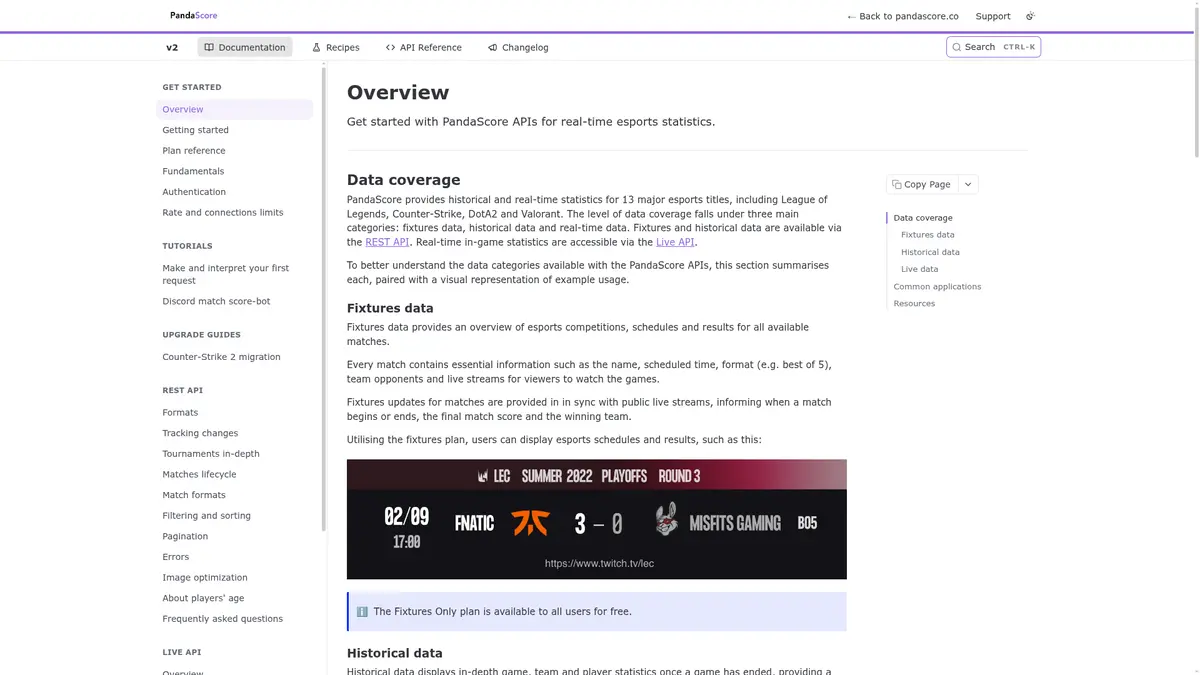
A data model built around esports workflows
PandaScore separates fixture data, historical records and live in-game statistics in its developer documentation. REST resources cover fixtures and post-match information, while its Live API is a separate route to real-time game statistics. This distinction lets a team design from the desired product outward: event discovery, completed-match analysis and live game-state experiences need not be forced into one generic polling model. [@docs]
Esports feeds are title-specific. A tournament page may need match format, team identity and schedule, while an analyst may depend on game-specific player performance after the event. The company names multiple major titles, but that does not demonstrate equivalent fields or historical depth for each one. Build the shortlist around the games and competitions that matter to the audience. [@docs] [@overview]
Sources: [2] Overview - PandaScore Developers, [1] PandaScore official product homepage
Fixtures, history and live data differ
The docs describe fixtures as schedules and results, historical data as post-match information, and live data as in-game statistics. A free fixtures-oriented entry tier is advertised, while historical and live products are separate plan categories. These distinctions are useful for a staged product: launch tournament pages first, then add analysis or live events after verifying access. They are not proof that a free tier includes advanced statistics. [@docs] [@pricing]
“Real-time” should not be converted into an unsupported latency promise. The plan page differentiates ordinary live products from lower-latency arrangements discussed for certain needs. Ask which games, competitions and fields are included, how a live match is sourced, and how soon a scheduled event becomes queryable. One game’s event schema is not a guarantee of equivalent coverage in another. [@pricing]
Sources: [2] Overview - PandaScore Developers, [3] PandaScore plans and pricing
Developer workflow and connection design
PandaScore offers API references, samples and documentation for REST and live resources. A developer can inspect the data categories and examples before deciding how they fit a tournament hub, analytics page or fan experience. The split between REST and the Live API creates more than a URL choice: it can require separate connection lifecycles, event handling and persistence decisions. Use the relevant current reference rather than treating the live resource as just another scheduled REST request. [@docs]
Design the application to distinguish pre-match, live and completed states. Optional fields may be absent before a game starts; historical records may carry a different set of statistics. Preserve event identifiers and provider timestamps so updates can be reconciled. These are prudent implementation questions, not tests performed in this review. The provider’s documentation describes its advertised interface but does not independently establish its accuracy or availability. [@docs]
Sources: [2] Overview - PandaScore Developers
Plan rules and business purpose
The pricing page lists fixture, historical and live categories and states that standard stats plans are not intended for betting products. It directs betting-related buyers to contact sales; lower-latency products are described separately for particular use cases. A developer should disclose whether the product is editorial, fantasy, analytics or wagering before building on an account tier. A free signup should not be mistaken for commercial rights or access to every API. [@pricing]
The score reflects the clarity of a specialist product map and useful developer materials, tempered by game-specific scope and commercial boundaries. It is not a customer-review average, latency benchmark or claim that PandaScore outperforms another vendor. This makes it a strong initial candidate for esports-focused products while leaving plan fit, rights and coverage as procurement questions. [@docs] [@pricing]
Sources: [3] PandaScore plans and pricing, [2] Overview - PandaScore Developers
How to evaluate the data for your game
Ask for a representative event from every required title: one current scheduled match, one active match if available and one completed match. Check how tournaments, stages, series and team or player IDs connect. If the UI depends on maps, rounds or play-by-play, establish whether those fields are included in the selected package and whether their meaning varies by title. A general claim of esports statistics cannot answer these details. [@docs]
Confirm territory, public display, storage, derived analysis and redistribution rights in writing. For betting use, request the proper commercial plan and clarify live timing rather than relying on a standard stats subscription. If the product also needs traditional sports, compare the cost of integrating a specialist esports feed with a multi-sport supplier. PandaScore’s clearest fit is a team whose roadmap is esports-first and whose required titles map to its documented offerings. [@pricing] [@overview]
Sources: [2] Overview - PandaScore Developers, [3] PandaScore plans and pricing, [1] PandaScore official product homepage
Game-specific schema work and portfolio scope
Esports integration often has game-specific concepts—such as a series, map, round or player role—that do not fit neatly into a conventional football-style schema. The documentation’s division between fixture and live information is a useful start, but your team should identify which game-specific fields are required and how the provider identifies a tournament stage. Avoid flattening distinct states into a single generic score record. [@docs]
PandaScore’s focused scope is a strength when esports is central to the product, because the developer materials are oriented to that content rather than incidental coverage. It may add a second integration for a multi-sport website, however. Compare the value of its title-level detail against the operational cost of maintaining a specialist feed alongside traditional sports data, and request the applicable rights for derived analysis or display. [@overview] [@pricing]
Sources: [2] Overview - PandaScore Developers, [1] PandaScore official product homepage, [3] PandaScore plans and pricing
Frequently asked questions
What does PandaScore provide?
Its documentation describes fixture schedules and results, historical match statistics, and real-time in-game data through a separate Live API. The company also offers esports odds, which are a distinct product. Confirm the title and competition that matter to your application.
Sources: [2] Overview - PandaScore Developers, [1] PandaScore official product homepage
Can I use PandaScore for betting?
The pricing page states standard statistics plans are not intended for betting-related products and directs those buyers to sales. Obtain terms for the specific betting use and do not assume a free or standard plan grants sportsbook rights.
Sources: [3] PandaScore plans and pricing
Is there a free PandaScore plan?
The provider advertises a fixtures-oriented free entry plan. That can help explore schedules and results but should not be treated as access to all historical statistics or live game resources. Confirm current access by title.
Sources: [3] PandaScore plans and pricing, [2] Overview - PandaScore Developers
Does PandaScore offer live esports statistics?
The docs identify a separate Live API for real-time in-game statistics, distinct from REST fixture and historical resources. Ask which games and data fields are available in your plan and what delivery model applies.
Sources: [2] Overview - PandaScore Developers
Does coverage have equal depth across games?
The checked public pages do not establish equal field depth across all titles or tournaments. Verify event availability, seasons and the game-specific statistics your product needs before committing.
Sources: [2] Overview - PandaScore Developers, [3] PandaScore plans and pricing
How our editorial ratings work
PandaScore scores 8.7 out of 10. This is our editorial fit score, not a customer score.
Our scores are subjective website-integration fit assessments based on providers’ publicly described products, not customer-review averages or independent speed, uptime or accuracy tests. We consider publishing usefulness, integration options, documented data scope, access information and clarity of product documentation. A higher score is not a guarantee of suitability. BettorServe is the featured first placement; the remaining list is a curated shortlist, not an exhaustive market ranking.
This is a commercially oriented comparison site. We may earn a commission through eligible partner links, at no extra cost to you. BettorServe is our featured first listing. Commercial relationships and featured placements should be considered alongside the product details, and you should confirm current terms directly with a provider before purchasing.
Sources
Content last reviewed