

Provider review · Pre-match odds and result displays
JsonOdds Review: pre-match data and API fit
JsonOdds presents a compact sports-data API rather than an all-purpose live sports platform. Its public material describes REST access to matches, teams, odds and results, and its homepage demonstrates a JSON request and response. Market coverage is centered on familiar pre-match moneyline, point-spread and total data. The most important qualification is explicit: the provider’s FAQ says the service does not support in-play odds. That boundary makes JsonOdds more relevant for pregame comparisons and archives than products promising continuously refreshed live lines.
 By Sarah Mitchell
Updated
Our verdict
JsonOdds earns a 7.6/10 editorial fit for projects that can work with pre-match prices and a compact API proposition. Its example request and public pricing/FAQ pages give a small team useful discovery material, while the named markets map to common scoreboard needs. A narrower market set and no in-play support are substantive constraints. Verify the current source/bookmaker model, supported event set, timing and production terms before treating a sample response as a coverage promise.
Key facts
Pros and cons
Pros
- The official homepage shows a concrete REST request and structured JSON response.
- Pre-match moneyline, spread, totals, matches and results form a clear base for an odds board.
- The FAQ explicitly states an important in-play limitation, while the pricing page makes access tiers discoverable.
Cons
- The provider’s FAQ says it does not support in-play odds.
- The FAQ describes one consolidated odds source, so do not assume independent bookmaker feeds.
- The API documentation page returned 429 during fetch; technical details need direct verification.
Provider website screenshots

A focused pre-match resource
JsonOdds’ homepage describes REST access to matches, teams, odds and results and provides a sample request with an API-key header and a JSON response. The public overview identifies pre-match moneyline, totals and point spreads. This is enough to understand an initial use case: an upcoming-game comparison, a schedule-linked odds table or a results archive. A sample response should still be treated as a starting point, not a complete reference for every sport or event state.
The FAQ draws a clear boundary: the API does not support in-play odds. That makes the product relevant to a pregame comparison but not a service promising live price movement after a match begins. Design explicit states around scheduled, started and completed events; do not leave an old pre-event price displayed as current. If the project requires live markets, request confirmation of a separate current offering or rule JsonOdds out for that specific requirement.
Sources: [1] JsonOdds official API homepage and sample, [2] JsonOdds official frequently asked questions
Markets and source interpretation
The provider names familiar game-level markets—moneyline, point spread and total—which can make an initial display straightforward. Still, market labels require careful mapping: identify home versus away, line versus price, total threshold, team orientation and result status. Ask for representative records for your target competition and exact schema; a sample response does not settle how voids, pushes, postponed games or corrected results are encoded.
JsonOdds’ FAQ describes one white-label odds source consolidated using its own models. Buyers should not infer a separately selectable feed for each bookmaker or assume that each page row is an independently attributed quote. Clarify source attribution, available book-level displays, price freshness and how consolidated values are formed. This distinction is particularly important when a site uses the word “comparison” and readers expect to see multiple named operators.
Sources: [1] JsonOdds official API homepage and sample, [2] JsonOdds official frequently asked questions
REST integration and plan selection
JsonOdds labels its service a REST API and its homepage sample demonstrates a GET request with an API key in a header and a JSON object response. That example helps a developer see how requests begin, but it is not the error catalogue, versioning policy or account-specific quota. Store credentials server-side, centralize requests behind an application service and handle denied credentials, missing events, changing results and incomplete fields explicitly.
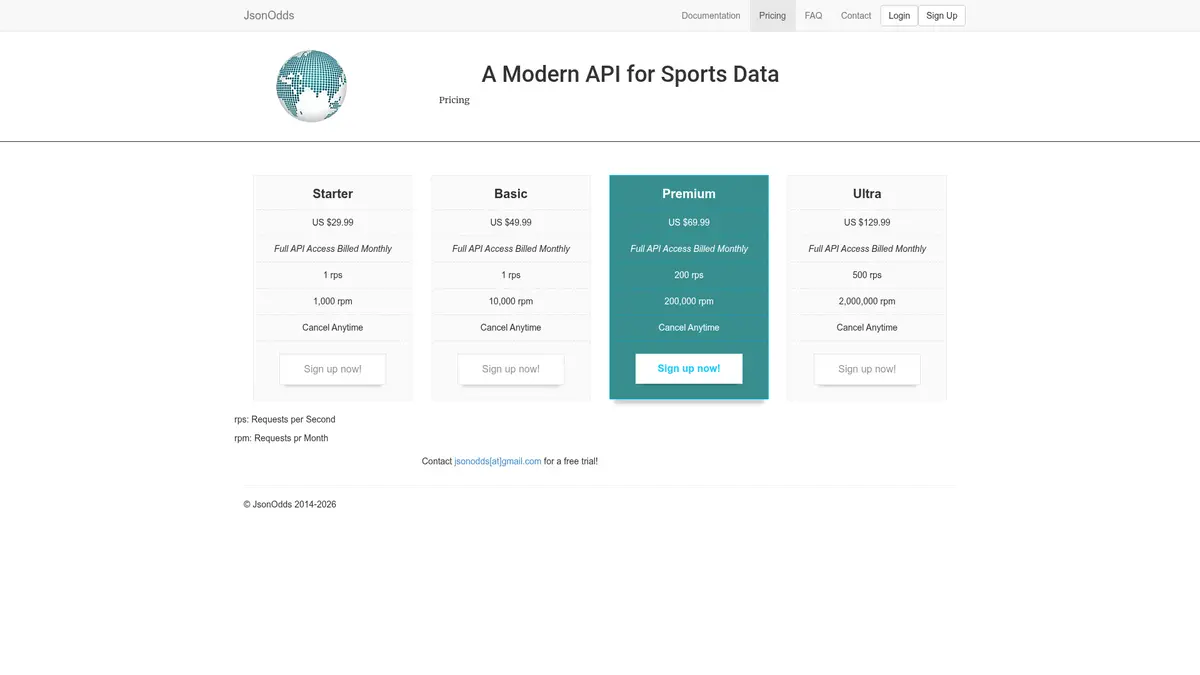
The provider publishes monthly access plans and says a free trial can be requested by email. This review does not quote the visible plan prices as enduring terms. Confirm current rates, request rates, monthly allowances, sport coverage, archive depth, renewal conditions and trial restrictions before budgeting. A low apparent entry plan can be a poor fit if the required event cadence or historical records are outside its limits.
Sources: [1] JsonOdds official API homepage and sample, [3] JsonOdds official pricing page, [2] JsonOdds official frequently asked questions
A clear yes/no use-case boundary
The strongest case for JsonOdds is a pre-event odds board or results workflow that needs a compact set of mainstream game markets and can accept a consolidated source. A requirement for live odds, market breadth beyond those named, player props or granular bookmaker attribution needs separate validation; those capabilities were not established by the official pages checked. Compare a real target sport against other providers using the same event identifiers and timestamp definitions.
The 7.6/10 score reflects a clear narrow use case, visible JSON example and public access information, moderated by the pre-match-only limit and uncertainty around source-level configuration. It is editorial fit, not a speed, accuracy or customer-satisfaction rating. Before implementation, document which events, market families, identifiers, updates, storage periods and display rights your contract covers. The official documentation page was rate-limited in fetching, so use the current reference and direct vendor support to resolve technical specifics.
A comparison page should make the provider’s source model understandable to readers. If the feed represents a consolidated quote rather than a named bookmaker line, label it accordingly and avoid showing sportsbook logos or implying a direct quote without permission. Confirm whether the API returns a timestamp per market, whether results are final or provisional, and how historical values can be retrieved. Those details determine whether the same compact feed works for a live schedule, an archive or a price-movement analysis.
Sources: [1] JsonOdds official API homepage and sample, [2] JsonOdds official frequently asked questions, [3] JsonOdds official pricing page
Frequently asked questions
Does JsonOdds provide in-play odds?
Its official FAQ says no: the API supports pre-match odds only. That makes it unsuitable for a product centered on in-play updates unless the provider separately confirms a new current service in writing.
Which markets does JsonOdds list?
The official overview identifies pre-match moneyline, point spread and totals, alongside matches, teams and results. Confirm sport-specific availability and market naming in current documentation.
Are bookmaker prices shown individually?
The FAQ describes a single white-label source that consolidates data using proprietary models. Do not assume separate book-level feeds or attribution until the provider explains the options for your account.
How can I try JsonOdds?
The FAQ says a free trial can be requested by email. Confirm current eligibility, duration, request limits and permitted uses directly; that statement alone does not define production access.
Sources: [2] JsonOdds official frequently asked questions, [3] JsonOdds official pricing page
How do I call the API?
The homepage demonstrates a REST-style GET request with an API-key header and a JSON response. Use the live reference for current endpoints, authentication requirements, errors and quotas.
How our editorial ratings work
JsonOdds scores 7.6 out of 10. This is our editorial fit score, not a customer score.
Our scores are subjective website-integration fit assessments based on providers’ publicly described products, not customer-review averages or independent speed, uptime or accuracy tests. We consider publishing usefulness, integration options, documented data scope, access information and clarity of product documentation. A higher score is not a guarantee of suitability. BettorServe is the featured first placement; the remaining list is a curated shortlist, not an exhaustive market ranking.
This is a commercially oriented comparison site. We may earn a commission through eligible partner links, at no extra cost to you. BettorServe is our featured first listing. Commercial relationships and featured placements should be considered alongside the product details, and you should confirm current terms directly with a provider before purchasing.
Sources
Content last reviewed