

Provider review · Football and basketball products needing odds, stats or widgets
iSports API review: Football and basketball products needing odds, stats or widgets
iSports API presents football and basketball services alongside data, odds and widget options. That variety makes it relevant to publishers whose plans span both sports or whose interface might benefit from an existing display component. The key buying question is which league, field and product tier applies: the existence of an endpoint is not proof that it is included in every trial or subscription.
 By Sarah Mitchell
Updated
Our verdict
iSports API receives a 7.9/10 editorial website-integration fit score for its two-sport product range and visible documentation. It is moderated by plan-specific scope and a query-string key pattern that needs careful credential handling. The score is not customer feedback, hands-on evaluation or a measured claim about accuracy, latency or uptime. Verify relevant leagues and sample responses before selecting it for a production product.
Key facts
- Product focus
- A two-sport data catalogue covering football and basketball, with separate data, odds and widget products. [1]
- Documented integration
- HTTP API with account API keys documented in request URLs [2]
- Coverage
- Football and basketball; product and league scope vary by plan [1]
- Current access caveat
- Trial and plan-based access advertised; verify feed entitlements [3]
Pros and cons
Pros
- The football and basketball product categories are explicit, making it easier to start a sport-specific scope discussion.
- Documentation includes example request patterns and describes fallback-host guidance, useful details when planning account setup.
- Widgets are presented alongside APIs, giving publishers a choice between custom data-driven pages and prepared presentation.
Cons
- The public catalogue covers two named sports, not a universal multi-sport scope, and plan entitlements need to be resolved separately.
- The documented key-in-URL pattern creates a credential-handling concern that should be reviewed before production use.
- Current commercial detail and the exact league-by-plan matrix require direct confirmation rather than extrapolation from endpoint names.
Provider website screenshots
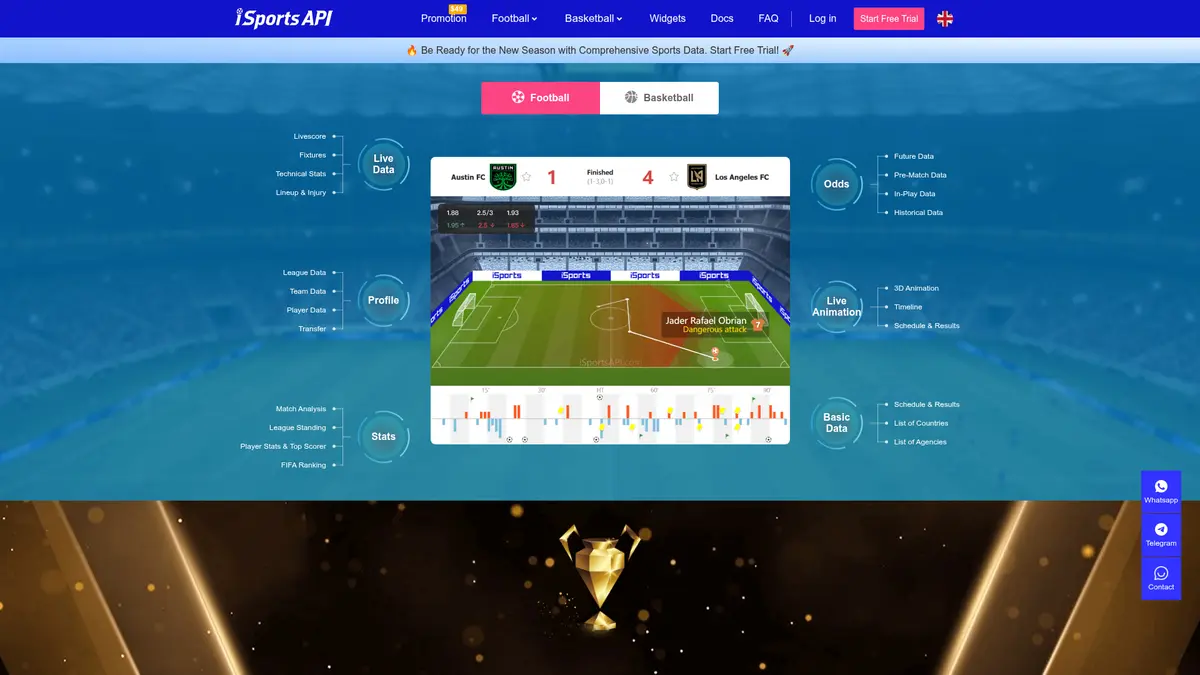

Two sport families, multiple product choices
The public catalogue identifies football and basketball, and presents API resources and widgets for those sports. Its football materials cover live scores, fixtures, lineups, match statistics, odds and historical-oriented information. These categories provide a map for a developer, but the plan determines which routes a particular account can call. A provider may document an endpoint without including it in a free trial or a specific sport package. [@overview] [@docs]
This structure can suit a business that wants to examine both football and basketball with one vendor, or compare an API with a visualisation product. It does not establish deep or uniform coverage across a wide multi-sport catalogue. Scope should be checked independently for each sport: a football plan’s seasons, statistics or odds do not automatically describe what a basketball package supplies. [@overview] [@pricing]
Sources: [1] iSports API official product overview, [2] iSports API developer documentation, [3] iSports API product and plan page
Scores, statistics and odds are different scopes
The developer reference includes football endpoints for schedules, live scores, lineups and technical statistics, while the broader site markets future, live, historical and odds product families. That collection can support a score page and additional match context when the relevant package contains the required fields. A website buyer still needs to verify how well each field is populated for its target leagues and seasons; a generic feature category cannot answer that granular question. [@docs] [@overview]
Treat odds as a separate selection rather than as an automatic byproduct of match statistics. The documentation assigns odds resources to specific plan categories, and neither a company-level product menu nor an example response proves that a target competition has every market required. Ask for current market samples, bookmaker scope and update details, then confirm display rights. A simple fan scoreboard may not need any odds integration at all. [@docs]
Sources: [2] iSports API developer documentation, [1] iSports API official product overview
Setup, endpoints and a credential caveat
The official getting-started guide asks users to register, begin a trial or subscribe, retrieve a personal API key and add it to requests. It shows standard and alternate API hostnames, advising the latter when the main host cannot be accessed or seems slow. That is provider-authored operational guidance—not a benchmark. A developer should use the current route for each resource and ask support how host selection should work in a production integration. [@docs]
The key-in-URL approach makes server-side requests especially important. Do not put credentials in browser scripts, public repositories, analytics events or unredacted logs. If using a widget, determine whether it exposes credentials or embeds data through a managed service. Test a scheduled, live and completed event using the intended plan; this review has not made authenticated requests or measured response quality. [@docs] [@overview]
Sources: [2] iSports API developer documentation, [1] iSports API official product overview
Access model and editorial assessment
The site promotes trial access and the documentation names plan categories such as live data, statistics and odds. A concise public summary does not settle every entitlement, current limit or commercial right. Ask for current terms by sport and competition, trial restrictions, request limits and the conditions for public display. Historical prices in a third-party directory should not be repeated as if they were current offers. [@pricing] [@docs]
The editorial score of 7.9/10 reflects a useful two-sport menu and a developer guide with concrete requests, along with a widget option. It is not a rating from customers or an assessment of measured feed performance. It is tempered by the work required to reconcile separate sport and data packages, and by credential exposure risks in query-based authentication. [@overview] [@docs]
Sources: [3] iSports API product and plan page, [2] iSports API developer documentation, [1] iSports API official product overview
Buyer checks before selecting a plan
Prepare a list of competitions, seasons, statistics, languages and expected refresh patterns for both sports if both are in scope. Ask for representative scheduled, live and completed records, including an event from a less prominent league. Clarify how corrected results and missing optional fields are represented. This sample-based approach is more informative than assuming a broad product category guarantees identical records everywhere. [@docs]
Separate rights questions for public display, long-term storage, odds and artwork. Confirm whether your project is a public information site, commercial app or betting-related experience, and request an answer for that intended use. If the integration fits, select only the plans needed for the identified resources. If not, compare a football-focused service or a broader multi-sport provider whose exact API scope aligns more closely with the project. [@overview] [@pricing]
Sources: [2] iSports API developer documentation, [1] iSports API official product overview, [3] iSports API product and plan page
Two-sport selection without assuming one uniform package
A publisher using both football and basketball may be able to consolidate supplier discussions, but the fact that one company sells two sport families does not guarantee identical identifiers, statistics or access conditions between them. Design the internal data model around a canonical match or game abstraction while preserving sport-specific fields and event semantics. Ask whether a widget uses the same entitlement as its underlying API data. [@overview] [@docs]
When the project is only a football site, basketball availability is not automatically an advantage: evaluate the football plan on its own requirements and compare it with a football specialist. When both sports are required, test them independently using scheduled, active and completed samples. This avoids an appealing vendor-level catalogue obscuring a mismatch in the actual resources your application must deliver. [@overview] [@pricing]
Sources: [1] iSports API official product overview, [2] iSports API developer documentation, [3] iSports API product and plan page
Frequently asked questions
What sports does iSports API cover?
The official pages list football and basketball products along with widgets. They do not establish an unlimited multi-sport subscription. Verify the exact sport and competition before planning a shared interface or data model.
Sources: [1] iSports API official product overview, [3] iSports API product and plan page
Does it offer football odds?
The documentation includes football odds resources under specific plan categories. Availability under an account and the markets returned for a particular event should be checked directly. An odds endpoint does not imply that every bookmaker or market is covered.
How does authentication work?
The getting-started page documents a personal key added to the request URL, plus an alternate host when the primary one is inaccessible or slow. Keep the credential on a server and ask about safe production practices.
Is iSports API free?
The public site advertises trial access and the documentation describes trial or subscription onboarding. Current package scope and commercial conditions should be checked directly. Historical third-party directory pricing is not a current provider quote.
Sources: [1] iSports API official product overview, [2] iSports API developer documentation
Do widgets remove the need for development?
Widgets are listed as an option, but publishers still need to assess styling, responsiveness, accessibility, account requirements and display rights. A widget may reduce interface work, but it does not confirm coverage for every data or licensing requirement.
How our editorial ratings work
iSports API scores 7.9 out of 10. This is our editorial fit score, not a customer score.
Our scores are subjective website-integration fit assessments based on providers’ publicly described products, not customer-review averages or independent speed, uptime or accuracy tests. We consider publishing usefulness, integration options, documented data scope, access information and clarity of product documentation. A higher score is not a guarantee of suitability. BettorServe is the featured first placement; the remaining list is a curated shortlist, not an exhaustive market ranking.
This is a commercially oriented comparison site. We may earn a commission through eligible partner links, at no extra cost to you. BettorServe is our featured first listing. Commercial relationships and featured placements should be considered alongside the product details, and you should confirm current terms directly with a provider before purchasing.
Sources
Content last reviewed