

Provider review · Football stats and prediction-oriented data applications
FootyStats review: API features, coverage & fit
FootyStats is a football statistics product with an API oriented toward league, team, match and goal-market analysis rather than simply showing final scores. Its documentation names resources for league lists, country lists, match schedules and statistics, teams, players, tables and measures such as both-teams-to-score and over/under results. The provider also presents a test path and package comparison. For an analytics-oriented football site, this can be a useful source shape; it should not be mistaken for proof that the API delivers every market, league or real-time requirement.
 By Sarah Mitchell
Updated
Our verdict
FootyStats is a worthwhile candidate when football statistics, team trends and match-level context matter more than a generic multi-sport feed. Its endpoint taxonomy and emphasis on JSON statistics can help power comparison tables, team pages and pre-match analysis. The public documentation notes periodic database maintenance, which is a reminder to ask about freshness and time-sensitive uses rather than assume every value is instantaneous. Our 8.2/10 score measures editorial integration fit based on that product focus and documentation, not customer feedback, predictive accuracy or data testing. Confirm the package’s league set, refresh expectations and permitted commercial use before building forecasts around it.
Key facts
- Primary sport
- Football/soccer statistics API in JSON format [2]
- Data areas
- League, team, match, player, referee, standings and goal-market endpoints [2]
- Maintenance
- Provider describes database maintenance on an approximately daily-to-weekly basis [2]
- Trial
- Free testing of endpoints and subscription packages advertised [3]
Pros and cons
Pros
- The docs describe distinct endpoints for leagues, matches, teams, players, tables, referees and specific statistical measures.
- JSON delivery and free endpoint testing are advertised, helping developers inspect the response shape before subscribing.
- The API is operated by the FootyStats team and the documentation discusses ongoing database maintenance.
Cons
- The stated database maintenance interval is daily-to-weekly, so a product needing second-by-second live scoring should verify that this is appropriate.
- League selection, package size and request limits vary across tiers; the total cost cannot be inferred from one feature list.
- Statistics and prediction-oriented coverage are provider descriptions, not independent validation that derived metrics improve decisions.
Provider website screenshots
A statistics-led rather than score-only proposition
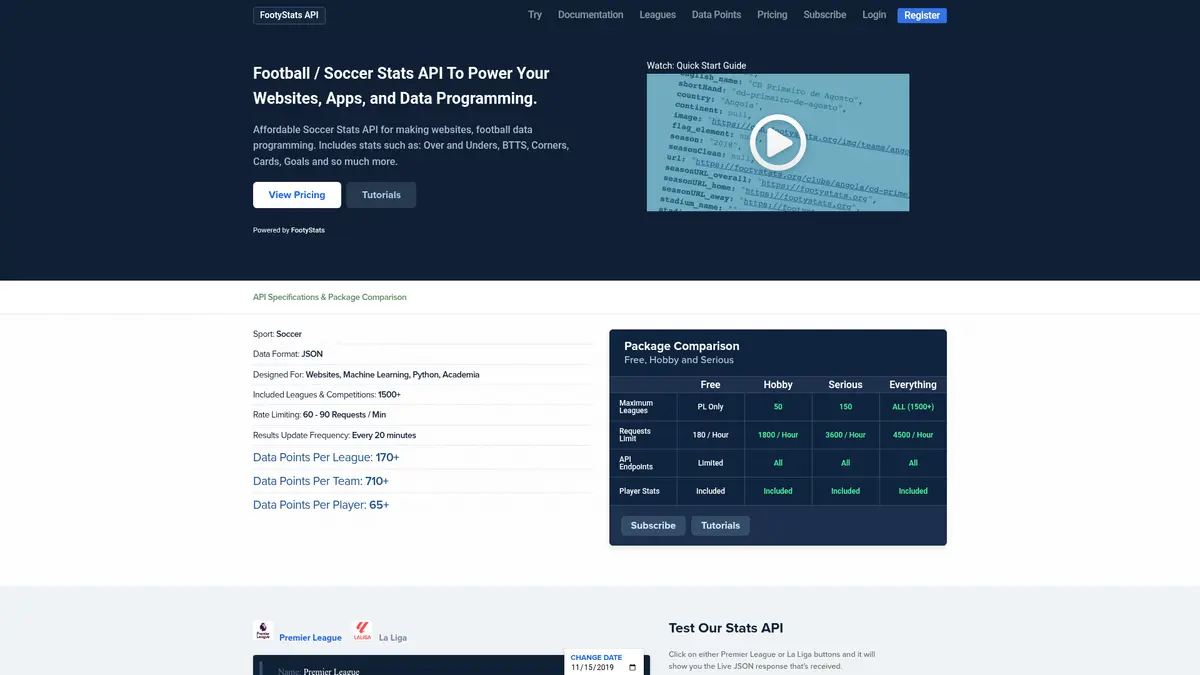
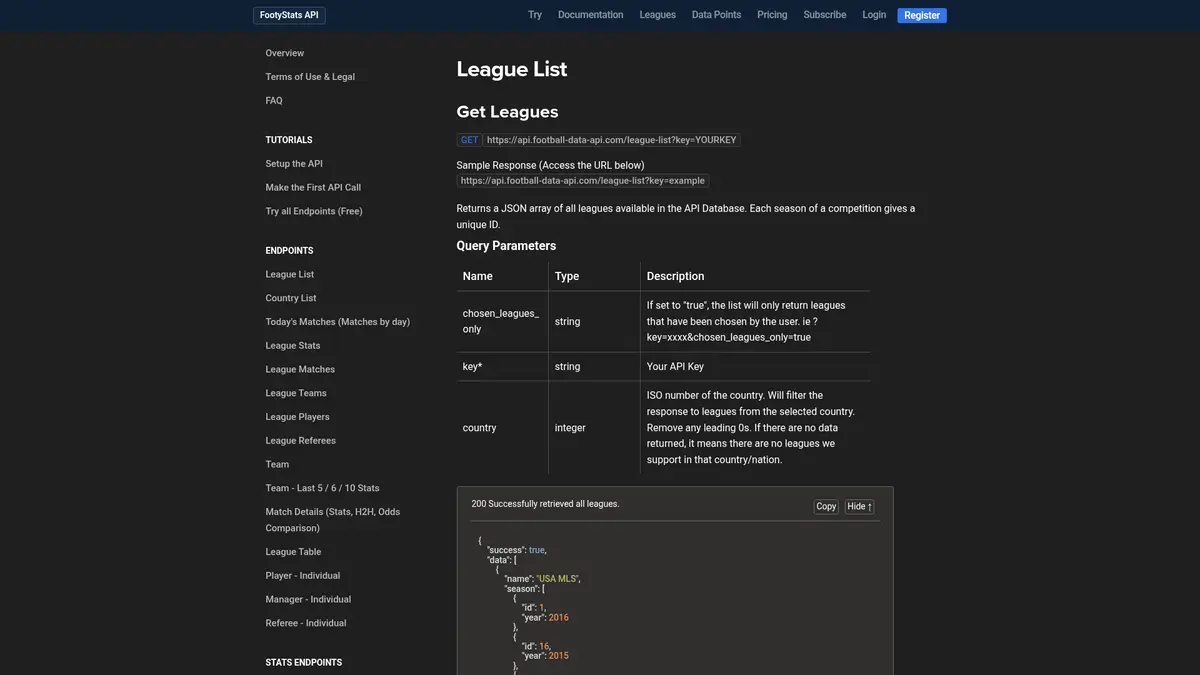
FootyStats describes its API around football statistics such as goals, corners, cards, over/under outcomes and both-teams-to-score rates. The documentation groups endpoints by leagues, countries, match schedules and stats, team and player details, referees and standings. That makes the service potentially useful for a data-rich page that compares form, league patterns or upcoming fixtures with statistical context. It is not merely a calendar feed, but its focus does not establish that it replaces every live scoring or play-by-play service.
The value of statistics depends on definitions and time windows. Before using a percentage or average in a public product, identify its sample period, population, competition context and update date. Ask whether the field is raw observed data or a derived metric and whether historical values are recalculated after corrections. For a betting-adjacent use, explain uncertainty and avoid presenting historical percentages as a guarantee of future outcomes. The API endpoint catalogue tells you what kinds of measures are available, not whether they are predictive or decision-grade.
Sources: [1] FootyStats official league-list endpoint reference, [2] FootyStats API documentation overview and endpoint catalogue, [3] FootyStats API product and package page (official search snippet, not full verification)
Endpoint organization can map to real editorial pages
The official docs provide a useful sequence from setup and first request into endpoint-specific references. The listed resources support an application structure: league pages can use season statistics and tables; team profiles can use form and roster information; match pages can use schedules and detail endpoints; and player or referee pages can focus on individual records. The provider also advertises a way to test endpoints, which can help a developer inspect sample output before designing a schema.
An implementation still needs more than a successful request. Compare the API’s response fields for league and match records, check season identifiers, handle missing values and decide how to cache summaries. Be precise about whether a field is updated during a match or only after a database refresh. If the site publishes both schedule information and analytical metrics, store observation time with the response so the UI does not imply that a week-old statistic is live. The official docs are a product reference; they do not measure actual update delivery.
Sources: [1] FootyStats official league-list endpoint reference, [2] FootyStats API documentation overview and endpoint catalogue, [3] FootyStats API product and package page (official search snippet, not full verification)
Package coverage and refresh timing need attention
FootyStats pages describe competition selection by package and provide a comparison of tiers. That can help the buyer align a plan to a focused league list rather than paying by assumption for a broad headline. Check whether each package includes all required leagues, seasons and endpoint families, and whether high-value stats are gated separately. Include per-minute or daily request ceilings and ask what happens when the allowance is reached. A product with extensive data points can still be unsuitable if its plan omits your core league.
The documentation says the database is maintained on a daily-to-weekly basis, with new features and data points added over time. That statement is important for deciding use. A daily or weekly maintenance cycle may be entirely adequate for a pre-match analysis page or an archive, but it should not be treated as evidence of second-by-second score updates. If the product needs in-play use, confirm the actual update intervals and available live endpoints in writing. Do not label cached metrics “live” just because the match is currently underway.
Sources: [1] FootyStats official league-list endpoint reference, [2] FootyStats API documentation overview and endpoint catalogue, [3] FootyStats API product and package page (official search snippet, not full verification)
Use the data with clear statistical framing
FootyStats may suit a football website that wants comparative stats and team or league context without building a statistical collection system from scratch. Its JSON interface and statistical endpoint families make it easier to plan content around specific resources. The provider’s commercial package and a visible free test path may support an evaluation sequence: choose a league, inspect examples, estimate traffic and then decide whether the paid package covers publication. That is a product fit argument, not a claim about independent data quality.
Before launch, confirm display rights, attribution rules, caching, historical retention, territory and any restrictions on betting-related content. Ask how the provider defines its formulas, when historical records are adjusted and how incomplete leagues are handled. If the site makes predictions, label them as editorial analysis rather than certainty. Our score gives credit to a clear football-statistics focus and public endpoint docs, but stays below the top because package-specific coverage and update expectations require direct validation and the current sources do not establish predictive accuracy.
Sources: [1] FootyStats official league-list endpoint reference, [2] FootyStats API documentation overview and endpoint catalogue, [3] FootyStats API product and package page (official search snippet, not full verification)
Frequently asked questions
What makes FootyStats different from a basic football score API?
The provider emphasizes statistical data such as goals, corners, cards, over/under and both-teams-to-score measures, with league, team and match endpoints. It can support analytical pages, but should not automatically be treated as a live play-by-play service.
Sources: [2] FootyStats API documentation overview and endpoint catalogue
Does FootyStats API provide live scores?
Its public materials include match schedules and statistics, but the reviewed documentation describes database maintenance as daily-to-weekly. Confirm actual live-score endpoints and update cadence for your intended competitions before building an in-play display.
Sources: [2] FootyStats API documentation overview and endpoint catalogue
Can I test the FootyStats API before subscribing?
The site advertises free endpoint testing and provides setup and first-call guides. Confirm which endpoints and limits are available for testing and whether the resulting access permits production or commercial publication.
Sources: [1] FootyStats official league-list endpoint reference, [2] FootyStats API documentation overview and endpoint catalogue
Are prediction metrics proven to improve betting decisions?
No. The documentation describes statistics and prediction-oriented use, but it does not provide independent evidence that metrics predict outcomes or improve decisions. Treat any derived numbers as descriptive inputs and communicate their limits.
Sources: [2] FootyStats API documentation overview and endpoint catalogue
Does every plan cover every league?
The official page presents package comparisons and league selection. Confirm your leagues, seasons, endpoints and request limits in the current plan before relying on a particular package.
Sources: [1] FootyStats official league-list endpoint reference
How our editorial ratings work
FootyStats scores 8.2 out of 10. This is our editorial fit score, not a customer score.
Our scores are subjective website-integration fit assessments based on providers’ publicly described products, not customer-review averages or independent speed, uptime or accuracy tests. We consider publishing usefulness, integration options, documented data scope, access information and clarity of product documentation. A higher score is not a guarantee of suitability. BettorServe is the featured first placement; the remaining list is a curated shortlist, not an exhaustive market ranking.
This is a commercially oriented comparison site. We may earn a commission through eligible partner links, at no extra cost to you. BettorServe is our featured first listing. Commercial relationships and featured placements should be considered alongside the product details, and you should confirm current terms directly with a provider before purchasing.
Sources
Content last reviewed