

Provider review · Football publishers needing injury, lineup and transfer context
Football Feeds review: Football publishers needing injury, lineup and transfer context
Football Feeds is a specialist football-information service whose public catalogue centers on injuries, absences, lineups and transfer activity. It is therefore better understood as a contextual feed for publishers than as a universal scores API. Its endpoint reference offers useful integration detail, but a buyer should map each desired field and competition to an actual subscription before planning a match product.
 By Sarah Mitchell
Updated
Our verdict
Football Feeds earns a 7.8/10 editorial integration-fit score for publishers needing squad and transfer context. Its feed categories are specific and its documentation describes incremental synchronization, but access windows and subscription boundaries matter. This is not customer feedback, direct product testing or a measured assessment of accuracy, uptime or latency. Use it to fill a defined content gap, not by default as the sole source for a live match centre.
Key facts
- Product focus
- A football-specialist feed for editorial context such as absences, injuries, lineups and transfer activity. [1]
- Documented integration
- Pull API with JSON or XML; documented API key in request query [2]
- Coverage
- Football competitions; availability varies by feed and subscription [1]
- Current access caveat
- Feed and subscription access varies; request current terms [2]
Pros and cons
Pros
- The feed catalogue targets useful newsroom gaps—availability, lineups and transfers—rather than presenting a generic score endpoint as its only differentiator.
- The API reference explains incremental synchronization and configuration feeds, giving developers more to work with than a bare list of feed labels.
- JSON and XML options may accommodate existing newsroom or publisher pipelines when those formats are required.
Cons
- Its short, non-extendable feed windows may not suit a project that needs a long-lived injury, lineup or transfer archive.
- The published product focus is contextual football data, so a broad match centre may need another provider for core scores and events.
- Query-string authentication and subscription-specific feed access should be checked against security practices and current commercial terms.
Provider website screenshots
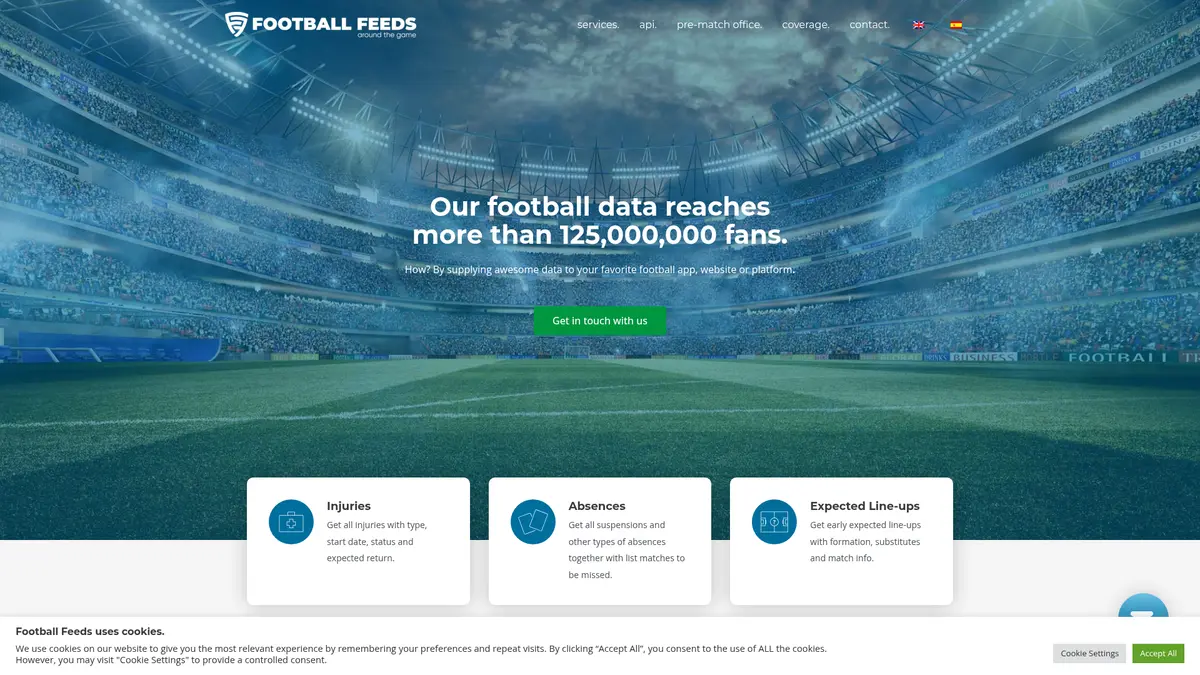

A football data supplement, not the whole match centre
The homepage emphasizes injuries, suspensions, other absences, expected and official lineups, transfer rumours and confirmed moves. These records add context to team news and match previews: they help explain a squad decision or a recent transfer rather than simply rendering a score. The documentation also lists match, player, team and competition resources, but endpoint names alone do not establish complete event-by-event score coverage. [@overview] [@docs]
The editorial fit is strongest when a publisher already has fixtures and results elsewhere and wants a structured source for squad availability or transfer reporting. A product whose core requirement is live match events, deep player statistics, standings or bookmaker markets should ask for samples before treating this catalogue as sufficient. Its differentiation is a focused set of football information categories, not an independently verified claim of universal coverage. [@overview] [@coverage]
Sources: [1] Football Feeds – Around the game, [2] FootballFeeds API, [3] Coverage – Football Feeds
Availability windows and competition coverage
The API docs describe availability windows that differ by feed. Injuries and absences are tied to a short current and post-event period; transfer rumours and official moves focus on recent reports or updates; lineups are associated with the period before kickoff. The docs say those windows cannot be extended. This has practical implications for an archive: timely material may not remain queryable long enough to support long-range research or retrospective features. Confirm retention for each endpoint. [@docs]
The coverage page describes popular competitions and invites requests for additional ones, rather than proving that every league has the same feeds. Ask for a matrix organized by competition, season and endpoint, and include a less prominent league in your evaluation. A missing lineup should render as unavailable, not as an empty squad or a claim that the team has not named players. That distinction preserves editorial accuracy when coverage is partial. [@coverage] [@docs]
Sources: [2] FootballFeeds API, [3] Coverage – Football Feeds
Pull integration and query-key considerations
Football Feeds documents a pull API with JSON and XML formats. Its recommended synchronization pattern starts with a full import, uses configuration resources to interpret the provider’s values and then applies incremental updates using an update-time parameter. This is a useful design guide for a newsroom pipeline: synchronize the baseline once, preserve stable identifiers and refresh changed records rather than repeatedly importing every feed without a plan. [@docs]
The examples put the API key in a query parameter. Keep calls on a trusted backend and redact request URLs from logs, analytics and error traces, because query strings can be copied or retained inadvertently. The docs also note that main-feed names are in English, even though configuration data includes translations. That makes localization a project-level mapping task rather than something to assume is complete in the feed. [@docs]
Sources: [2] FootballFeeds API
Access model and editorial score
The service’s public pages invite contact and describe feed-specific subscriptions, while the reference states that clients may have access to all or only a subset of feeds. That lets a buyer discuss an exact product brief, but the public materials do not make every commercial entitlement self-evident. Ask for a dated proposal specifying endpoints, competitions, request terms, display rights and record retention. Do not repeat a historical directory price as a current rate. [@overview] [@docs]
The score reflects a differentiated football content layer and practical documentation, offset by the need to pair it with a core scores source for many websites. It is an editorial fit judgment, not a customer review average or a test of service quality. The distinction matters: a provider’s own pages support the description of its advertised offer, not a claim that every injury or lineup is complete or arrives on a particular schedule. [@overview] [@docs]
Sources: [1] Football Feeds – Around the game, [2] FootballFeeds API
Questions to resolve before a launch
Request examples for a current lineup, a changed injury status and a transfer that moves from rumour to confirmed. Check stable identifiers, timestamps, correction behavior and whether updates are full snapshots or partial changes. The sync guidance helps plan import frequency but does not answer every downstream reconciliation question. A small representative sample can clarify whether the feed fits the publishing workflow more effectively than a broad feature list. [@docs]
Obtain written terms for public editorial display, historical storage, derived records and any redistribution. Ask whether a header credential is supported and how support handles missing data during a major match window. If the main requirement is live match action, shortlist a broader football API as well. Football Feeds makes the most sense when squad news or transfer context is the requirement that existing sources fail to cover. [@overview] [@coverage]
Sources: [2] FootballFeeds API, [1] Football Feeds – Around the game, [3] Coverage – Football Feeds
Language, corrections and downstream record design
The documentation says that main-feed names are English, although configuration resources provide translation support. A multilingual publisher should treat this as a mapping requirement and test how club, player and competition names fit its house style. It should also decide how a transfer rumour is revised if the report changes or a later official confirmation arrives; consumers need an editorial state model rather than a flat list of updates. [@docs]
A practical import should preserve original source identifiers and timestamps, record when your own system observed an update, and distinguish a changed record from a new report. These steps help an editor audit a claim without overstating certainty. The provider’s documentation offers a basis for synchronization, but the actual schema and correction behavior should be confirmed with a production sample and current support guidance. [@docs]
Sources: [2] FootballFeeds API
Frequently asked questions
Does Football Feeds provide a general live-score API?
The documentation lists match-related resources, but the public product pages emphasize injuries, absences, lineups and transfers. They do not establish that the service is a complete substitute for a broad live event feed. Request the specific score endpoint and sample response needed for your application before making that assumption.
Sources: [1] Football Feeds – Around the game, [2] FootballFeeds API
Which information does the API cover?
The official catalogue includes injury records, absences, expected and official lineups, transfer rumours and official transfers. Feed availability and retention differ. The exact competition, endpoint and time window should be checked together rather than extrapolated from a headline list.
Sources: [1] Football Feeds – Around the game, [2] FootballFeeds API
Can I use XML?
The API reference describes JSON as the primary format and XML as an option using the same feed parameters. It also recommends configuration feeds to interpret values and incremental synchronization for changed records. Test the current response format and encoding before selecting a production parser.
Sources: [2] FootballFeeds API
How should I protect the API key?
The examples include the key in a query parameter. Keep requests on a server, redact full URLs in logs and do not place the key in public code or browser-delivered pages. Ask the provider whether production supports an alternative header credential.
Sources: [2] FootballFeeds API
Does it cover every football competition?
The coverage page discusses prominent competitions and invites inquiries about additional ones. That is not confirmation that every feed is populated in every league. Obtain a current competition-by-feed availability list for the exact seasons you plan to publish.
Sources: [3] Coverage – Football Feeds, [2] FootballFeeds API
How our editorial ratings work
Football Feeds scores 7.8 out of 10. This is our editorial fit score, not a customer score.
Our scores are subjective website-integration fit assessments based on providers’ publicly described products, not customer-review averages or independent speed, uptime or accuracy tests. We consider publishing usefulness, integration options, documented data scope, access information and clarity of product documentation. A higher score is not a guarantee of suitability. BettorServe is the featured first placement; the remaining list is a curated shortlist, not an exhaustive market ranking.
This is a commercially oriented comparison site. We may earn a commission through eligible partner links, at no extra cost to you. BettorServe is our featured first listing. Commercial relationships and featured placements should be considered alongside the product details, and you should confirm current terms directly with a provider before purchasing.
Sources
Content last reviewed