

Provider review · Fantasy projection and draft-tool APIs
Fantasy Nerds API Review: fantasy data and fit
Fantasy Nerds is a fantasy-data service rather than a bookmaker-odds feed. Its official API site separates football, baseball and basketball products; public documentation lists fantasy resources including auction values, projections, rankings, lineups, depth charts and player data. This specialization can suit a fantasy platform needing projections and draft context, but it does not replace sportsbook prices or comprehensive live scores. This review evaluates the published developer interface and distinguishes sample credentials from production access.
 By Sarah Mitchell
Updated
Our verdict
Fantasy Nerds earns a 7.4/10 editorial fit for fantasy applications that need sport-specific projections and draft resources. Its API documentation provides actionable endpoint details, and its getting-started page explains account-issued keys. The fit is narrower than a full sports-data service: the published product families are fantasy football, baseball and basketball, while exact package, season coverage and permitted use need confirmation. This score is not a test of projection accuracy or update speed.
Key facts
Pros and cons
Pros
- Three named fantasy API families provide a defined initial scope.
- Public documentation lists practical fantasy resources for rankings, projections, auction values, depth charts and lineups.
- Getting-started guidance explains account and API-key setup, while endpoint pages show parameters and examples.
Cons
- It is a fantasy-focused product, not a sportsbook odds API or a comprehensive play-by-play feed.
- A visible TEST key is for sample access and does not prove a free production tier.
- The sources do not establish current prices, quotas, full historical coverage or commercial redistribution rights.
Provider website screenshots

A fantasy-first data model
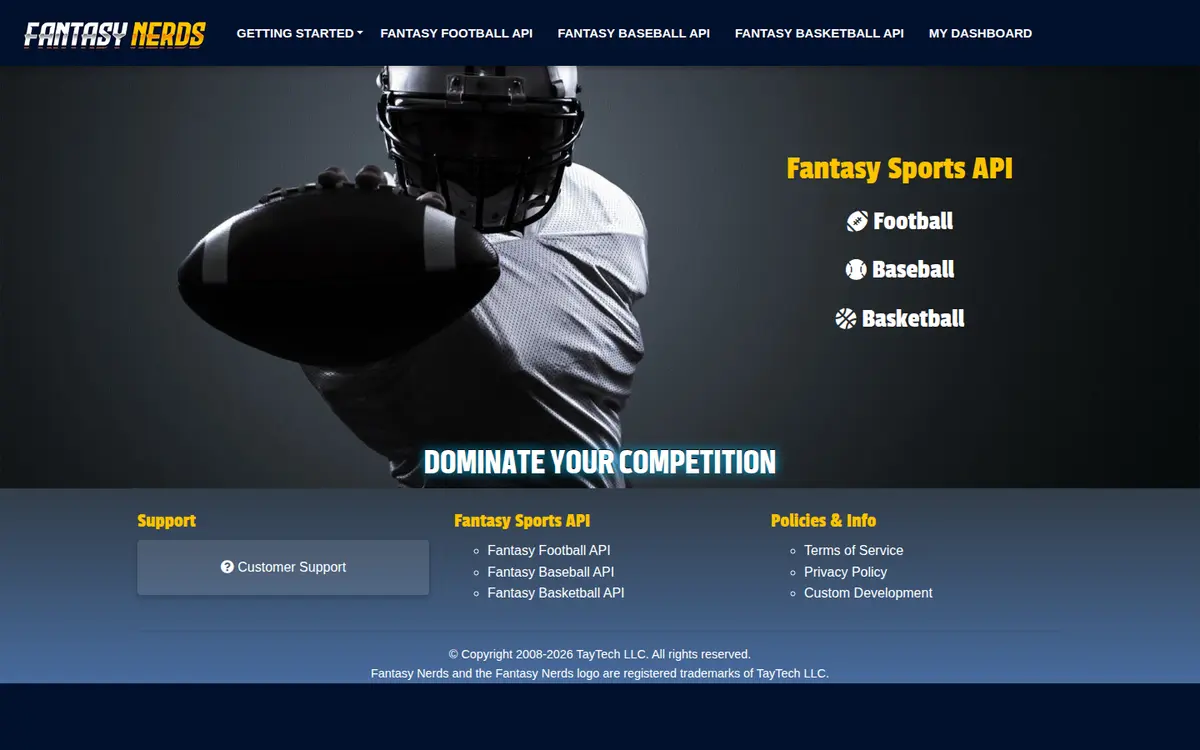
Fantasy Nerds’ homepage names Fantasy Football, Fantasy Baseball and Fantasy Basketball APIs as distinct services. The football documentation lists auction values, average draft position, rankings, depth charts, draft projections, player information and schedule-related resources. These are useful components for draft preparation, roster tools and fantasy publishing; they should not be mistaken for bookmaker markets or a full sports event feed. The specialization gives product teams a clearer initial feature map than a generic “all sports” promise.
The endpoint choices also expose assumptions a publisher must model. Auction-value examples accept variables such as team count, budget and scoring format, and the documentation notes that some league sizes may not have auction values. A fantasy application that treats one default profile as universal risks presenting misleading recommendations. Test the actual league format your users select, retain scoring context with each record, and display missing values as unavailable rather than silently substituting a default.
Sources: [1] Fantasy Nerds Fantasy Sports API, [3] Fantasy Nerds NFL API documentation
Account access and developer documentation
The getting-started page says an account is required and that a unique API key is generated through a developer dashboard; the key is required for API calls. It links to first-call, error and FAQ guidance as well as a data dictionary and images resources. That offers a reasonably clear onboarding route for a developer evaluating the service, but public guidance should still be checked against the documentation version and account setup currently in use.
NFL endpoint pages illustrate request parameters and example values. A TEST key appears in the documentation for sample calls, which is useful for understanding endpoint shape but does not establish a free production entitlement or all-data access. Keep actual credentials server-side, review error responses, and confirm current quotas, plan inclusion and any attribution rules before launch. The public materials reviewed do not settle pricing or production limits, so avoid relying on examples as commercial terms.
Sources: [2] Fantasy Nerds API getting started and authentication, [3] Fantasy Nerds NFL API documentation
Coverage, scoring and missing fantasy values
Assess coverage resource by resource rather than assuming a sport name proves a complete catalogue. A football API may include projections and player listings but have configuration-dependent draft values, position-specific statistics or playoff resources that require particular parameters. The NFL documentation says returned statistical categories vary by player position, and its auction-value example warns that some league sizes may lack data. Build coverage tests around your exact roster, scoring rules, season and postseason scenario.
The homepage also advertises baseball and basketball APIs, but the retrieved technical examples here focus on NFL football. That means this review cannot substantiate identical depth, endpoint count or current season status across all three sports. Open the matching current documentation before promising those features. A fantasy projection is a modeled recommendation rather than a bookmaker quote or independently audited forecast; make its context visible to readers and do not treat it as a guaranteed result.
Sources: [3] Fantasy Nerds NFL API documentation, [1] Fantasy Nerds Fantasy Sports API
Who should shortlist Fantasy Nerds?
A fantasy startup, draft assistant or rankings publisher can benefit from an interface organized around projections, player resources and draft choices. Such an integration should normalize scoring settings, preserve season and week context, and handle position-specific fields without assuming every response has the same shape. If the central experience is live betting odds, a scoreboard, play-by-play or official league statistics, the sources reviewed do not show that Fantasy Nerds fills that role; use a separate provider for those requirements.
The 7.4/10 score reflects a coherent niche and useful public documentation, balanced against a narrow sport/data focus and uncertainty about public commercial terms. It is an editorial fit assessment, not feedback or a test of projection quality. Before purchasing, ask which package includes each sport and resource, how projections are updated, which historical seasons are available, and whether public display, images and redistribution are permitted.
A fantasy site should also decide how it handles midseason changes. Injuries, inactive players, bye weeks and playoff rounds may appear as distinct resources or parameters; test whether the endpoint’s week and player status match the interface you plan to show. Keep the raw provider value and its retrieval context so a corrected projection or changed roster does not become an unexplained permanent number in your database. The documentation’s varied service list makes this a realistic implementation concern, not an assumption that every resource updates identically.
Sources: [1] Fantasy Nerds Fantasy Sports API, [3] Fantasy Nerds NFL API documentation, [2] Fantasy Nerds API getting started and authentication
Frequently asked questions
Does Fantasy Nerds provide betting odds?
The published product families and NFL documentation are fantasy-focused, with projections, rankings and draft resources. The evidence reviewed does not establish a sportsbook odds feed. For bookmaker markets and prices, evaluate a dedicated odds service rather than treating a fantasy projection as a line.
Sources: [1] Fantasy Nerds Fantasy Sports API, [3] Fantasy Nerds NFL API documentation
Which sports does the API cover?
Its homepage names fantasy football, baseball and basketball APIs. The retrieved NFL documentation provides the most detailed service evidence here; check the current baseball and basketball references for their individual resources, seasons and fields.
Sources: [1] Fantasy Nerds Fantasy Sports API, [3] Fantasy Nerds NFL API documentation
Is there a free production API?
Getting-started materials explain account and API-key creation, and documentation examples include a TEST key for sample data. A test credential does not establish free production access or commercial rights. Verify the current package and limits directly.
Sources: [2] Fantasy Nerds API getting started and authentication, [3] Fantasy Nerds NFL API documentation
How do I authenticate?
The provider says callers need a unique API key generated through the developer dashboard. Use the current documentation for exact request syntax, protect credentials on the server and review error handling before deployment.
Sources: [2] Fantasy Nerds API getting started and authentication
Can projections support any fantasy scoring format?
Do not assume so. Examples expose scoring parameters such as standard and PPR, and some resources accept team size or budget. The docs warn some league configurations may lack values, so test the options your users actually select.
How our editorial ratings work
Fantasy Nerds scores 7.4 out of 10. This is our editorial fit score, not a customer score.
Our scores are subjective website-integration fit assessments based on providers’ publicly described products, not customer-review averages or independent speed, uptime or accuracy tests. We consider publishing usefulness, integration options, documented data scope, access information and clarity of product documentation. A higher score is not a guarantee of suitability. BettorServe is the featured first placement; the remaining list is a curated shortlist, not an exhaustive market ranking.
This is a commercially oriented comparison site. We may earn a commission through eligible partner links, at no extra cost to you. BettorServe is our featured first listing. Commercial relationships and featured placements should be considered alongside the product details, and you should confirm current terms directly with a provider before purchasing.
Sources
Content last reviewed