

Provider review · Multi-sport publisher and fantasy integrations
EntitySport review
EntitySport sells sports data feeds and related products to digital publishers, fantasy platforms and developers. Its official pages present APIs for cricket, football, basketball, kabaddi and several additional sports, while its documentation describes resources, credentials and request flows. The multi-sport pitch may help a team that wants a single commercial conversation across more than one sport. It should not be mistaken for one perfectly uniform feed: each sport has its own coverage, access requirements and likely integration details.
 By Sarah Mitchell
Updated
Our verdict
Editorial integration fit: 8.5/10. EntitySport is a strong candidate for developers evaluating several sport-specific feeds, particularly where cricket and football are both in scope. Its documentation and free-development language provide practical evaluation paths. The score reflects documented breadth and implementation material, not independently verified competition coverage or measured accuracy. Buyers should use sport-specific coverage pages to build a precise trial checklist and distinguish the company’s public development access from paid commercial permissions.
Key facts
- Provider identity
- EntitySport identifies itself as Entity Digital Sports and markets sports-data feeds and APIs. [1]
- Sport products
- The homepage lists cricket, football, basketball, kabaddi and other sports products. [1]
- API style
- Documentation describes HTTPS REST requests with access and secret keys used to obtain tokens. [2]
- Development access
- The provider promotes a free development API and trial path; production permissions require confirmation. [1]
Pros and cons
Pros
- The catalogue spans multiple sport-specific feeds, which is useful to publishers with a multi-sport roadmap. A buyer can consider cricket, football and basketball without treating the company as a single generic API that magically provides identical fields everywhere.
- The public documentation gives concrete implementation information, including authentication, token generation and example client approaches. That lets engineering teams inspect the shape of access before commercial commitment and makes questions about credential handling and token expiration more actionable.
- EntitySport separates development access, paid subscriptions, coverage pages and widgets in its public site. That structure gives a prospective customer several ways to understand the product—provided they keep the scope of a trial distinct from the scope and legal rights of production.
Cons
- A large sport list does not tell a buyer which target competitions are currently covered at which level. The provider’s broad totals are promotional; competition pages and an account-level trial are still necessary to establish the actual leagues, seasons, fields and match states relevant to an application.
- Authentication uses credentials and tokens, adding a backend responsibility. The documentation warns against exposing secrets and notes token expiry behavior, so a browser-only implementation that embeds credentials would be inappropriate. Teams need to plan secure storage, renewal, error handling and rotation.
- The public materials do not establish one shared subscription, one quota model or one set of usage rights for every sport. A project that begins with a development key should ask for written terms covering paid access, data display, historical use, redistribution and whether its expected traffic is included.
Provider website screenshots

A multi-sport catalogue, not a one-size feed
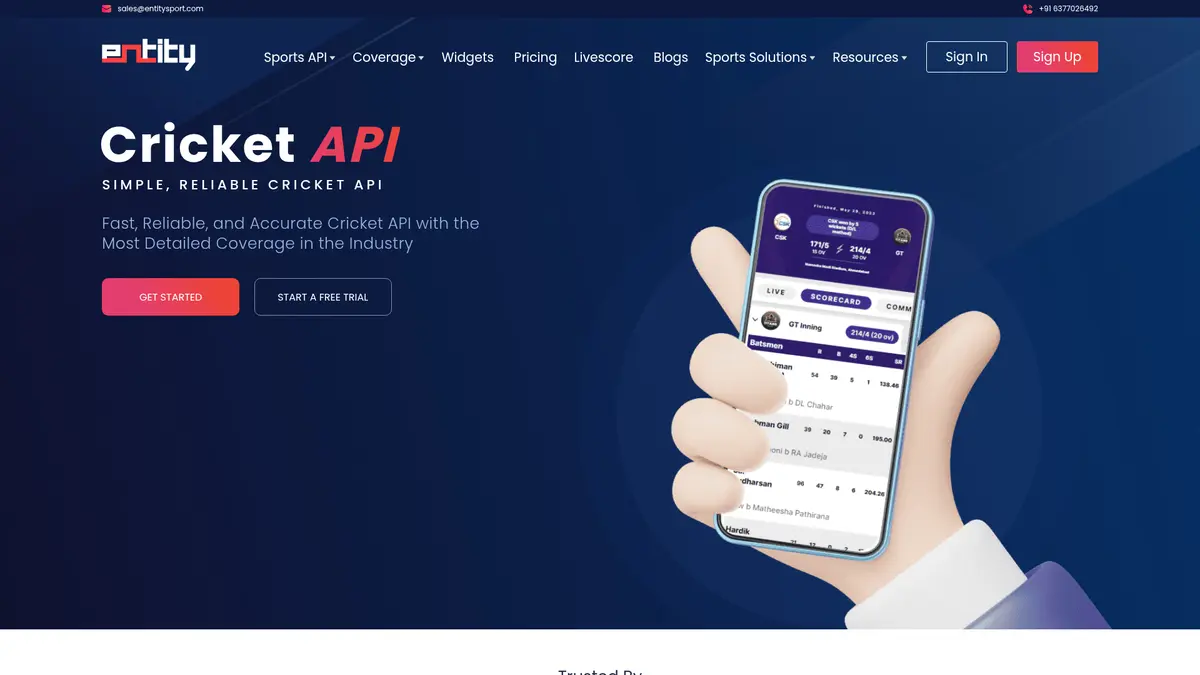
EntitySport advertises separate APIs for cricket, football, basketball, kabaddi and other sports, as well as widget and fantasy-oriented products. This breadth makes it worth considering for teams that may expand across sports and prefer one supplier relationship. The catalogue is still a set of sport-specific products. Do not assume every sport shares the same identifiers, fields, update cadence or endpoint lifecycle simply because the sales site uses a common “sports API” label.
The company describes itself as serving publishers and fantasy applications and presents many resource types such as schedules, live scores, players, teams, competitions, matches and fantasy points. These are useful categories for drafting a requirements list. They are supplier descriptions rather than independent evidence that every requested resource exists for every competition. Ask for a per-sport schema and coverage sheet before designing a normalized data model around the broadest product page.
Sources: [1] EntitySport — sports API and data feed overview, [2] Entity Sports — API documentation
Authentication is explicit and belongs on the server
The EntitySport documentation describes an HTTPS REST approach and an access-key/secret-key flow that produces a token for API use. It also warns that keys should not be placed in public client-side code and describes token expiry. This is useful operational guidance: credentials need to remain on a server, the server must renew tokens safely, and the front end should receive only the data its own application is authorized to display.
An API that uses a token is not necessarily complex, but it changes the integration plan. Account setup, secret handling, expiry, unauthorized responses and competition-level access need deliberate error states. Teams should test a renewal path and confirm how tokens are scoped before exposing any endpoint through a mobile or web client. Public examples establish the documented interface, not how the service behaves under every failure or production traffic scenario.
Validate each sport and competition separately
EntitySport promotes broad annual competition totals and separate coverage pages. Those figures are useful for discovery but not enough to select a feed. For each intended competition, record whether the API offers schedules, live scores, lineups, player or team statistics, historical seasons and any fantasy fields. Also ask which fields are updated during a match and whether postponed or abandoned fixtures keep stable identifiers. A trial should use real target competitions, not just whichever sample record is easiest to find.
The practical risk of a multi-sport catalogue is false equivalence. A buyer may assume that a deeply covered cricket competition implies a similarly deep kabaddi or basketball product. Official sport pages are the appropriate starting point, but they remain provider-authored descriptions. Make coverage acceptance a contract and integration milestone, and preserve a fallback state for a target event that is absent or has only a reduced data set.
Sources: [1] EntitySport — sports API and data feed overview, [2] Entity Sports — API documentation
Separate development access from production terms
The site promotes free development access and trial options, which can reduce the cost of initial technical exploration. But a trial credential should be treated as a way to inspect requests and response shapes, not as evidence that a production app may reuse the same allowance or show data publicly. Confirm the plan, request limits, environments and data rights for the exact application and audience before moving from a sandbox to a deployed product.
Commercial questions should include the permitted display, caching, storage and redistribution of feed data; whether attribution is required; how the supplier defines a request; and what support is available during a major event. The available public sources do not create a universal terms sheet for each sport. Ask EntitySport to state in writing the subscription and rights that cover each API product, particularly if cricket and football are both part of a single release.
Sources: [1] EntitySport — sports API and data feed overview, [2] Entity Sports — API documentation
A promising shortlist entry with a validation workload
EntitySport is a sensible shortlist choice for a product team that wants to examine several sports and is willing to validate them individually. Its public documentation offers more implementation detail than a simple lead-generation page, and free development access creates a plausible path to test data structures. A team with a single tournament and strict completeness needs should still compare that tournament with other specialist providers, because a wide catalogue does not automatically make it the strongest fit for one league.
The 8.5 score recognizes its documented APIs, developer documentation, trial pathway and product variety. It does not reward the company’s claims as if they were verified outcomes, nor does it predict feed quality. The next step is a scoped technical and legal evaluation: confirm competition, schema, field availability, update behavior, quotas and rights, then check integration effort against the feature your product actually needs.
Sources: [1] EntitySport — sports API and data feed overview, [2] Entity Sports — API documentation
Frequently asked questions
Is EntitySport the same company as Roanuz?
No relationship is established in the official material reviewed. EntitySport presents itself under the EntitySport/Entity Digital Sports identity, while Roanuz operates CricketAPI, FootballAPI and Kabaddi products. Keep the suppliers and their respective documentation, keys and commercial terms separate.
Sources: [1] EntitySport — sports API and data feed overview, [2] Entity Sports — API documentation
Which sports does EntitySport list?
Its homepage lists products across cricket, football, basketball, kabaddi and additional sports. The available catalogue should be treated as a starting point; consult each sport’s coverage page for the specific competitions, seasons and endpoints you need.
Sources: [1] EntitySport — sports API and data feed overview
Can I call EntitySport directly from a browser?
The documentation says the access and secret credentials should not be exposed in client-side code. Use a server-side integration to hold credentials and obtain or renew tokens, then return only the authorized application data to the browser or mobile client.
Does the free development API include production rights?
The public site describes free development and trial access, but it does not establish that those credentials include commercial display, high-volume usage or redistribution rights. Confirm the current plan, quota and license in writing before launch.
Sources: [1] EntitySport — sports API and data feed overview, [2] Entity Sports — API documentation
What should a multi-sport buyer validate first?
Start with the precise competition list, then map each competition to required fields, seasons, update expectations, identifiers, quotas and data rights. Test cricket, football or other products separately; the presence of several sports in one catalogue does not prove a uniform schema.
Sources: [1] EntitySport — sports API and data feed overview, [2] Entity Sports — API documentation
How our editorial ratings work
EntitySport scores 8.5 out of 10. This is our editorial fit score, not a customer score.
Our scores are subjective website-integration fit assessments based on providers’ publicly described products, not customer-review averages or independent speed, uptime or accuracy tests. We consider publishing usefulness, integration options, documented data scope, access information and clarity of product documentation. A higher score is not a guarantee of suitability. BettorServe is the featured first placement; the remaining list is a curated shortlist, not an exhaustive market ranking.
This is a commercially oriented comparison site. We may earn a commission through eligible partner links, at no extra cost to you. BettorServe is our featured first listing. Commercial relationships and featured placements should be considered alongside the product details, and you should confirm current terms directly with a provider before purchasing.
Sources
Content last reviewed