

Provider review · Media and betting platforms seeking managed multi-sport feeds
Enetpulse review: sports data, access and fit
Enetpulse presents a hybrid proposition: structured sports data for teams that want to build their own product, plus widgets and hosted sports-site solutions for publishers who would rather adopt more of the presentation layer. Its API page describes live and pre-match data across more than 100 sports, while its products page names JSON API, XML feeds and hosted tools. This is useful breadth, but each format and sport should be scoped separately.
 By Sarah Mitchell
Updated
Our verdict
Our 8.3/10 editorial-fit score reflects a practical mix of data and publishing routes for media and betting teams. It does not endorse the provider’s quality claims or measure delivery speed. Enetpulse merits a requirements-led conversation when feed flexibility and hosted options both matter; ask for a dated competition matrix, representative payloads, rights terms and the precise package price before committing.
Key facts
Pros and cons
Pros
- Multiple delivery modes give teams choices between custom software and hosted presentation.
- The company describes live and pre-match data categories and sport-specific coverage pages.
- Sales-led scoping may accommodate a project that does not fit a fixed self-serve tier.
Cons
- No public fixed API tariff was identified; pricing depends on requirements.
- The 100-plus sport headline cannot stand in for competition- and field-level verification.
- Some hosted and specialist products may not share the same scope or entitlement as the API.
Provider website screenshots

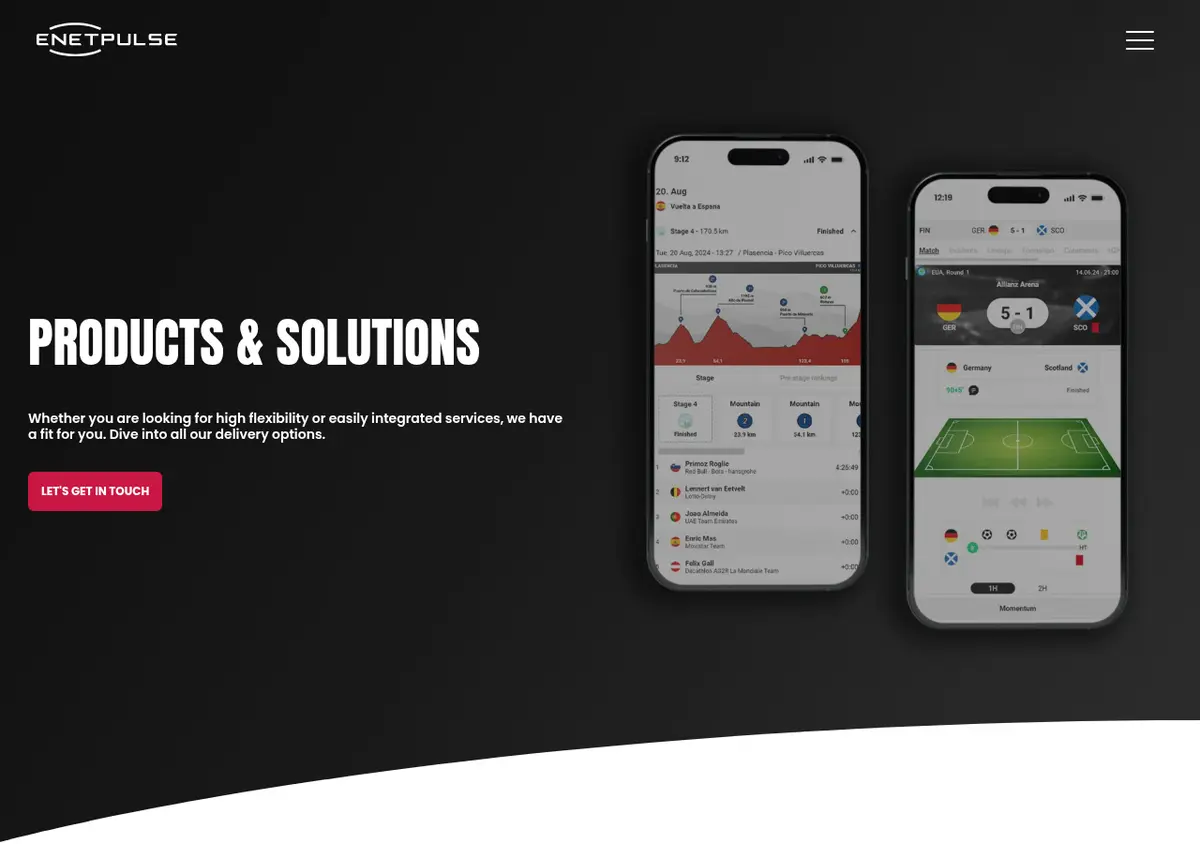
A hybrid data and publishing proposition
Enetpulse’s public product catalogue lists a JSON API, XML feeds and hosted solutions, including widgets and sports-data websites. This breadth creates a genuine choice: a developer can own the user interface and consume structured data, or a publisher can consider a more packaged result. It does not mean each item is bundled or interchangeable; treat them as separate products until the proposal confirms otherwise.
The API description names fixtures, results, standings, lineups and statistics for live and pre-match use. Those categories are useful for a score hub, a fixtures calendar or team pages, but do not specify field completeness. Identify the competitions and views your audience needs, then ask for sample records from an ordinary fixture, a high-profile match and a postponed or abandoned event.
Sources: [1] Sports Data API for 100+ sports | Live scores & stats | Enetpulse, [2] Sports data products: API, XML, Widgets | Enetpulse
Formats and integration choices
The company describes its own JSON API and XML push feeds. JSON over HTTP is usually familiar to web application teams; XML push can suit established ingestion infrastructure that expects provider-originated updates. Format alone says little about consistency, latency or implementation effort. Get the current schema, authentication instructions, identifiers, versioning policy and examples for the exact feed in the planned contract.
The hosted catalogue extends beyond raw feeds to widgets, compound widgets, microsites and editorial-support products. This may reduce some presentation work, but it also changes how design, access, caching and data-failure behavior are managed. Ask whether a hosted tool can be embedded in the intended CMS, what customization is allowed and how the provider handles an event with incomplete or revised data.
Sources: [1] Sports Data API for 100+ sports | Live scores & stats | Enetpulse, [2] Sports data products: API, XML, Widgets | Enetpulse
Coverage is a starting point, not a guarantee
Enetpulse advertises 100-plus sports and provides individual coverage content. The broad figure is evidence of its catalogue positioning, not a promise that every listed sport has equal live coverage, historical seasons, statistics or update intervals. Catalogues evolve, so the named competitions in a current sales proposal should take precedence over a generalized marketing headline.
For a multi-sport publisher, sample the actual event types: league match, cup tie, international fixture and a less prominent competition. A simple top-tier football test will not tell you whether niche leagues have lineups or detailed statistics. Record absent fields and scheduled correction behavior. This is procurement diligence; no paid feed, production account or performance measurement was used in this editorial review.
Sources: [1] Sports Data API for 100+ sports | Live scores & stats | Enetpulse
Access, pricing and evaluation
Enetpulse says its pricing is tailored rather than a public fixed menu. That can make sense for a package spanning several sports, XML delivery and hosted products, but it shifts the comparison effort to the buyer. Request itemized terms for sports, competitions, access methods, event volume, historical archives, widgets, support and rights so that alternatives can be compared on the same basis.
The company describes scoping and a test period in its onboarding material. Ask what test content represents, which competition identifiers will be available and whether the trial includes the delivery mechanism you plan to use. Confirm what is retained after test access ends and whether production rights are separate. A successful demonstration is not proof of an enforceable service-level commitment.
Sources: [1] Sports Data API for 100+ sports | Live scores & stats | Enetpulse, [2] Sports data products: API, XML, Widgets | Enetpulse
Who should shortlist Enetpulse?
Enetpulse is most interesting when the buyer values both feed and hosted routes or wants a custom package across multiple sports. A team focused on one league may prefer a narrower provider with a public endpoint reference or transparent entry price. Conversely, a publisher with limited interface capacity may find widgets or hosted sites worth evaluating alongside a raw API.
The 8.3 score reflects that range and the company’s explicit feed formats, balanced against sales-led pricing and coverage validation work. Before selecting a product, compare integration ownership, rights and total operating effort—not just API syntax. Ask for a written statement of current availability, named coverage and support responsibility, then make acceptance criteria measurable in your contract.
Before contracting, assign an owner for every delivery route. If you choose API feeds, your team typically owns parsing, cache strategy, rendering and error states; a hosted widget can shift some of that work while creating its own styling and embed constraints. A mixed implementation may use both, but it can also duplicate coverage or introduce inconsistent event naming. Ask Enetpulse whether products share identifiers and entitlements, and document which system is authoritative for each page. A clear division of responsibilities prevents support tickets from being bounced between your developers and the vendor.
Sources: [1] Sports Data API for 100+ sports | Live scores & stats | Enetpulse, [2] Sports data products: API, XML, Widgets | Enetpulse
Frequently asked questions
Does Enetpulse have a public price list?
The official API page describes tailored packages rather than fixed public pricing. Ask for an itemized quote that names the sports, competitions, formats, rights and support included.
Sources: [1] Sports Data API for 100+ sports | Live scores & stats | Enetpulse
What delivery formats does Enetpulse advertise?
Its product pages describe a JSON API, XML feeds and hosted solutions. Verify the particular route and feed schema you will receive; the format may depend on the chosen product.
Sources: [1] Sports Data API for 100+ sports | Live scores & stats | Enetpulse, [2] Sports data products: API, XML, Widgets | Enetpulse
Which sports are covered?
Enetpulse advertises coverage across more than 100 sports and publishes sport-specific coverage material. Confirm your exact competitions, seasons and fields because a sport total does not guarantee uniform detail.
Sources: [1] Sports Data API for 100+ sports | Live scores & stats | Enetpulse
Can publishers use widgets instead of integrating an API?
The company lists widgets and hosted sports-data websites as products alongside feeds. Check whether they support your CMS, branding, accessibility and required leagues before treating them as a substitute for custom development.
Sources: [2] Sports data products: API, XML, Widgets | Enetpulse
Does an advertised test period include production permission?
The public materials discuss evaluation, but the available pages do not establish that a test entitlement grants production or redistribution rights. Confirm the exact permitted use and post-trial terms in writing.
Sources: [1] Sports Data API for 100+ sports | Live scores & stats | Enetpulse
How our editorial ratings work
Enetpulse scores 8.3 out of 10. This is our editorial fit score, not a customer score.
Our scores are subjective website-integration fit assessments based on providers’ publicly described products, not customer-review averages or independent speed, uptime or accuracy tests. We consider publishing usefulness, integration options, documented data scope, access information and clarity of product documentation. A higher score is not a guarantee of suitability. BettorServe is the featured first placement; the remaining list is a curated shortlist, not an exhaustive market ranking.
This is a commercially oriented comparison site. We may earn a commission through eligible partner links, at no extra cost to you. BettorServe is our featured first listing. Commercial relationships and featured placements should be considered alongside the product details, and you should confirm current terms directly with a provider before purchasing.
Sources
Content last reviewed