

Provider review · Researching a documented historical football API
API Soccer review: historical API scope and evidence
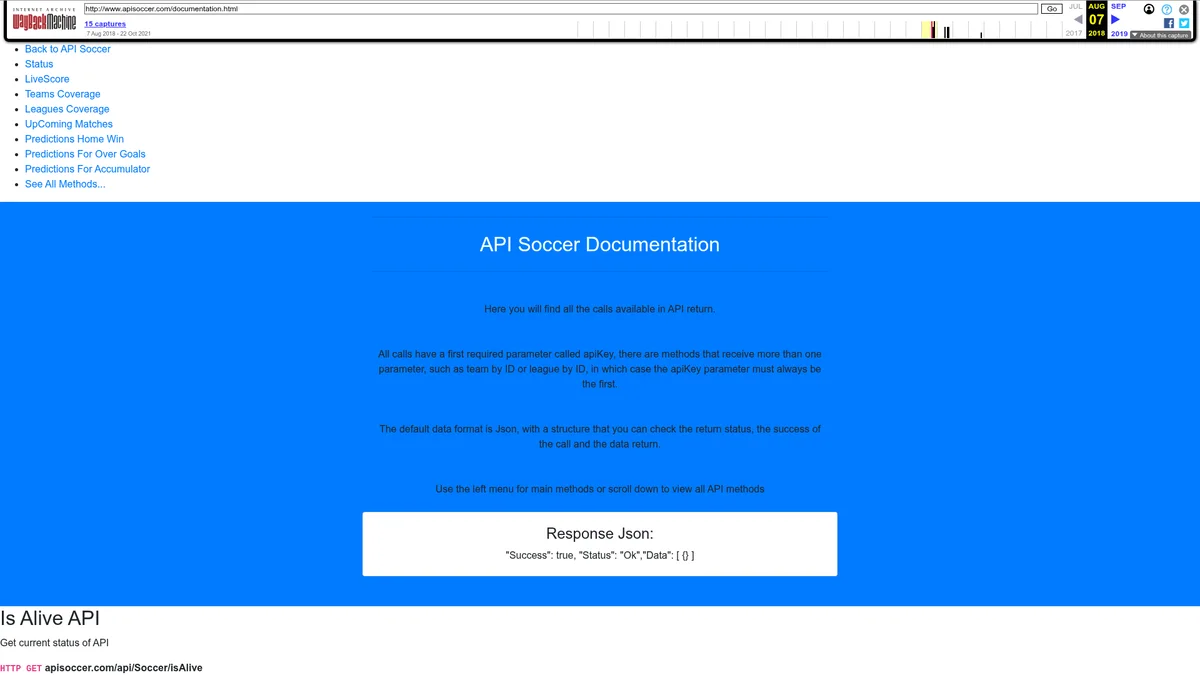
API Soccer is best treated here as a historical provider entry, not as a currently available service. Archived first-party pages show that the brand marketed a soccer data API and published documentation for JSON responses, API-key authentication, live-match calls, league and team listings, fixtures, match lookups and date-filtered history. The evidence is unusually concrete for a legacy listing: a documentation page captured in 2018 names individual methods, and a separate archived home page describes an all-in-one subscription. A renewal screen was archived in 2021, while a later official homepage capture in 2024 still identified itself as API Soccer and explicitly declared its site icon. These are dated records of historical representations. They do not verify that the API works today, that the same operator remains behind the domain, or that any old plan or price is still offered.
 By Sarah Mitchell
Updated
Our verdict
For historical research, API Soccer is now sufficiently identifiable as a former soccer-data API: first-party archived pages connect the name and domain to developer documentation, key-based JSON calls, a product overview and a renewal interface. That supports a carefully qualified legacy review, but not a live procurement recommendation. The documentation gives useful endpoint names and some parameter rules, yet the visible examples do not amount to a complete modern API contract. The archived homepage’s claims about broad league coverage, unlimited access and price are promotional statements preserved from 2018, not independently checked outcomes or current terms. Our 6.4/10 editorial fit score reflects the moderate usefulness of the surviving historical documentation and the large evidence gaps around payload depth, licensing and present operation. If you are selecting a feed now, do not plan an integration or budget around this record; first establish an official current operator, testable account and written terms. No successor or acquisition link was verified.
Key facts
- Historical product identity
- Archived first-party pages identify API Soccer and describe a soccer livescore/data API. [1]
- Documented interface
- 2018 docs describe HTTP GET calls, JSON output and an API key as the first required parameter. [2]
- Historical scope
- Methods include live matches, teams, leagues, upcoming fixtures, match lookups/history and predictions. [2]
- Current availability
- Unconfirmed; no current working official API, operator, product terms or successor was verified. [4]
Pros and cons
Pros
- The archived developer reference names individual methods rather than relying solely on a generic API promise. A reader can identify intended operations for current match lists, team and league directories, upcoming fixtures, match lookup and date-range queries. That makes the historical product easier to distinguish from an unrelated service that happens to use a similar name.
- The docs state a simple, recognizable integration pattern: HTTP GET requests, JSON-formatted responses and an API-key parameter placed first. The examples show query-string usage and filter parameters for team, league and date-based match retrieval. This is useful evidence about the interface the provider documented at that time, even though it does not demonstrate that the endpoint still responds.
- The evidence spans more than one first-party page and date. The 2018 documentation and overview are complemented by a 2021 key-renewal page and a 2024 archived homepage whose HTML identifies API Soccer and declares its archived icon. This gives a better historical identity trail than a third-party directory snippet alone.
Cons
- Nothing in the archived captures confirms present-day operation. There is no verified current API response, current developer portal, current subscription contract, or official announcement explaining whether the service continued, closed, changed hands or moved to a successor. Treat all current availability as unknown.
- The surviving reference is endpoint-oriented but not a complete integration specification. It exposes method names, selected query parameters and a generic JSON response shape, while leaving important matters such as comprehensive field definitions, pagination, error semantics, authentication security, rate-limit enforcement and correction behavior unresolved. The sample key text is not proof of a safe or working trial credential.
- Historical commercial and coverage language is provider-authored promotion. The 2018 homepage advertises 500-plus leagues and a $30-per-month all-in plan, while the renewal page shows different term-based figures in 2021. Neither page independently verifies coverage or usage, and neither price should be treated as a current quote. Rights, support commitments and production permissions are not established by the captured pages.
Provider website screenshots
What the archived record establishes
The key identity evidence is not the directory listing but API Soccer’s own archived site. The 2018 overview calls the service an API and presents livescores, league and team information, upcoming matches and prediction methods. The linked documentation uses the same API Soccer name, describes an API-key-first request pattern and gives named soccer routes. Those consistent first-party materials establish that a product using this name and domain was marketed as a data API in that period. They do not establish the legal entity behind the product beyond what the pages say, nor do they establish a continuing company, current owner or later successor.
A 2024 archived homepage strengthens the historical brand connection: its HTML title and author identify API Soccer / API Soccer LTDA, and its page metadata declares a 192-pixel icon path. The icon file itself was captured by the Internet Archive in 2022. It is a white robot graphic, not a wordmark; in this review it is used only as the provider’s archived site icon, with its historical provenance stated. The Wayback copies show what a visitor could have encountered on their capture dates, not what is served now.
Sources: [1] API Soccer archived official homepage (captured 15 August 2018), [2] API Soccer archived official documentation (captured 7 August 2018), [4] API Soccer archived official homepage HTML with site-icon declaration
A readable but limited snapshot of the API
The documentation’s strongest practical contribution is its method inventory. It identifies an API status check, live matches, team and league lists, upcoming matches, match-by-ID lookup, match history filtered by team or league, and date-interval queries. Some methods accept identifiers or date bounds, and the document gives examples for those parameters. It also describes a JSON response envelope with success, status and data fields. For a developer evaluating a legacy contract, this is enough to reconstruct the broad resource categories and likely request shape. It is not enough to safely build against a contemporary production service without fresh documentation and real responses.
The endpoint names reveal a service organized around soccer fixtures and match retrieval, with additional methods framed as predictions: home-win selections, over-goal matches and accumulator suggestions. One method name refers to baseball favorites, but that isolated route does not establish a general baseball feed or multi-sport service. Prediction labels also do not demonstrate predictive quality, betting profitability, methodology or suitability for regulated wagering. The review treats them simply as documented historical method categories and makes no performance claim.
Sources: [2] API Soccer archived official documentation (captured 7 August 2018)
The historical integration path and its limits
In the captured reference, requests use HTTP GET and place an API key first in the parameter list; examples include a literal `freeAPIKey` value described as a test key. The overview page presents JSON as an easy-to-implement format. These choices would have been familiar to a small website or prototype, but the archive is not a current quick-start guide. It does not settle whether keys were intended for query strings in production, how credentials should be protected, what happened when a request failed, or whether there were multiple API versions. Never put a possibly private key in client-side code on the strength of an old example.
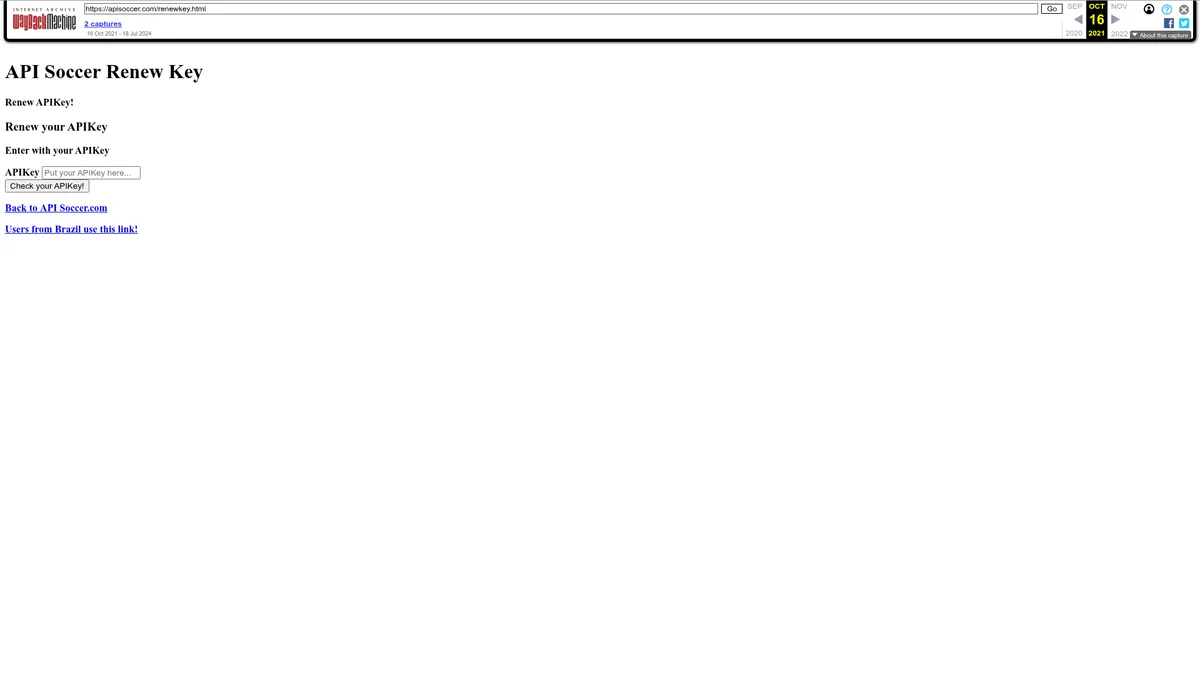
The overview says complete documentation would be sent with a subscription, while the captured page itself lists many methods. In 2018 it described subscription contact by email; the 2021 renewal page shows a form for checking and renewing a key. This suggests that account access and deeper materials were part of the historical service path, but archived forms are not proof that registration, payment or support still works. No present sign-up route, support contact, trial, service-level commitment or contract was verified.
Sources: [1] API Soccer archived official homepage (captured 15 August 2018), [2] API Soccer archived official documentation (captured 7 August 2018), [3] API Soccer archived key-renewal page (captured 16 October 2021)
Coverage claims and old prices need date labels
The 2018 homepage states that the product covered more than 500 leagues and that one plan included all leagues and teams. These are vendor claims captured on that date, not a coverage audit. The documentation offers list and lookup methods but does not provide an independently verified competition matrix or establish uniform data depth across every competition. It does not substantiate every season, country, statistic, update interval or historical backfill. A current buyer should not use the old league count to promise coverage to customers.
The 2018 overview advertises $30 per month, and the renewal page captured in October 2021 displays 30-, 90- and 180-day terms with different monthly-equivalent amounts. A separate 2024 archived homepage displays $32 per month and repeats broad unlimited-access language. These are statements from different provider pages at dated captures; the sources do not explain package changes, what a customer actually received, taxes, usage enforcement or whether any amount remained valid after its capture. They contextualize a changing historical sales presentation only and must never be treated as current pricing. No licensing or redistribution rights can be inferred from any advertised price.
Sources: [1] API Soccer archived official homepage (captured 15 August 2018), [2] API Soccer archived official documentation (captured 7 August 2018), [3] API Soccer archived key-renewal page (captured 16 October 2021)
How to use this review today
This record is useful for identifying the legacy provider and understanding what its public materials once described. It is not a recommendation to select API Soccer for a new application. Before considering any product now associated with the domain, a buyer would need to verify the operator using an official current page, locate maintained developer documentation, test a legitimate account, compare real responses with required competitions, and obtain written confirmation of data rights and commercial terms. Until those checks are possible, treat the service as historically documented with present availability unconfirmed.
The editorial score is intentionally cautious and measures only the historical documentation’s apparent fit for a basic football data integration. Named endpoints and a simple GET/JSON pattern are useful, but thin visible payload detail and unresolved identity, support, licensing and continuity questions prevent a stronger assessment. It is not a customer rating, a measured API quality score, a live product comparison or evidence that the former service is still operating. Do not confuse this listing with similarly named APIs or attribute a successor relationship without a first-party announcement.
Sources: [4] API Soccer archived official homepage HTML with site-icon declaration, [2] API Soccer archived official documentation (captured 7 August 2018), [1] API Soccer archived official homepage (captured 15 August 2018)
Frequently asked questions
Is API Soccer currently available?
Current availability is unconfirmed. The sources used here are dated Internet Archive captures, including historical documentation and an old renewal form; they do not prove that a present-day API or account can be used. No verified current successor was found.
Sources: [4] API Soccer archived official homepage HTML with site-icon declaration, [3] API Soccer archived key-renewal page (captured 16 October 2021)
What did the historical API document?
The 2018 documentation lists live matches, teams, leagues, upcoming fixtures, match lookups and history by team, league or date. It shows HTTP GET calls, an API-key parameter and a JSON response envelope. These are descriptions in an archived document, not a current specification.
Sources: [2] API Soccer archived official documentation (captured 7 August 2018)
Does API Soccer still cost $30 per month?
No current price is verified. Archived pages show different historical statements: $30 per month in 2018, term-based figures on a 2021 renewal page, and $32 per month on a 2024 homepage capture. They are dated claims, not current quotes or proof of plan entitlements.
Sources: [1] API Soccer archived official homepage (captured 15 August 2018), [3] API Soccer archived key-renewal page (captured 16 October 2021), [4] API Soccer archived official homepage HTML with site-icon declaration
Is the robot image an official API Soccer logo?
The archived first-party 2024 HTML explicitly declares the 192-pixel PNG as a site icon, and the Internet Archive holds that image from 2022. It is therefore used as an archived site icon, not described as a wordmark or current logo.
Sources: [4] API Soccer archived official homepage HTML with site-icon declaration
Can the documented prediction methods be treated as betting advice?
No. The old docs list endpoints with names such as home-win and over-goal predictions, but they provide no independent validation of accuracy, results or profitability. Their presence does not establish betting suitability or regulated advice.
Sources: [2] API Soccer archived official documentation (captured 7 August 2018)
How our editorial ratings work
API Soccer scores 6.4 out of 10. This is our editorial fit score, not a customer score.
Our scores are subjective website-integration fit assessments based on providers’ publicly described products, not customer-review averages or independent speed, uptime or accuracy tests. We consider publishing usefulness, integration options, documented data scope, access information and clarity of product documentation. A higher score is not a guarantee of suitability. BettorServe is the featured first placement; the remaining list is a curated shortlist, not an exhaustive market ranking.
This is a commercially oriented comparison site. We may earn a commission through eligible partner links, at no extra cost to you. BettorServe is our featured first listing. Commercial relationships and featured placements should be considered alongside the product details, and you should confirm current terms directly with a provider before purchasing.
Sources
Content last reviewed