

Provider review · A broad sports catalogue under one developer account
API-Sports review: football and sports data
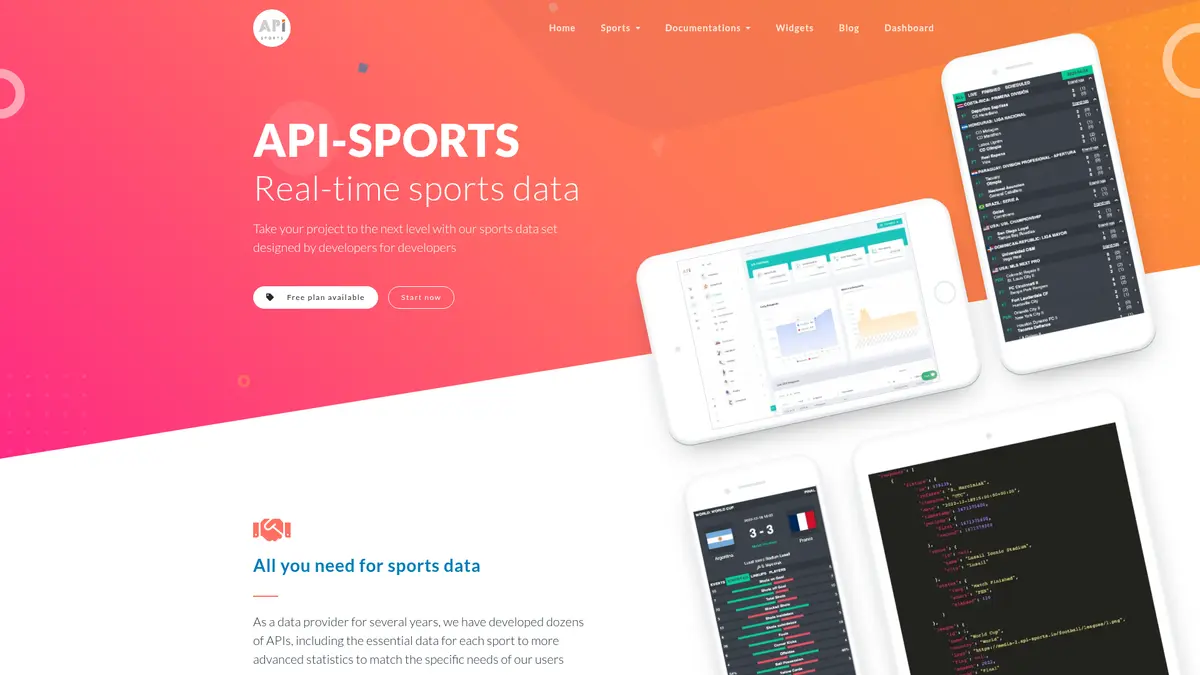
API-Sports is best understood as a catalogue and account ecosystem, not as a single all-sports feed. Its official site presents distinct services for football, basketball, baseball, Formula 1, hockey, rugby, volleyball and other sports, with separate documentation for each. The catalogue also advertises shared dashboard tools and free widgets, but sport-specific subscription and data rules remain important. This review addresses the parent catalogue and does not treat API-Football as a synonym for every API-Sports product: API-Football is one football service within the broader family.
 By Sarah Mitchell
Updated
Our verdict
For a developer weighing multiple sports, API-Sports offers a convenient route to compare a portfolio of documented APIs without treating a sport count as proof of equal coverage. Its central dashboard, per-API free allowance and free widgets are practical entry points. The trade-off is that a parent-level listing cannot answer the most consequential question—whether the exact competition, fields, seasons and rights are included in the particular sport product. Our 8.6/10 score is a subjective integration-fit assessment of the published catalogue and tools, not a customer score or a measurement of performance. Select the individual sport products first, then validate them independently.
Key facts
- Catalogue
- Distinct APIs listed for multiple sports including football, basketball, hockey, rugby and Formula 1 [1]
- Access
- Free plan advertised with 100 daily requests for each API; verify current account terms [1]
- Presentation
- Free widgets advertised, with themes and configurable update frequency [1]
- Product boundary
- API-Football is the named football product, not the whole API-Sports catalogue [2]
Pros and cons
Pros
- A broad, named sport catalogue makes it possible to assess several sports from one provider family.
- The provider advertises per-API free access, dashboard usage monitoring and free widgets that can lower initial evaluation friction.
- The football detail page gives a separate product view with its own coverage context rather than hiding behind a generic family page.
Cons
- Separate APIs mean that data models, coverage, plan details and documentation require sport-by-sport review; a catalogue is not a unified schema.
- Provider statements about 15-second updates, breadth and affordability are promotional claims and not independently measured service guarantees.
- Football numbers on a product page do not establish similar competitions, depth or history in other API-Sports products.
Provider website screenshots
One brand, separate sports products
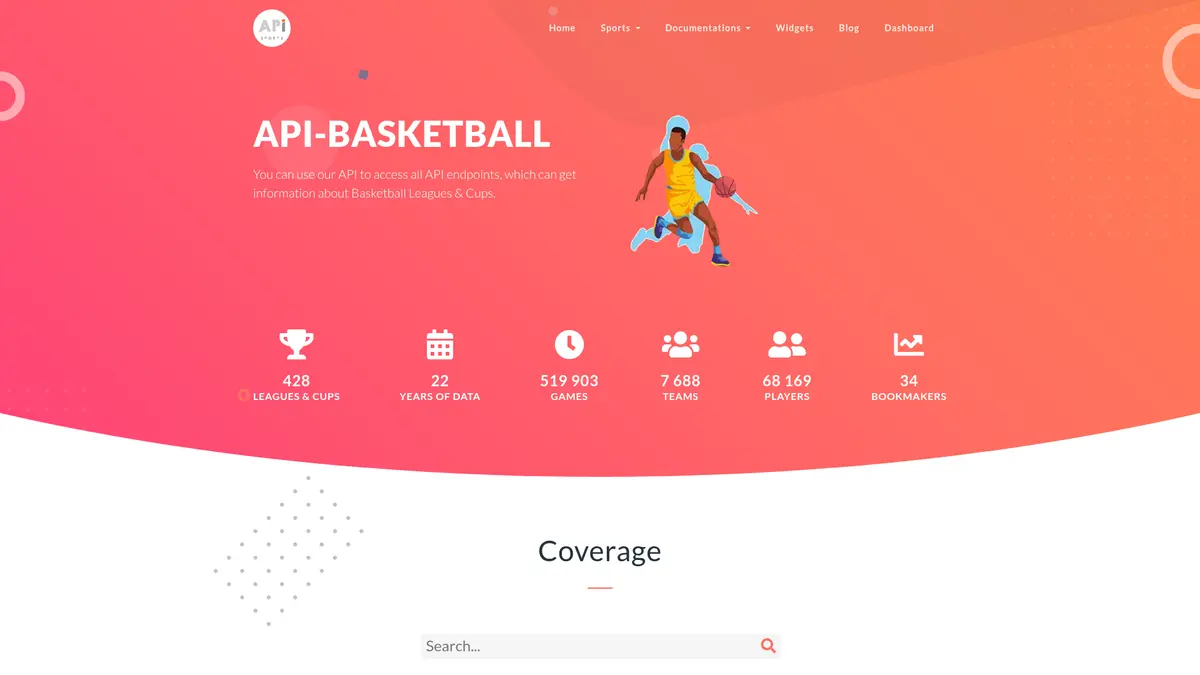
The catalogue page lists separate sport families rather than suggesting a single normalized service. Football, basketball, baseball, Formula 1, handball, hockey, MMA, NBA, NFL and NCAA, rugby, volleyball and AFL are presented as covered products. This breadth is useful if your roadmap spans several disciplines, but a list of sports is only an inventory of product labels. It does not show a common resource structure or establish that all leagues and statistical fields are available with the same depth.
The most reliable way to evaluate the family is to create one requirement sheet per sport. Record the competitions, seasons, live fields, historical needs and display outputs, then follow each sport’s official product page and documentation. A football plan should not silently be treated as an entitlement to basketball data; the provider’s separate service pages and docs indicate product-level boundaries. This distinction matters for budgeting, software architecture and the schedule for validating response examples.
Sources: [1] API-Sports official multi-sport API catalogue, [2] API-Sports football product overview and coverage
Documentation, widgets and dashboard features
API-Sports describes separate documentation for its APIs and advertises code examples, shared dashboard access, request monitoring, key controls and team permissions. These tools can reduce operational friction for a small development team: usage dashboards help identify call peaks, and credential controls are relevant to a production integration. They still do not replace application-side secret handling, caching, error processing or quota planning. Avoid exposing a private key in client-side code merely because the provider offers a browser-based tester.
The official site also advertises copy-and-paste widgets, several themes and configurable update frequency. That may appeal to a publisher that needs a conventional score or standings display more than a custom analytics interface. Before deployment, test the component in the target CMS and check mobile behavior, accessibility, loading states, branding, and whether its refresh schedule is compatible with the selected allowance. The widget claim applies to the provider’s advertised widgets; it should not be assumed that every product, sport or advanced data type has a finished component.
Sources: [1] API-Sports official multi-sport API catalogue, [2] API-Sports football product overview and coverage
Coverage, update language and access
The main page advertises a large number of competitions and historical seasons and describes live events as updating at a stated interval. Those figures are useful as provider claims that orient a buyer, not evidence that every competition has identical fields or that each event is polled at exactly the same cadence. The football product page offers its own coverage exploration and illustrates why a buyer should inspect the relevant sport’s current season list rather than extrapolate from the parent catalogue.
The site advertises a free plan with 100 daily requests for each API and says odds and widgets are included in its plan messaging. Availability, exact limits, season access and commercial terms can change; verify the selected sport’s current pricing and dashboard before relying on the headline. A request allowance is not a refresh strategy by itself. Estimate calls per event, competition, day and environment, then account for retries and shared caching. Ask how the API responds at quota exhaustion and whether different API subscriptions share any allowances.
Sources: [1] API-Sports official multi-sport API catalogue, [2] API-Sports football product overview and coverage
Who should shortlist the catalogue
API-Sports makes the most sense when a team genuinely needs more than one sport or is comparing the adjacent product families before committing to one. A developer can inspect the relevant docs and decide whether the documented model fits a scoreboard, team page or live match centre. Its fit is less direct when a project needs a bespoke licensed feed with negotiated contractual guarantees or one uniform data layer across a broad international portfolio; the public catalogue alone does not answer those procurement details.
Keep brand attribution clear in a comparison: API-Sports is the parent catalogue, and API-Football is the football API. Do not merge their product identities or imply that one football endpoint supplies every sport. Likewise, a good result from one sport API says little about another service within the family. The editorial score rewards product discovery and publicly described tooling while discounting the uncertainty around sport-specific coverage and commercial rights. Ask for representative responses and written terms before scaling.
Sources: [1] API-Sports official multi-sport API catalogue, [2] API-Sports football product overview and coverage
Frequently asked questions
Is API-Sports the same thing as API-Football?
No. API-Sports is the wider family catalogue, while API-Football is the football product. Separate sport pages and documentation describe multiple APIs. A buyer should identify the specific product and subscription needed for each sport rather than use the names interchangeably.
Sources: [1] API-Sports official multi-sport API catalogue, [2] API-Sports football product overview and coverage
Can one API-Sports subscription cover all listed sports?
The public site presents the products as separate APIs and advertises a free allowance per API. Do not assume one sport’s paid entitlement carries over to every other sport. Confirm account, quota and commercial terms with the provider for each product.
Does API-Sports offer free access?
The official catalogue advertises a free plan with 100 requests per day for each API. That is provider-published access information, not an assurance of production suitability. Check current season restrictions, rate limits, rights and the required fields in the specific API.
Are API-Sports widgets included?
The company says its widgets are free and can be themed and configured. Verify which sports and products have a suitable widget, how refreshes work, and whether the embed fits your design, accessibility and quota needs.
Does the parent catalogue prove uniform live coverage across sports?
No. The product catalogue names distinct sports, but coverage and available fields need separate review for each. A headline total or advertised update interval does not establish a common guarantee for all competitions or endpoints.
Sources: [1] API-Sports official multi-sport API catalogue, [2] API-Sports football product overview and coverage
How our editorial ratings work
API-Sports scores 8.6 out of 10. This is our editorial fit score, not a customer score.
Our scores are subjective website-integration fit assessments based on providers’ publicly described products, not customer-review averages or independent speed, uptime or accuracy tests. We consider publishing usefulness, integration options, documented data scope, access information and clarity of product documentation. A higher score is not a guarantee of suitability. BettorServe is the featured first placement; the remaining list is a curated shortlist, not an exhaustive market ranking.
This is a commercially oriented comparison site. We may earn a commission through eligible partner links, at no extra cost to you. BettorServe is our featured first listing. Commercial relationships and featured placements should be considered alongside the product details, and you should confirm current terms directly with a provider before purchasing.
Sources
Content last reviewed